
Idaho is famous for potatoes, which is fitting, because a lot of Idaho's winter birds spend December looking like small, round, slightly lumpy potatoes puffed up against the cold (I say this with love, from under three blankets). The winter birds in Idaho are a mountain-and-desert crowd: juncos that drop down from the high country, magpies that never leave, rosy-finches that show up in flocks of hundreds, and Bald Eagles that line up along the Snake River like they're waiting for a table.
The state bird won't be one of them, though. The Mountain Bluebird has been Idaho's state bird since 1931, but most of them spend the cold months in the southwestern U.S. and, according to Idaho Fish and Game, return to Idaho by late February or early March. If you see a flash of sky blue on a fence post in early March, that's your sign winter's on its way out.
Types of Winter Birds in Idaho
There are 3 types of winter birds in Idaho you'll see on this list:
- Resident Idaho Birds – species that live here all year. Some, like Mountain Chickadees and Steller's Jays, simply move downhill when the snow gets deep
- Winter Migrants / Visitors – birds that breed farther north, often on the Arctic tundra, and spend the winter here. That includes Rough-legged Hawks, Snow Buntings, American Tree Sparrows, and huge numbers of ducks. At Deer Flat National Wildlife Refuge, duck numbers peak in mid-December with up to 150,000 on Lake Lowell
- Irruptive Species – birds like Pine Siskins, Evening Grosbeaks, Bohemian Waxwings, and Redpolls that pour in some winters and barely show up in others, depending on seed and fruit crops up north
Each entry covers ID, male vs female, calls, where to find the bird in Idaho, and its feeder favorites if it visits feeders. If you've ever wondered where the summer crowd disappeared to, here's where birds go in the winter.
1. Dark-eyed Junco
- Family – Passerellidae
- Species – Junco hyemalis
- Primary Activity Time – Daytime
- Diurnal
- Resident Idaho Bird / Winter Migrant
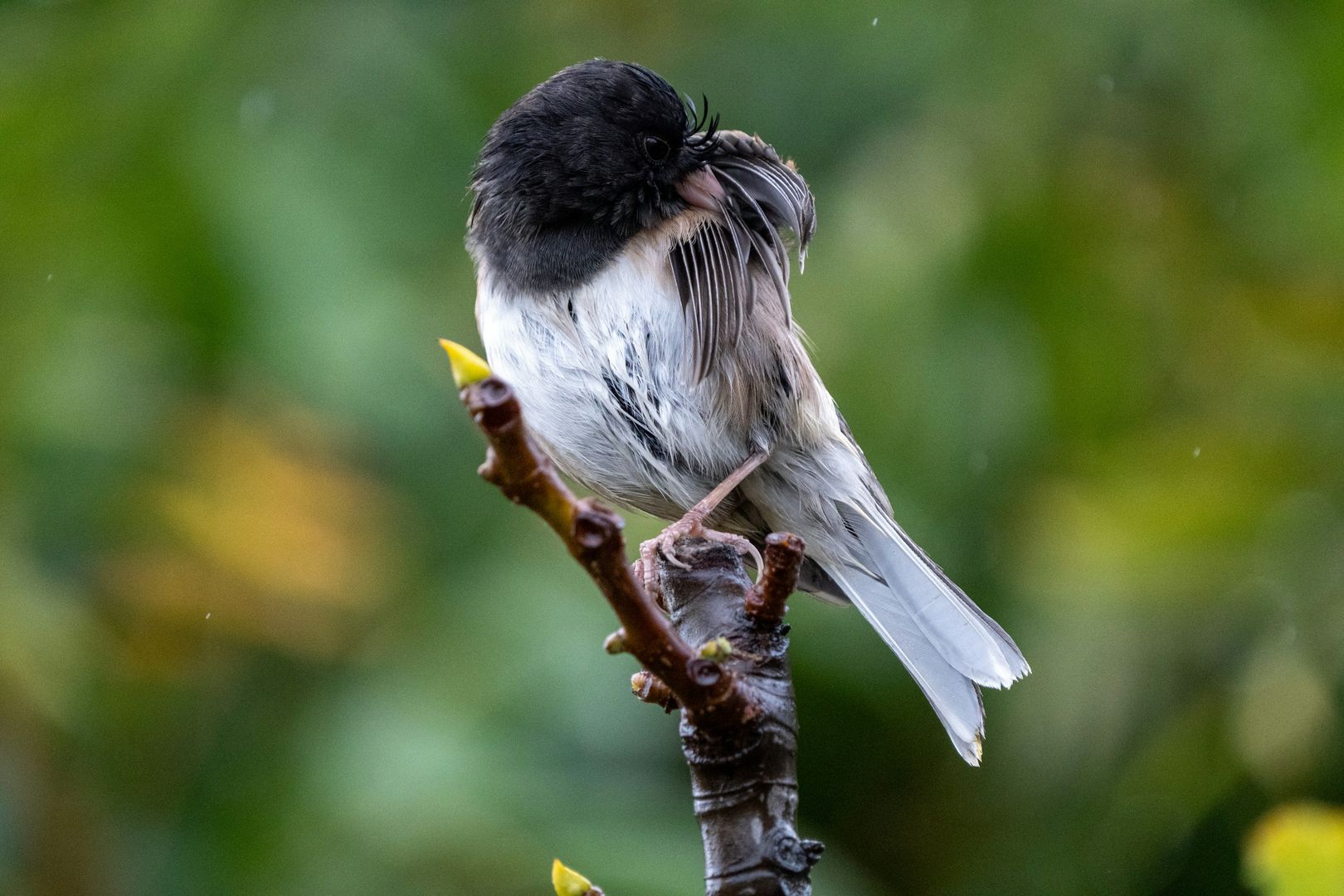
The Dark-eyed Junco is the undisputed champion of Idaho feeders. Idaho Press columnist Terry Rich, who tracks Idaho's FeederWatch results, calls it "always No. 1" on the state's top 25 list. Many of Idaho's juncos breed in the high country and simply move down into the valleys for winter, where they hop around under feeders cleaning up whatever the messier eaters drop.
Most juncos in southwestern Idaho are the "Oregon" form. Males have a crisp black hood, a brown back, and pinkish-buff sides. Females wear a softer gray hood and look a little faded overall. Both have a pale pink bill and flash white outer tail feathers when they flush.
The Dark-eyed Junco call is a sharp tick or smack, and the song is a quick, dry trill.
In Idaho winters, juncos are statewide in yards, foothill brush, and woodland edges, usually in small, chattering flocks on the ground.
Feeder favorites: millet, cracked corn, sunflower chips scattered on the ground
2. House Finch
- Family – Fringillidae
- Species – Haemorhous mexicanus
- Primary Activity Time – Daytime
- Diurnal
- Resident Idaho Bird
The House Finch is the junco's runner-up at Idaho feeders, and in Ada and Canyon Counties it's the most commonly reported species in any given month. It's a seed and fruit eater that travels in noisy little gangs and will happily empty a tube feeder by lunch.
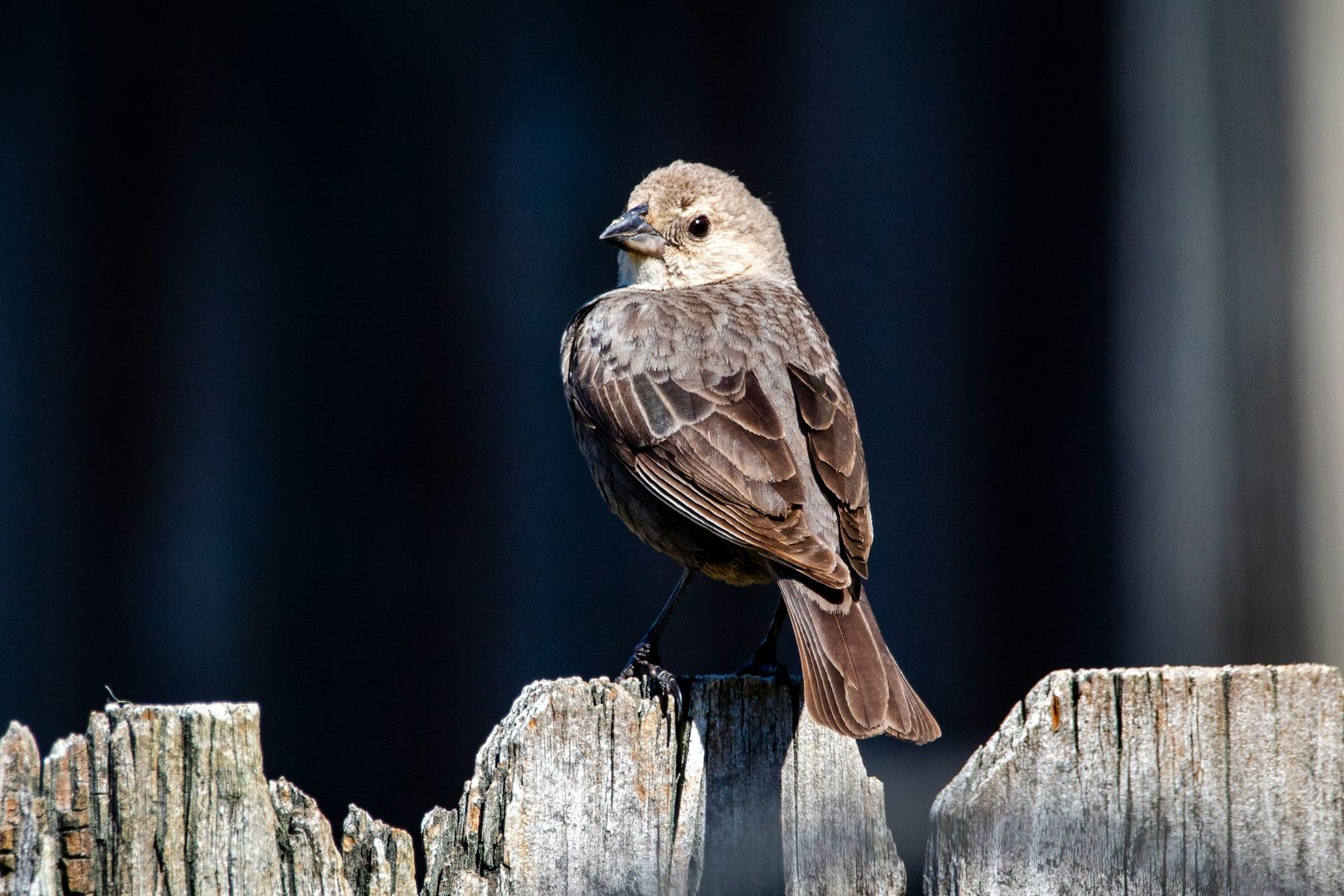
Males have a rosy-red head, breast, and rump, though the shade varies from strawberry to orange depending on what they've been eating. Females are plain gray-brown with blurry streaks and no red at all, so they're easy to write off as "some sparrow."
The House Finch song is a long, rambling warble that usually ends on a buzzy, rising note. Their call is a cheerful cheep.
In Idaho winters, House Finches are most common in towns, farmyards, and suburbs, especially across the Treasure Valley and the Snake River Plain.
Feeder favorites: black oil sunflower, nyjer, sunflower chips
3. Black-capped Chickadee
- Family – Paridae
- Species – Poecile atricapillus
- Primary Activity Time – Daytime
- Diurnal
- Resident Idaho Bird
The Black-capped Chickadee was the single most widespread bird in Project FeederWatch's Northern Rockies rankings, visiting nearly 78% of the region's count sites. It's a tiny, fearless omnivore that hides seeds in bark all fall and remembers where most of them are (which is more than I can say for my car keys).
It has a black cap and bib, bright white cheeks, a gray back, and buffy sides. Males and females look the same.
The Black-capped Chickadee call is the namesake chick-a-dee-dee-dee, with more dees when it's agitated. The song is a sweet, two-note fee-bee whistle.
In Idaho winters, it's common in river corridors, cottonwood bottoms, towns, and lower-elevation woods statewide, often leading mixed flocks of nuthatches and woodpeckers.
Feeder favorites: black oil sunflower, suet, shelled peanuts
4. Mountain Chickadee
- Family – Paridae
- Species – Poecile gambeli
- Primary Activity Time – Daytime
- Diurnal
- Resident Idaho Bird
The Mountain Chickadee is the chickadee that got a little extra eyeliner. It lives in Idaho's conifer forests and moves downhill in winter, so foothill neighborhoods near the mountains often get a few at their feeders once the snow comes.
It looks like a Black-capped Chickadee with a bold white stripe over each eye that breaks up the black cap. Its sides are grayer, too. Males and females look alike.
The Mountain Chickadee call is a hoarser, buzzier chick-a-dee-dee, and its song is a clear, descending whistle of three or four notes.
In Idaho winters, look for it in pine and fir forests, mountain towns, and foothill yards, from the Boise Front to the Panhandle.
Feeder favorites: black oil sunflower, suet, shelled peanuts
5. American Goldfinch
- Family – Fringillidae
- Species – Spinus tristis
- Primary Activity Time – Daytime
- Diurnal
- Resident Idaho Bird
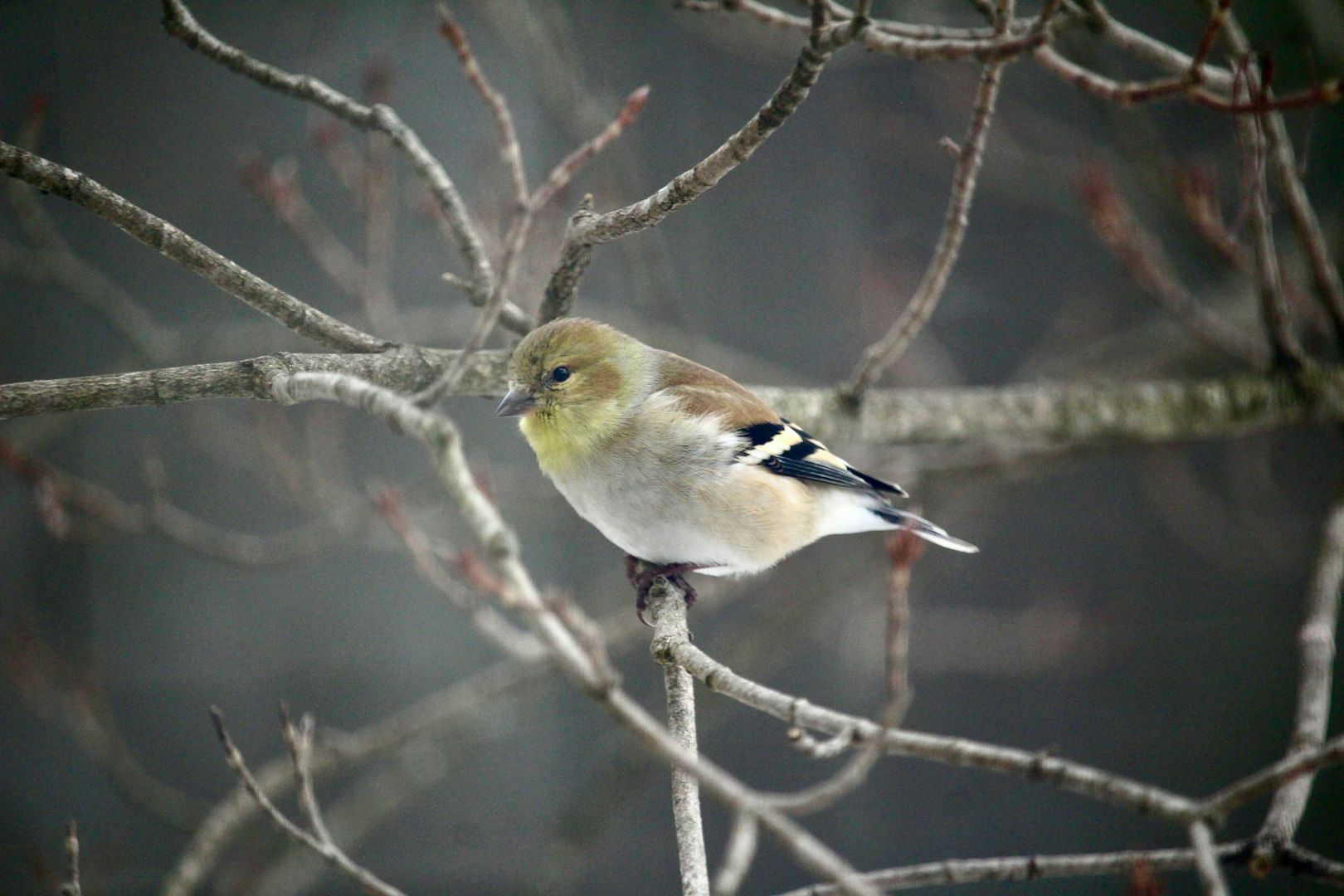
The American Goldfinch stays in Idaho all winter, but it trades its lemon-yellow summer outfit for something closer to dish-water olive. It's a strict seed eater that bounces from weed patches to feeders in tight little flocks.
In winter, males show a yellowish wash on the face and throat and jet-black wings with white bars. Females are grayer and duller, with brownish wings and fainter bars.
The American Goldfinch call is a bouncy po-ta-to-chip given in flight, which feels like the right soundtrack for the Gem State.
In Idaho winters, goldfinches are widespread in weedy fields, river bottoms, and backyards with tube feeders.
Feeder favorites: nyjer, sunflower chips, black oil sunflower
6. Lesser Goldfinch
- Family – Fringillidae
- Species – Spinus psaltria
- Primary Activity Time – Daytime
- Diurnal
- Resident Idaho Bird (southwest Idaho and Lewiston area)
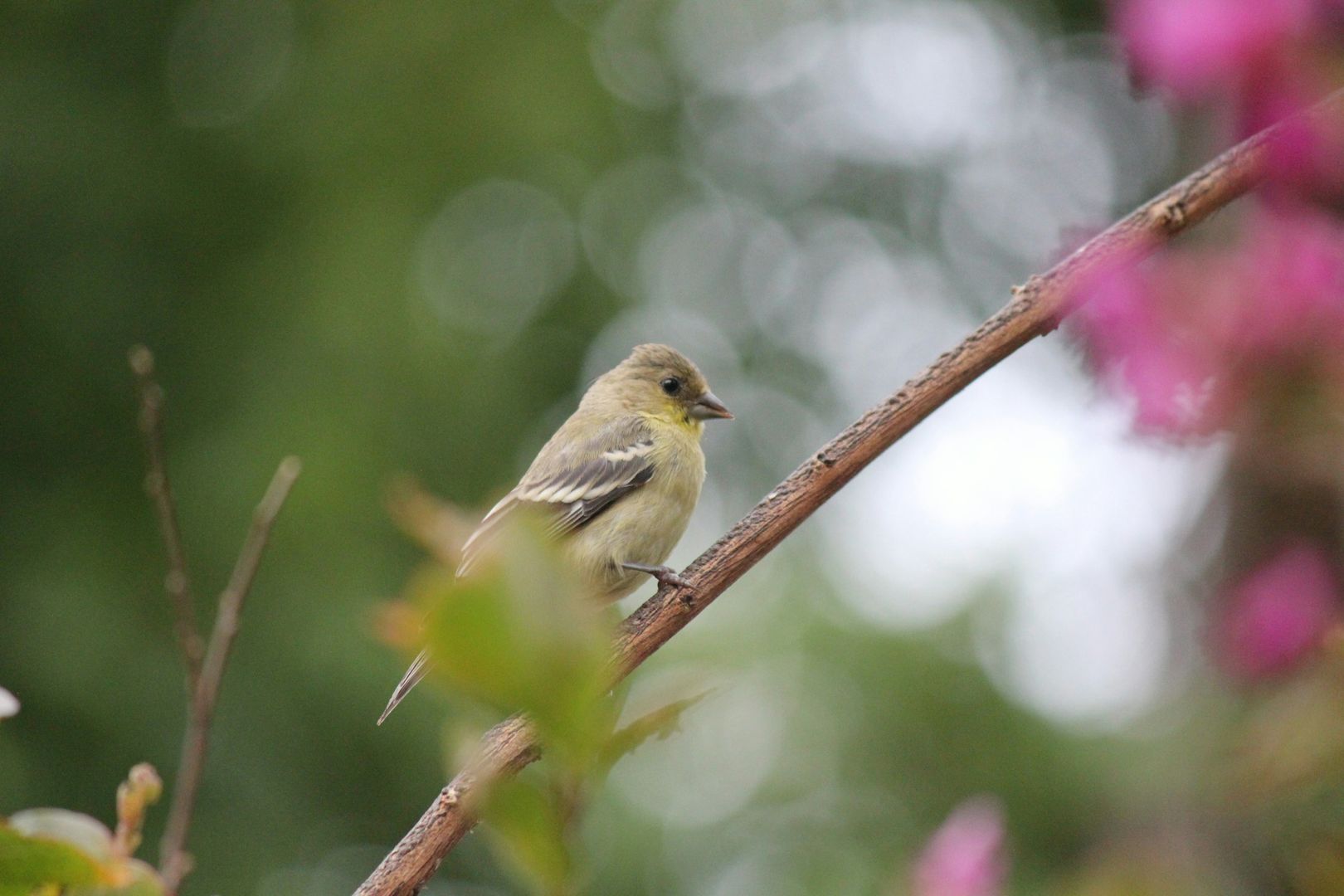
The Lesser Goldfinch is the smaller, scrappier goldfinch that has become a regular at Idaho feeders, and it's easy to confuse with an American Goldfinch in winter plumage. The difference is that the Lesser stays yellow underneath all year.
Males have a black cap, a green back, and bright yellow underparts. Females are olive above and yellowish below with no black cap. Both show white patches in the wings.
The Lesser Goldfinch call is a plaintive, rising tee-yee, and its song is a jumble of chatter that often includes bits it borrowed from other birds.
In Idaho winters, it's most common in the Treasure Valley and around Lewiston and the lower Clearwater and Snake River canyons, where Christmas Bird Counts tally most of the state's total.
Feeder favorites: nyjer, sunflower chips
7. Black-billed Magpie
- Family – Corvidae
- Species – Pica hudsonia
- Primary Activity Time – Daytime
- Diurnal
- Resident Idaho Bird
The Black-billed Magpie is the bird visitors from back East point at and ask, "What on earth is that?" It's a loud, flashy corvid with a tail longer than its body, and it'll eat nearly anything: insects, seeds, carrion, roadkill, and whatever the dog left in its bowl.
It's black and white with an iridescent blue-green sheen on the wings and tail. Males and females look alike, though males are slightly larger.
The Black-billed Magpie call is a harsh, rapid shek-shek-shek chatter that sounds a bit like someone shaking a box of rocks.
In Idaho winters, magpies are common across the open country and towns of southern Idaho, from the Treasure Valley to the Upper Snake. They ranked in the top 10 of the Northern Rockies FeederWatch list.
Feeder favorites: suet, peanuts, cracked corn
8. Northern Flicker
- Family – Picidae
- Species – Colaptes auratus
- Primary Activity Time – Daytime
- Diurnal
- Resident Idaho Bird
The Northern Flicker is a woodpecker that spends a lot of time on the ground, poking for ants and seeds. In winter it switches to berries and suet, and it's a regular at Idaho feeders.
Idaho's flickers are mostly the "Red-shafted" type, with salmon-red under the wings and tail. They're brown with black bars on the back, a spotted belly, and a black crescent on the chest. Males have a red mustache stripe at the base of the bill, and females don't.
The Northern Flicker call is a loud, single kyeer, plus a long, rolling wick-wick-wick series. They'll also drum on gutters and chimneys, which is how many people learn about flickers at 6 a.m.
In Idaho winters, flickers are widespread in towns, farmland, river corridors, and open woods.
Feeder favorites: suet, peanuts, black oil sunflower
9. Downy Woodpecker
- Family – Picidae
- Species – Dryobates pubescens
- Primary Activity Time – Daytime
- Diurnal
- Resident Idaho Bird
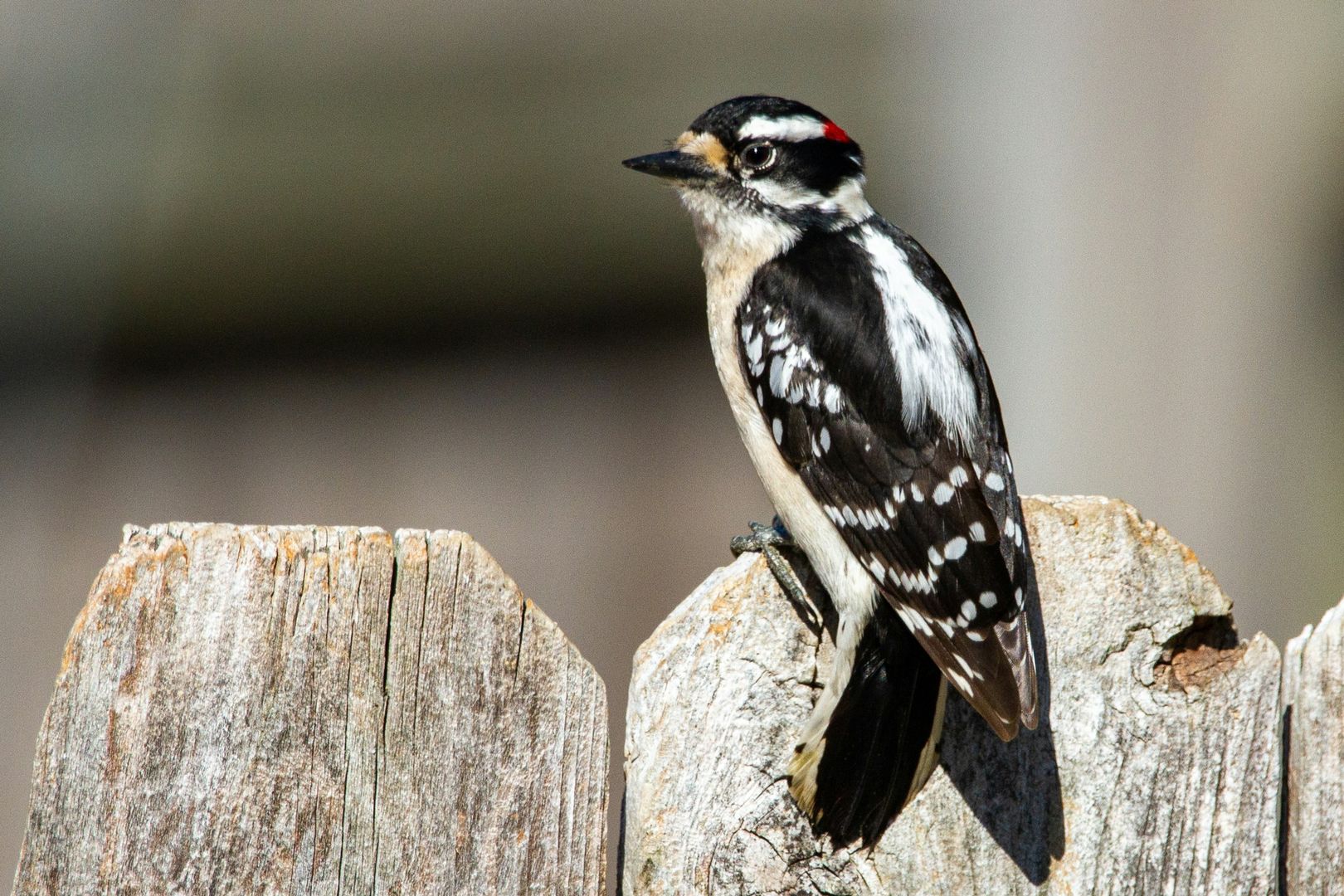
The Downy Woodpecker is the smallest woodpecker in Idaho and the second most widespread bird in the Northern Rockies FeederWatch rankings. It works over small branches and even weed stalks for insect larvae, then visits the suet cake for dessert.
It's black and white with a white stripe down the back and a short, stubby bill. Males have a small red patch on the back of the head, while females are all black and white.
The Downy Woodpecker call is a soft pik and a descending, whinnying rattle.
In Idaho winters, it's found in cottonwoods, willows, parks, and backyards statewide, often tagging along with chickadee flocks.
Feeder favorites: suet, black oil sunflower, peanuts
10. Hairy Woodpecker
- Family – Picidae
- Species – Dryobates villosus
- Primary Activity Time – Daytime
- Diurnal
- Resident Idaho Bird
The Hairy Woodpecker is the Downy's bigger lookalike, and telling them apart is one of birding's great rites of passage. It digs deeper into bark for beetle larvae and readily visits suet feeders in winter.
The fastest way to separate them is the bill: the Hairy's is almost as long as its head, while the Downy's is short and stubby. Males have a red patch at the back of the head, and females don't.
The Hairy Woodpecker call is a loud, sharp peek, plus a rattle that doesn't drop in pitch the way the Downy's does.
In Idaho winters, look for it in mature forests, burned areas, river bottoms, and wooded neighborhoods across the state.
Feeder favorites: suet, black oil sunflower, peanuts
11. Red-breasted Nuthatch
- Family – Sittidae
- Species – Sitta canadensis
- Primary Activity Time – Daytime
- Diurnal
- Resident Idaho Bird / Irruptive
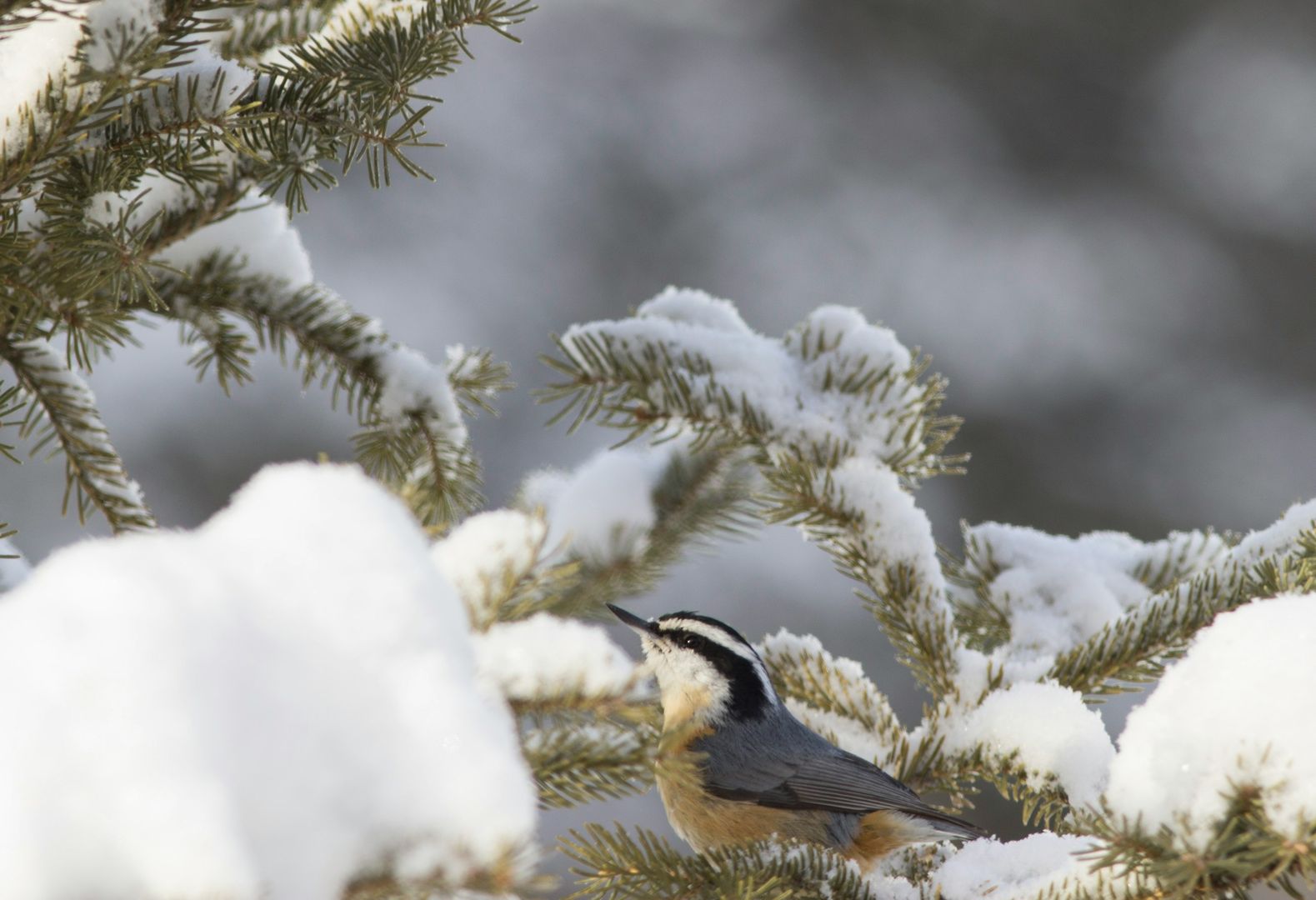
The Red-breasted Nuthatch is a tiny conifer specialist that climbs down trees head-first and eats spruce, fir, and pine seeds. When cone crops fail, numbers can move into valleys and towns in bigger numbers than usual.
It has a black cap, a bold white eyebrow, a black eye stripe, and a rusty-cinnamon belly. Males have a jet-black cap and richer rust below, while females have a grayer cap and paler underparts.
The Red-breasted Nuthatch call is a nasal yank-yank, often compared to a tiny tin horn.
In Idaho winters, it's common in mountain forests statewide and turns up at feeders in towns with pines and spruces.
Feeder favorites: suet, shelled peanuts, black oil sunflower
12. White-breasted Nuthatch
- Family – Sittidae
- Species – Sitta carolinensis
- Primary Activity Time – Daytime
- Diurnal
- Resident Idaho Bird
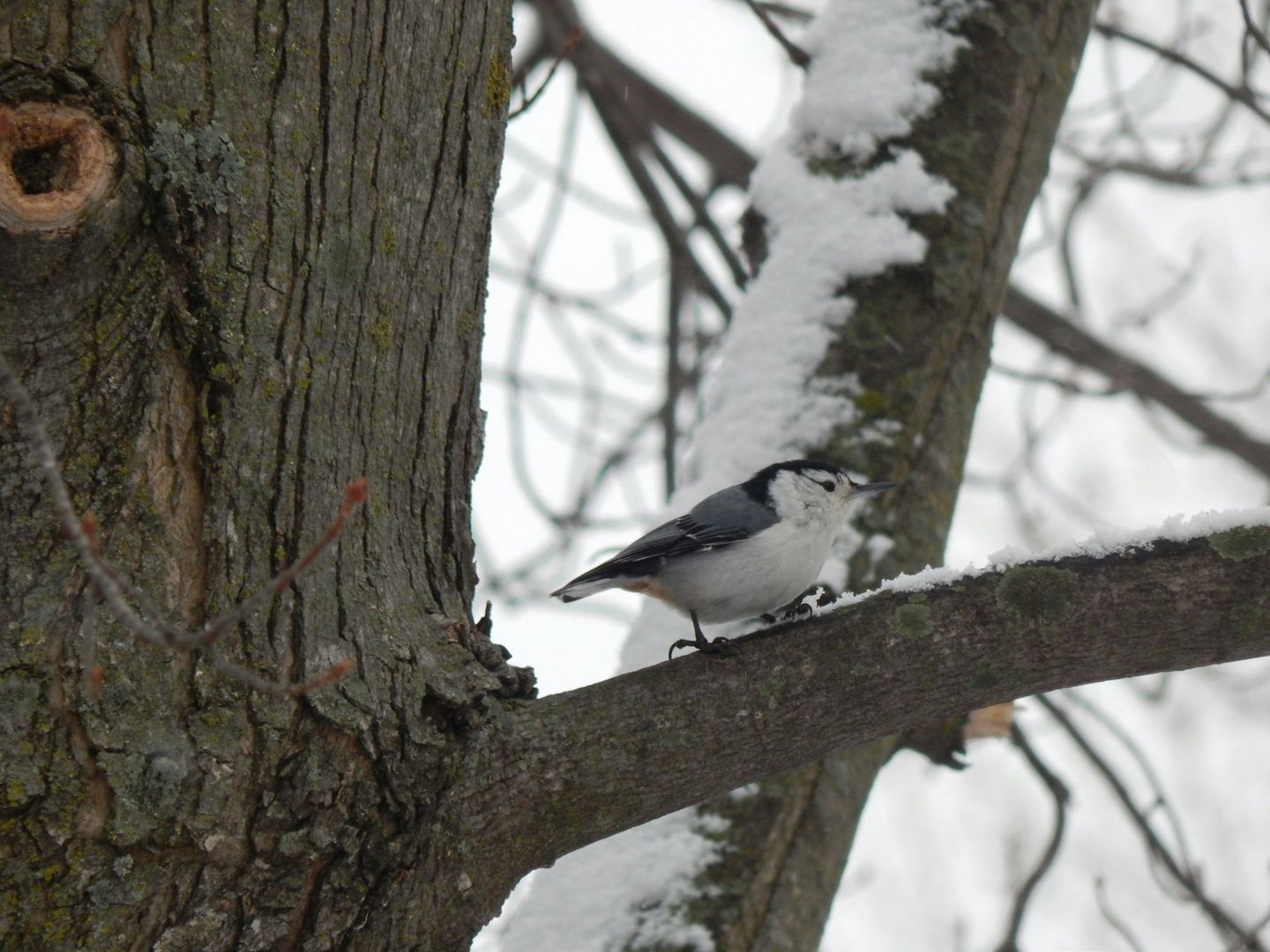
The White-breasted Nuthatch is the larger nuthatch, and it spends winter wedging seeds into bark and hacking them open, which is where the name comes from. It's slightly less common at Idaho feeders than the Red-breasted, but it's a reliable regular wherever there are big trees.
It's blue-gray above with a clean white face and breast and a rusty wash under the tail. Males have a glossy black cap, while females usually show a duller, grayer cap.
The White-breasted Nuthatch call is a nasal yank or quank, lower and less tinny than the Red-breasted's.
In Idaho winters, look for it in ponderosa pine forests, cottonwood bottoms, and older neighborhoods with mature shade trees.
Feeder favorites: black oil sunflower, peanuts, suet
13. Eurasian Collared-Dove
- Family – Columbidae
- Species – Streptopelia decaocto
- Primary Activity Time – Daytime
- Diurnal
- Resident Idaho Bird (Non-Native Species)
The Eurasian Collared-Dove wasn't here a few decades ago, and now it's on nearly every Idaho Christmas Bird Count. It's a non-native dove that spread across North America after being introduced to the Bahamas in the 1970s, and it loves farm towns with grain elevators and backyard feeders.
It's pale sandy gray with a thin black half-collar on the back of the neck and a square-tipped tail. Males and females look alike.
The Eurasian Collared-Dove call is a three-part coo-COO-cook, repeated with all the urgency of a sleepy owl that's running late.
In Idaho winters, it's widespread in towns, farmsteads, and suburbs, especially across the Snake River Plain.
Feeder favorites: millet, cracked corn, black oil sunflower on a platform or the ground
14. Mourning Dove
- Family – Columbidae
- Species – Zenaida macroura
- Primary Activity Time – Daytime
- Diurnal
- Resident / Partial Migrant
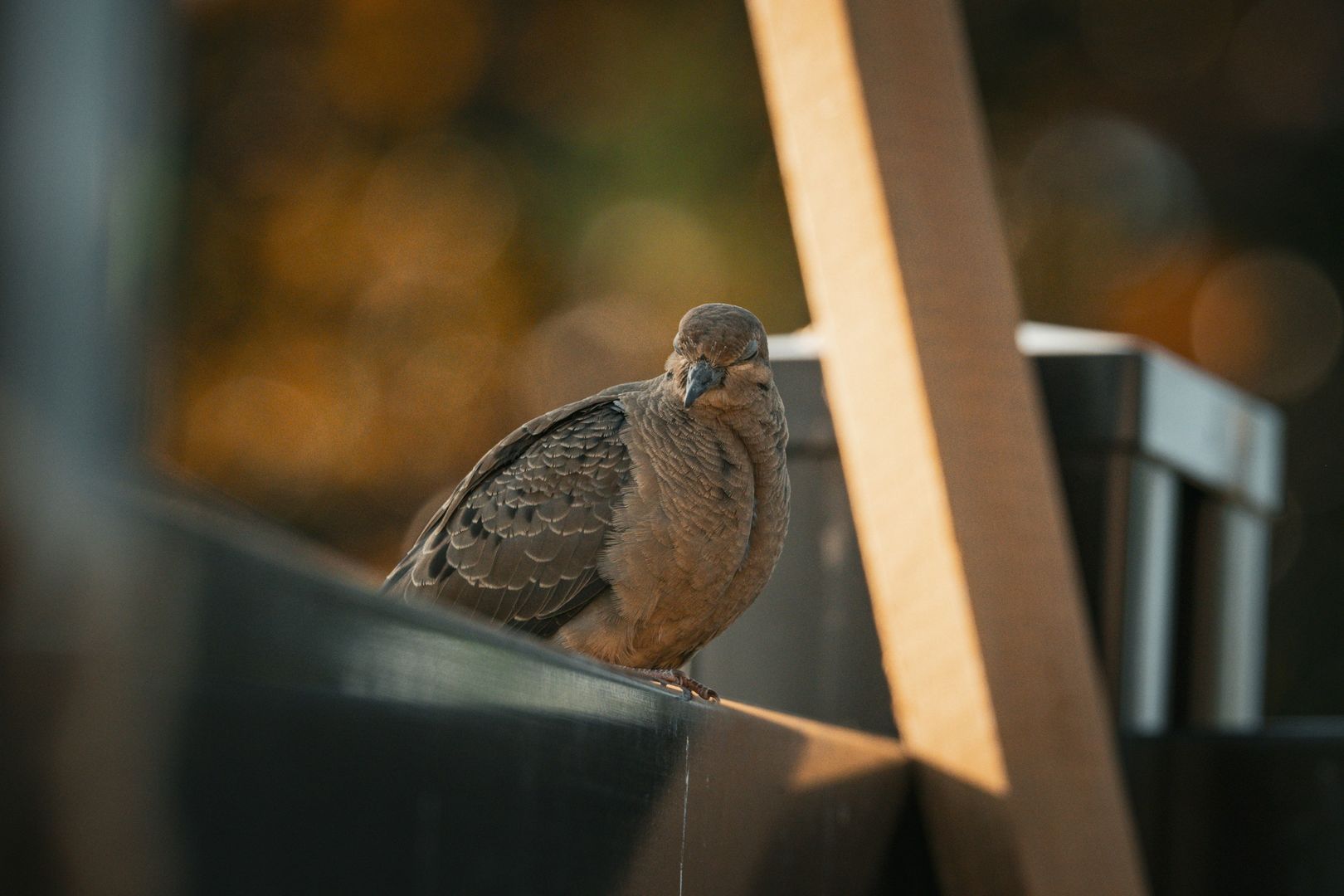
The Mourning Dove is the slimmer native dove you'll see sharing the ground with collared-doves. Many leave Idaho in fall, but plenty stay in the farm valleys, where waste grain keeps them fed.
It's soft gray-brown with black spots on the wings and a long, pointed tail. Males have a faint pinkish breast and bluish crown, while females are browner.
The Mourning Dove call is a soft, sad coo-OO-oo-oo-oo, and its wings whistle on takeoff.
In Idaho winters, look for flocks in southern farm country and suburban yards with ground feeders.
Feeder favorites: millet, cracked corn, black oil sunflower on the ground
15. California Quail
- Family – Odontophoridae
- Species – Callipepla californica
- Primary Activity Time – Daytime
- Diurnal
- Resident Idaho Bird
The California Quail is the bird that makes backyard birders in southwestern Idaho feel like they're hosting a parade. Coveys of a dozen or more march out from under the hedge, eat everything on the ground, and march back again.
Males have a black face outlined in white, a chestnut cap, a scaly belly, and a forward-curling black plume on the forehead. Females are plainer gray-brown with a smaller plume and no black face.
The California Quail call is a loud, three-note chi-CA-go, which is ironic for a bird that lives in Idaho.
In Idaho winters, coveys are common in brushy yards, farm hedgerows, and river thickets in the Treasure Valley, the Magic Valley, and the Lewiston-Clearwater area.
Feeder favorites: millet, cracked corn scattered on the ground near cover
16. American Robin
- Family – Turdidae
- Species – Turdus migratorius
- Primary Activity Time – Daytime
- Diurnal
- Resident / Partial Migrant
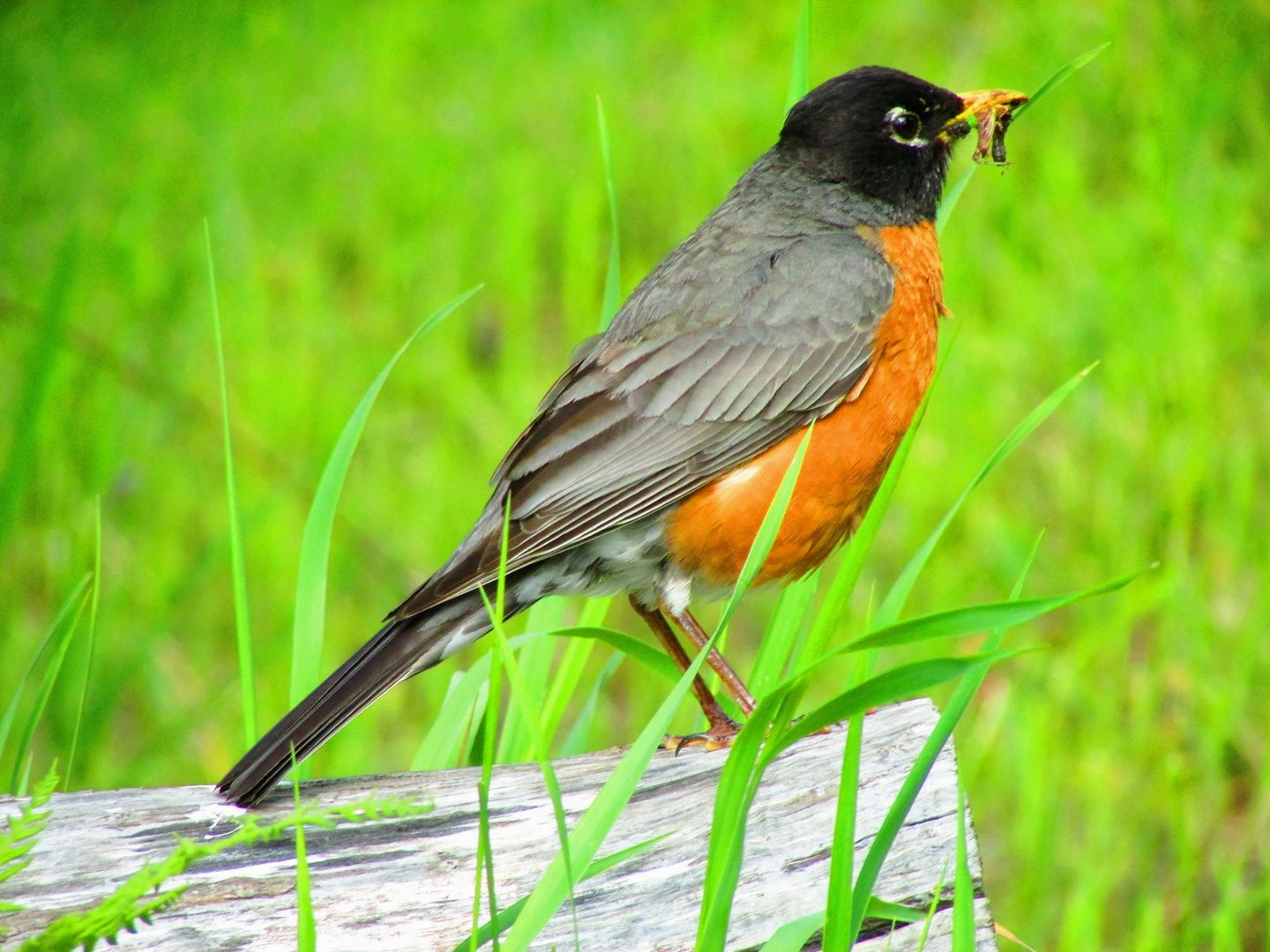
The American Robin doesn't leave Idaho for winter, it just stops pulling worms out of your lawn. On the 2012-13 Christmas Bird Counts it was among the five most abundant birds in the state, gathered in roving flocks that strip berries from junipers, Russian olives, and ornamental trees.
It has a dark gray back and a warm orange breast. Males have a darker, almost black head and richer orange, while females are paler and grayer overall.
In winter, the American Robin call is mostly a low tut-tut and a thin, high tseep in flight. The full song waits for spring.
In Idaho winters, robins are common along river corridors and in towns with fruiting trees and shrubs.
Feeder favorites: chopped apples, softened raisins, and a heated bird bath
17. Song Sparrow
- Family – Passerellidae
- Species – Melospiza melodia
- Primary Activity Time – Daytime
- Diurnal
- Resident Idaho Bird
The Song Sparrow turned up on all 30 of Idaho's Christmas Bird Counts in 2012-13, which makes it one of the most dependable winter birds in the state. It lurks in streamside brush and cattails, popping up to scold you before ducking back in.
It's streaky brown with a rusty-gray face and heavy breast streaks that often merge into a dark central spot. Males and females look alike.
The Song Sparrow call is a nasal chimp, and on mild winter days it sings a bright, jumbled song that starts with a few sharp notes.
In Idaho winters, look for it along creeks, irrigation canals, marsh edges, and brushy backyards.
Feeder favorites: millet, sunflower chips scattered under shrubs
18. White-crowned Sparrow
- Family – Passerellidae
- Species – Zonotrichia leucophrys
- Primary Activity Time – Daytime
- Diurnal
- Winter Migrant / Visitor (southern Idaho)
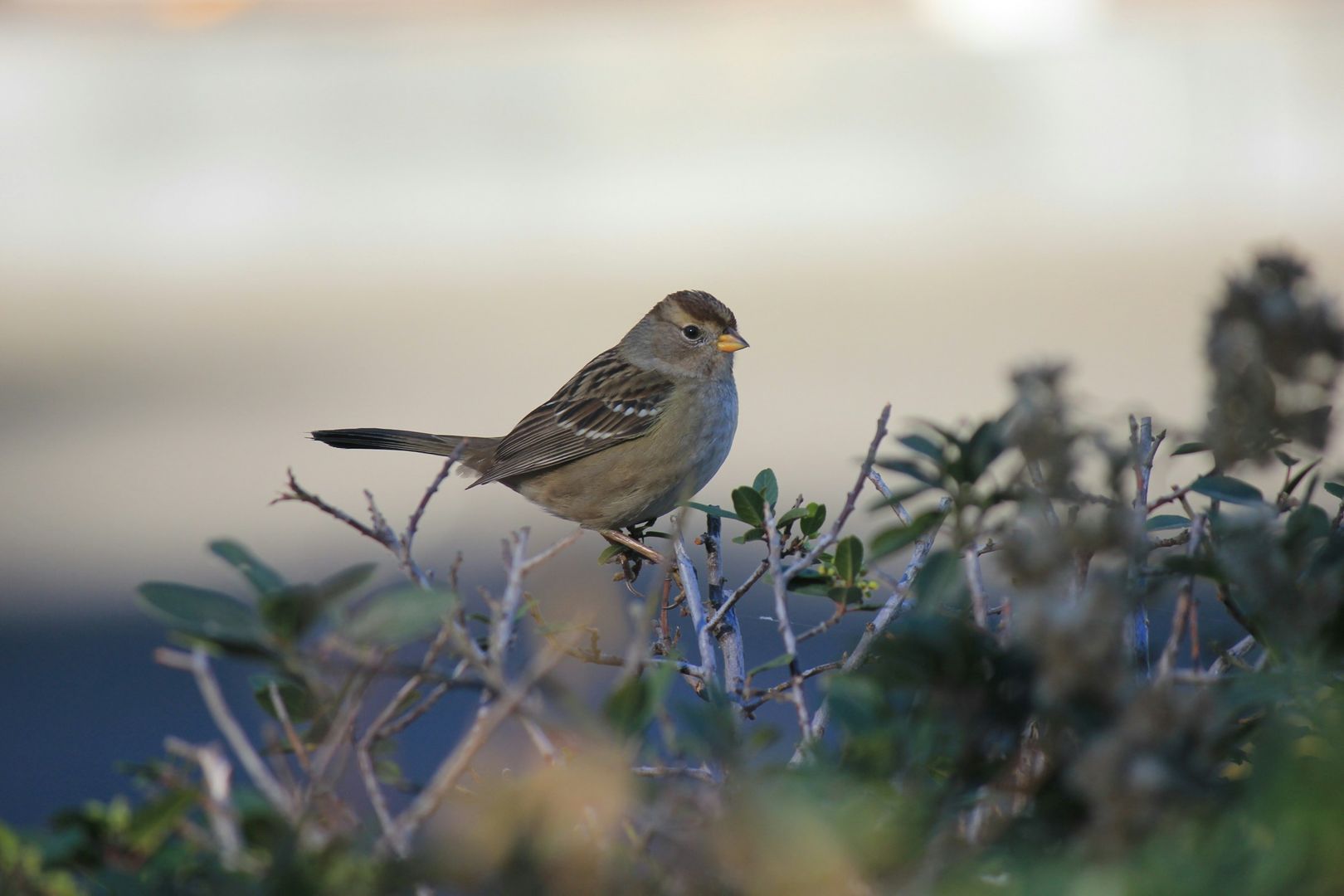
The White-crowned Sparrow is a sharp-dressed sparrow that winters in the lowlands of southern Idaho, often in flocks that work hedgerows and feeder areas together. The ones here in winter are mostly the "Gambel's" form, with an orange-pink bill.
Adults have bold black-and-white crown stripes, a gray face and breast, and a brown back. Males and females look alike. First-winter birds swap the black and white for brown and tan stripes.
The White-crowned Sparrow call is a sharp pink, and its whistled song often starts in late winter.
In Idaho winters, look for it in brushy fields, farm edges, and suburban yards in the Treasure Valley and across the Snake River Plain.
Feeder favorites: millet, sunflower chips, cracked corn on the ground
19. American Tree Sparrow
- Family – Passerellidae
- Species – Spizelloides arborea
- Primary Activity Time – Daytime
- Diurnal
- Winter Migrant / Visitor
The American Tree Sparrow breeds north of Idaho and flies south to spend the winter here, which tells you how cold its summer home must be. Despite the name, it forages mostly on the ground, eating weed and grass seeds.
Look for a rusty cap, a rusty eye line, a gray face, a two-toned bill (dark above, yellow below), and a dark spot in the middle of a plain gray breast. Males and females look alike.
The American Tree Sparrow call is a high tseet, and flocks give a soft, musical twitter.
In Idaho winters, look for small flocks in weedy fields, willow thickets, and farm hedgerows, especially in eastern and northern Idaho.
Feeder favorites: millet, cracked corn scattered on the ground
20. Steller's Jay
- Family – Corvidae
- Species – Cyanocitta stelleri
- Primary Activity Time – Daytime
- Diurnal
- Resident Idaho Bird
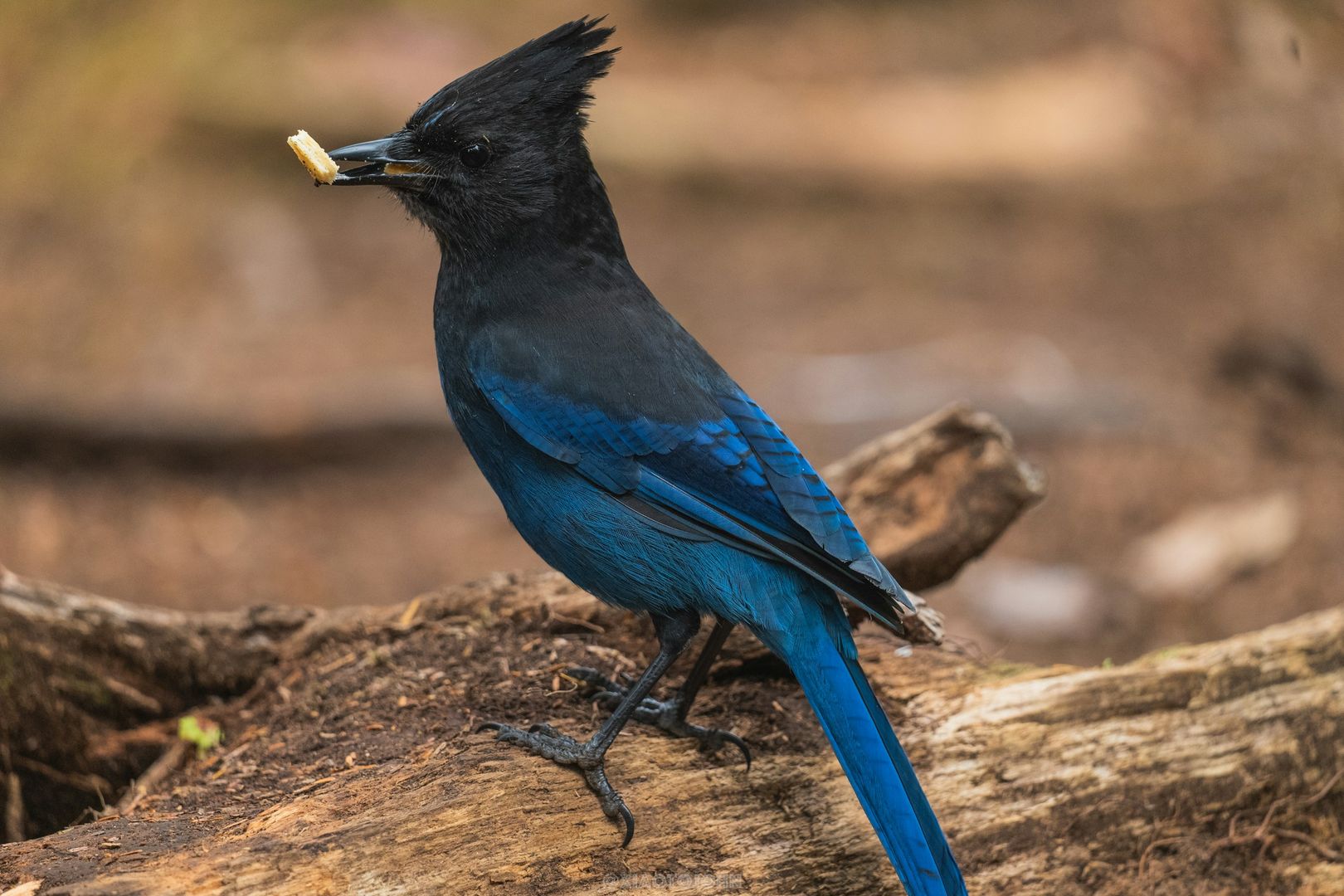
The Steller's Jay is Idaho's mountain jay, a bold, crested blue-and-charcoal bird that treats every campsite and feeder as its personal snack bar. It eats seeds, nuts, and insects, and caches pine seeds for winter.
It has a sooty black head and tall crest, a deep blue body, and faint blue streaks on the forehead. Males and females look alike.
The Steller's Jay call is a harsh shook-shook-shook, and it does a convincing Red-tailed Hawk scream when it wants the feeder to itself.
In Idaho winters, look for it in conifer forests of northern and central Idaho and in mountain towns, with some moving into lower foothills after big snows.
Feeder favorites: peanuts, black oil sunflower, suet
21. Common Raven
- Family – Corvidae
- Species – Corvus corax
- Primary Activity Time – Daytime
- Diurnal
- Resident Idaho Bird
The Common Raven was reported on every single one of Idaho's 2012-13 Christmas Bird Counts. It's a giant, clever corvid that eats carrion, scraps, eggs, and small animals, and it's equally at home over sagebrush, ski resorts, and big-box parking lots.
It's all black, larger than a crow, with a thick bill, shaggy throat feathers, and a wedge-shaped tail in flight. Males and females look alike.
The Common Raven call is a deep, croaking gronk, plus a whole repertoire of knocks, gurgles, and bell-like notes.
In Idaho winters, ravens are statewide, from desert highways to mountain passes.
22. Pine Siskin
- Family – Fringillidae
- Species – Spinus pinus
- Primary Activity Time – Daytime
- Diurnal
- Irruptive
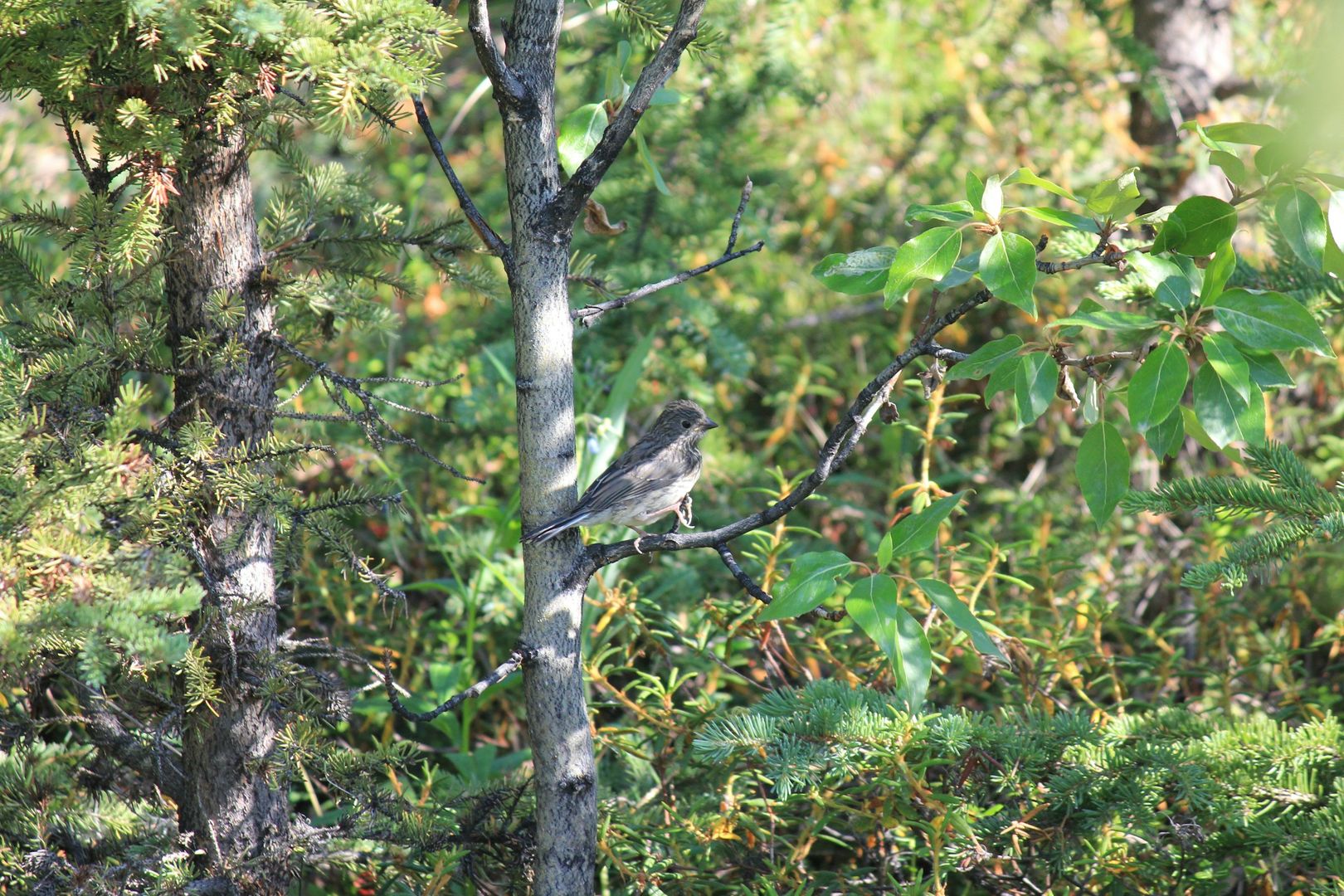
The Pine Siskin is a streaky little finch that roams in search of conifer seeds, and some winters it descends on Idaho feeders in swarms. It was the eighth most widespread bird in the Northern Rockies FeederWatch rankings.
It's brown and heavily streaked with a thin, pointed bill and flashes of yellow in the wings and tail. Males tend to show more yellow than females, though there's a lot of overlap.
The Pine Siskin call is a rising, buzzy zreeeee, like a tiny zipper being yanked up.
In Idaho winters, numbers depend on cone crops. Look in conifer forests, mountain towns, and well-stocked backyard feeders statewide.
Feeder favorites: nyjer, sunflower chips
23. Evening Grosbeak
- Family – Fringillidae
- Species – Coccothraustes vespertinus
- Primary Activity Time – Daytime
- Diurnal
- Resident / Irruptive
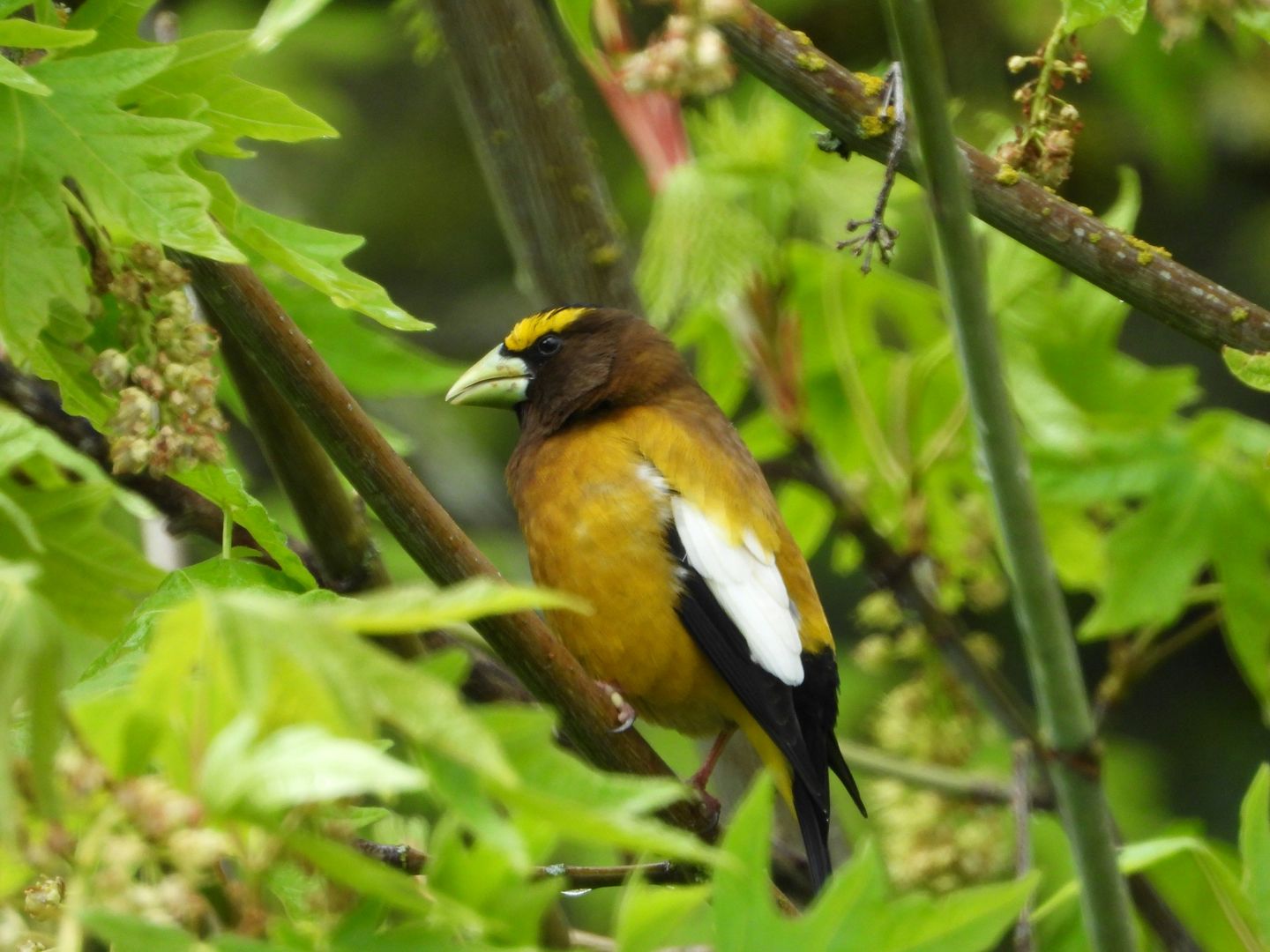
The Evening Grosbeak is a chunky finch with a bill like a pair of pliers, built for cracking big seeds. It's nomadic in winter and can show up at an Idaho feeder in a noisy flock one week and be gone the next.
Males are mustard-yellow and brown with a bright yellow eyebrow, black wings, and big white wing patches. Females are silvery gray with a yellowish wash on the neck and black-and-white wings.
The Evening Grosbeak call is a loud, ringing cleer or peer, often given by the whole flock at once.
In Idaho winters, look in mountain forests and towns of central and northern Idaho, with occasional irruptions into southern valleys.
Feeder favorites: black oil sunflower on a platform feeder
24. Bohemian Waxwing
- Family – Bombycillidae
- Species – Bombycilla garrulus
- Primary Activity Time – Daytime
- Diurnal
- Winter Migrant / Irruptive
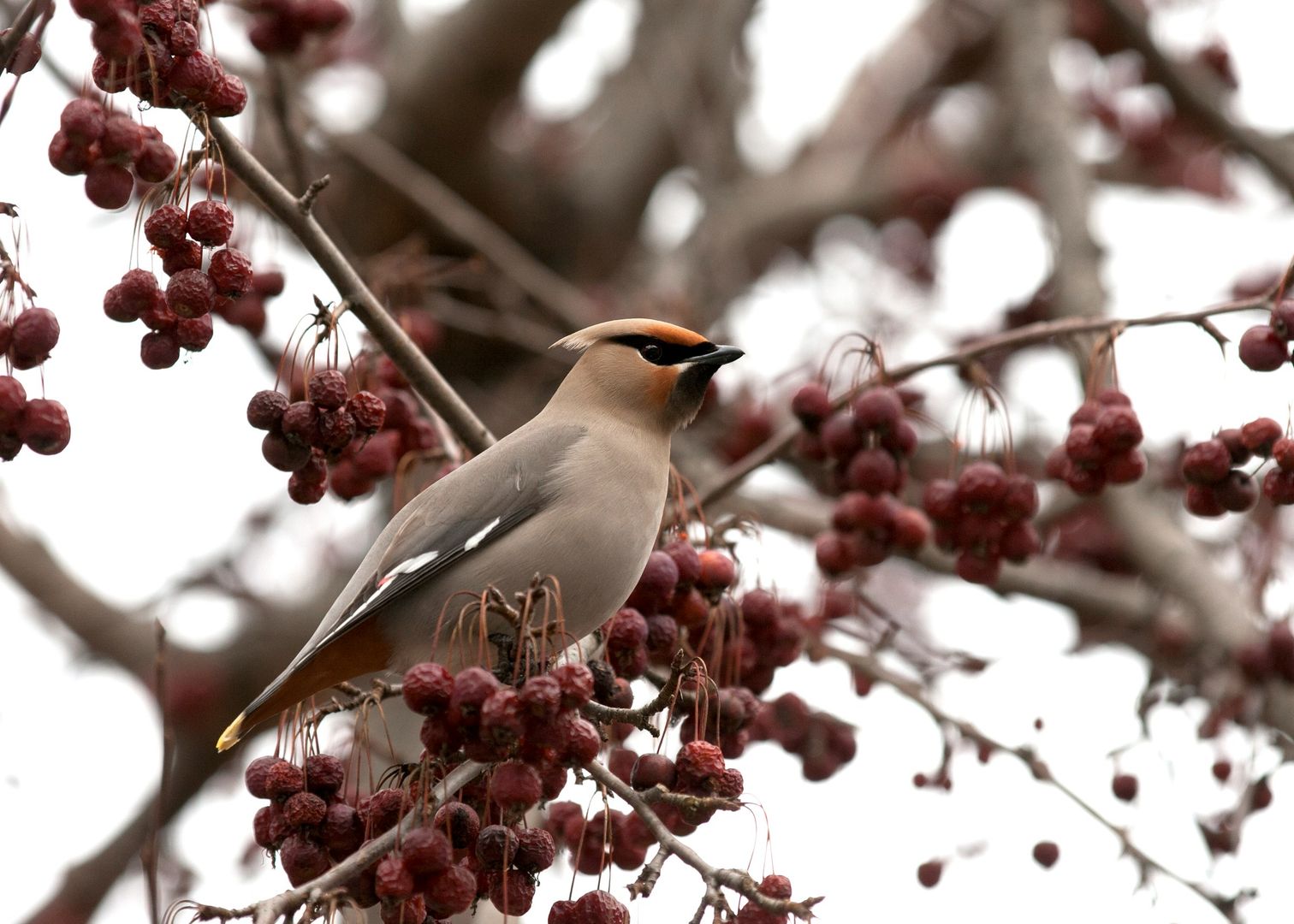
The Bohemian Waxwing arrives from the far north in big, wheeling flocks and strips fruiting trees bare like a crowd that just heard the buffet is closing. It's the larger, grayer cousin of the Cedar Waxwing and ranked in the Northern Rockies FeederWatch top 25.
It's soft gray with a sleek crest, a black mask, rusty feathers under the tail, and yellow, white, and waxy red marks on the wings. Males and females look nearly alike.
The Bohemian Waxwing call is a high, buzzy trill, lower and rougher than a Cedar Waxwing's.
In Idaho winters, numbers vary year to year. Look in towns with mountain ash, crabapple, and juniper, especially in northern and eastern Idaho.
Feeder favorites: not a seed eater, but a heated bird bath and fruiting shrubs will draw them in
25. Gray-crowned Rosy-Finch
- Family – Fringillidae
- Species – Leucosticte tephrocotis
- Primary Activity Time – Daytime
- Diurnal
- Winter Migrant / Visitor
The Gray-crowned Rosy-Finch breeds on mountain peaks above treeline and comes down to open country in winter, often in flocks of hundreds. One flock of over 600 turned up at Bogus Basin one November, and East Idaho birders have watched hundreds fly up from the roadsides on the Rexburg Bench.
It's chocolate brown with a pink wash on the belly and wings, a gray band on the back of the head, and a black forehead. Females are duller and browner, with less pink.
The Gray-crowned Rosy-Finch call is a buzzy, sparrow-like chew, given constantly by flocks in flight.
In Idaho winters, look on open farmland, ridges, and roadsides, especially in eastern Idaho and the foothills above Boise.
Feeder favorites: black oil sunflower, millet on the ground or a platform
26. Redpoll
- Family – Fringillidae
- Species – Acanthis flammea
- Primary Activity Time – Daytime
- Diurnal
- Irruptive
In 2024, the American Ornithological Society lumped the Common and Hoary Redpolls into one species: the Redpoll. Idaho birders have counted both "versions" over the years, including more than 3,000 Common Redpolls on 19 Christmas Bird Counts in 2012-13 and a few frosty "Hoaries" at Lewiston-Clarkston and Bear Lake Valley. Now they're all just Redpolls (the bird world's version of finally merging two group chats).
It's a small, streaky finch with a red cap and a tiny black chin. Males have a rosy-pink wash on the breast, while females lack the pink and are streakier. Some birds are much paler and frostier than others.
The Redpoll call is a dry, rattling chit-chit-chit and a rising zweee.
In Idaho winters, numbers swing wildly. Look in birch and alder stands, weedy fields, and feeders, mostly in northern and eastern Idaho.
Feeder favorites: nyjer, sunflower chips
27. Snow Bunting
- Family – Calcariidae
- Species – Plectrophenax nivalis
- Primary Activity Time – Daytime
- Diurnal
- Winter Migrant / Visitor
The Snow Bunting breeds on the Arctic tundra and winters on Idaho's windiest, most open fields, where a flock lifting off looks like a snow squall going the wrong way.
In winter, it's white below with warm tan on the head and back and big white wing patches that flash in flight. Males show more white in the wings, while females have more brown on the head and back.
The Snow Bunting call is a soft, rolling rattle and a whistled tew.
In Idaho winters, the most reliable place to find it is around Fairfield on the Camas Prairie, and East Idaho birders find flocks mixed with Lapland Longspurs near Walker Siding and on the Rexburg Bench.
28. Horned Lark
- Family – Alaudidae
- Species – Eremophila alpestris
- Primary Activity Time – Daytime
- Diurnal
- Resident / Winter Migrant
The Horned Lark is the bird flying up from the shoulder of every rural highway in Idaho in winter. In eastern Idaho, larks are usually the most numerous winter roadside birds, picking weed seeds and waste grain off bare ground.
It's sandy brown above with a yellow-and-black face pattern, a black chest band, and two tiny feather "horns." Males have bolder black markings and more obvious horns than females.
The Horned Lark call is a thin, tinkling tsee-titi, and the song is a high, rambling jingle.
In Idaho winters, look on plowed fields, sagebrush flats, and windswept roadsides across the Snake River Plain and the eastern valleys.
29. Mallard
- Family – Anatidae
- Species – Anas platyrhynchos
- Primary Activity Time – Daytime
- Diurnal
- Resident / Winter Migrant
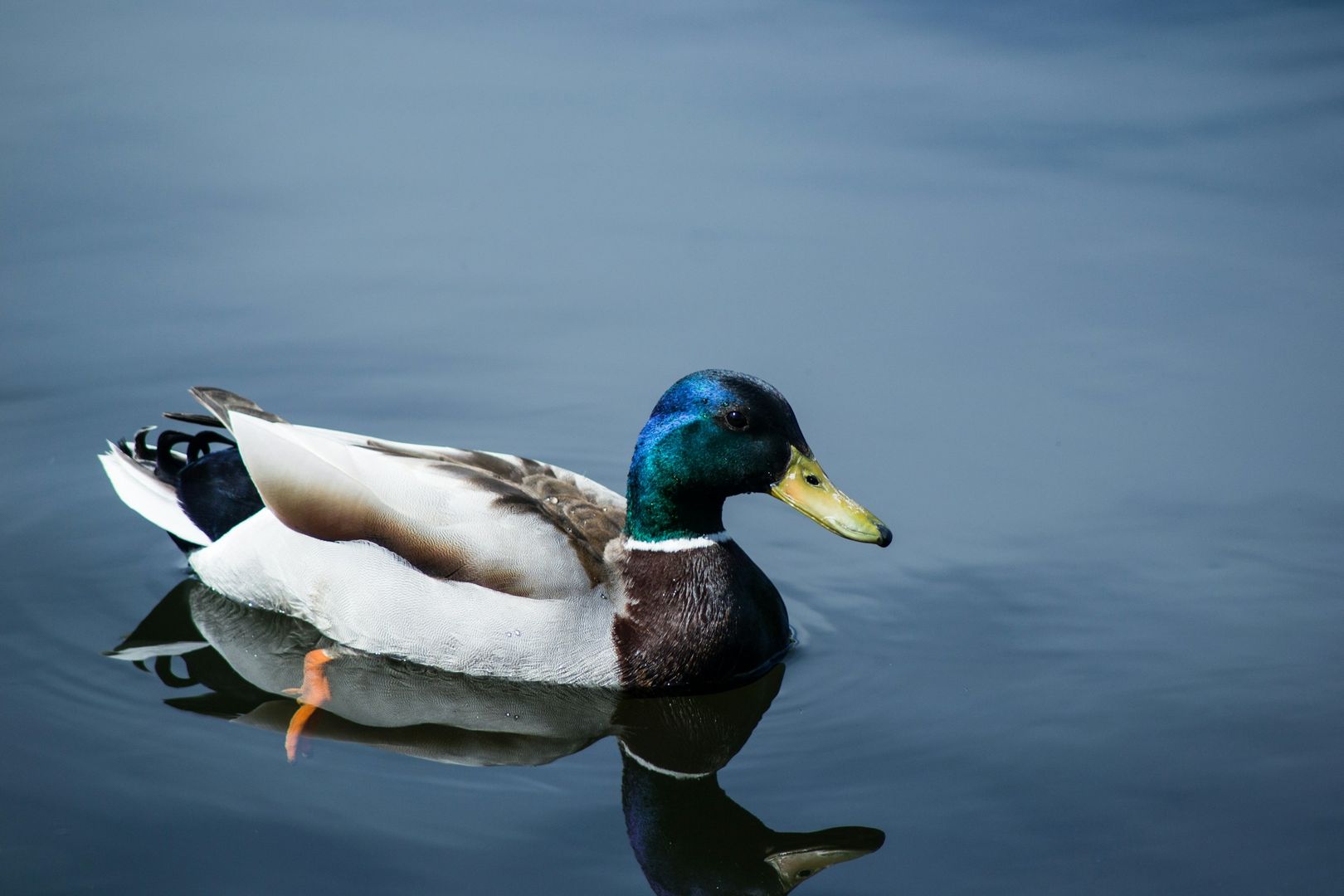
The Mallard is the duck everyone knows, but Idaho's winter numbers are something else. At Deer Flat National Wildlife Refuge, Mallards make up most of the up to 150,000 ducks that pack onto Lake Lowell by mid-December, and their constant activity keeps patches of water open all winter.
Males have a glossy green head, a white neck ring, a chestnut breast, and a yellow bill. Females are mottled brown with an orange-and-brown bill. Both have a blue wing patch edged in white.
The Mallard call is the classic quack, which, fun fact, comes from the female. Males give a quieter, raspy rhaeb.
In Idaho winters, look on Lake Lowell, the ponds of Hagerman Wildlife Management Area, and any open water along the Snake and Boise Rivers.
30. Trumpeter Swan
- Family – Anatidae
- Species – Cygnus buccinator
- Primary Activity Time – Daytime
- Diurnal
- Resident / Winter Migrant (eastern Idaho)
The Trumpeter Swan is North America's heaviest native waterfowl, and eastern Idaho is one of its most important wintering areas. Spring-fed rivers in Island Park stay ice-free, so swans gather there when the rest of the region freezes solid.
Adults are all white with a long neck and a solid black bill. Males and females look alike, though males are a little larger. Young birds are dusky gray with a pinkish bill.
The Trumpeter Swan call is a deep, bugling honk, like a French horn that's had a long day.
In Idaho winters, look along the Henry's Fork of the Snake River, including Harriman State Park, and other open water in the Upper Snake region. Give them plenty of room. A flushed swan burns energy it can't spare in January.
31. Bald Eagle
- Family – Accipitridae
- Species – Haliaeetus leucocephalus
- Primary Activity Time – Daytime
- Diurnal
- Resident Idaho Bird / Winter Migrant
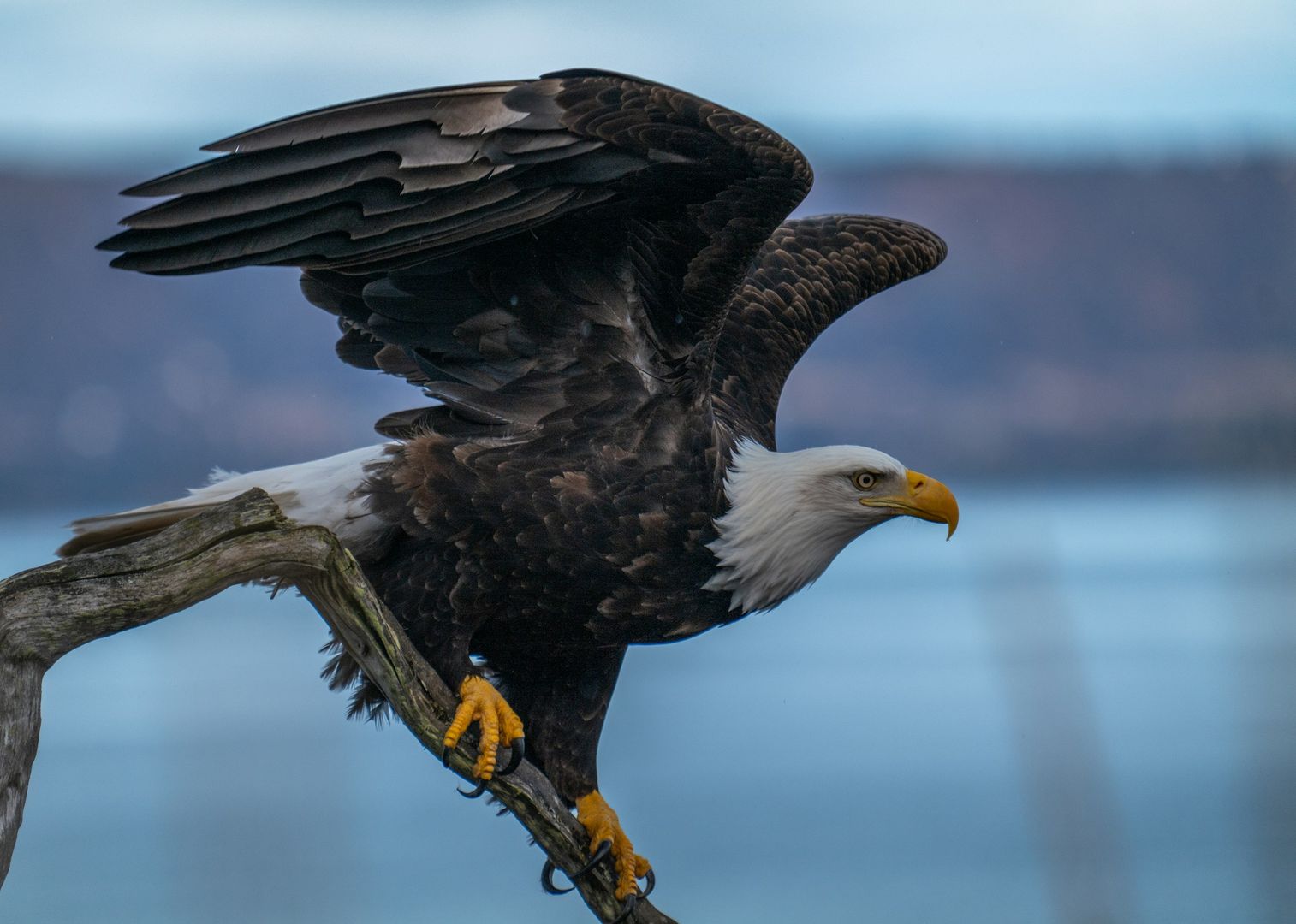
The Bald Eagle was reported on all but two of Idaho's 2012-13 Christmas Bird Counts, and winter is when numbers swell. At Deer Flat, eagles move in to feed on weak and injured waterfowl around Lake Lowell.
Adults have a white head and tail, a dark brown body, and a massive yellow bill. Young eagles are mottled brown and white and take about five years to get the full look. Females are larger than males.
The Bald Eagle call is a surprisingly thin, high, chattering whistle, not the scream movies give it.
In Idaho winters, the famous Eagle Tree near Hagerman holds 20 to 30 eagles on a typical day in January and February. Lake Coeur d'Alene, Lake Lowell, and open stretches of the Snake River are also good bets.
32. Rough-legged Hawk
- Family – Accipitridae
- Species – Buteo lagopus
- Primary Activity Time – Daytime
- Diurnal
- Winter Migrant / Visitor
The Rough-legged Hawk nests on the Arctic tundra and spends winter hunting voles in Idaho's open country. It's one of the few hawks that hovers in place, wings flapping, while it scans the ground below.
It has feathered legs all the way to the toes (hence the name), dark patches at the wrists under the wings, and a white tail base with a dark band. Females usually show a solid dark belly band and paler head, while males are often darker on the chest with more bands on the tail.
The Rough-legged Hawk call is a descending, catlike scream, though it's mostly quiet in winter.
In Idaho winters, look along the Snake River Plain, including the Swan Falls and Grandview areas. They tend to avoid town, so Boise rarely gets one.
33. Sharp-shinned Hawk
- Family – Accipitridae
- Species – Accipiter striatus
- Primary Activity Time – Daytime
- Diurnal
- Resident / Winter Migrant
The Sharp-shinned Hawk is the small, fast hawk that occasionally turns your feeder into a crime scene. It hunts songbirds by surprise, and in winter many move down from Idaho's mountains to the valleys where feeders concentrate prey. It showed up at almost 29% of Northern Rockies FeederWatch sites.
Adults are slate gray above with fine orange barring below and a square-tipped tail. It looks very similar to the larger Cooper's Hawk (Astur cooperii), but the Sharpie has a smaller head and a squared-off tail. Females are noticeably larger than males.
The Sharp-shinned Hawk call is a high, rapid kik-kik-kik, though it's mostly silent outside nesting season.
In Idaho winters, it's widespread in towns, river corridors, and anywhere small birds gather. (If your feeder suddenly goes quiet, check the nearest tree.)
34. Northern Shrike
- Family – Laniidae
- Species – Lanius borealis
- Primary Activity Time – Daytime
- Diurnal
- Winter Migrant / Visitor (uncommon)
The Northern Shrike is a songbird with a raptor's job. It arrives from northern Canada in winter and hunts small birds and rodents, sometimes wedging prey on thorns or barbed wire to eat later.
It's pale gray above and whitish below with a black mask, black wings and tail, and a hooked bill. Males and females look alike, while first-winter birds are browner with faint barring below.
The Northern Shrike call is a harsh, grating scold, and it sometimes sings a squeaky song even in winter.
In Idaho winters, it's an uncommon find in open country with scattered perches, and recent sightings have come from Blacks Creek, Garden Valley, and Montour Wildlife Management Area.
35. Snowy Owl
- Family – Strigidae
- Species – Bubo scandiacus
- Primary Activity Time – Dawn and Dusk
- Diurnal / Crepuscular
- Irruptive (rare)
The Snowy Owl is the bird every Idaho birder hopes for and few actually get. It comes south from the Arctic tundra in some winters, but it's much less common here than in the Great Lakes states, and plenty of winters pass with no Idaho reports at all.
It's a big, white owl with yellow eyes. Adult males can be nearly pure white, while females and young birds have heavy dark barring.
The Snowy Owl call is a low, booming hoot, though it's usually silent in winter.
In Idaho winters, any that do show up tend to pick wide-open farmland, airports, and lakeshores. Past sightings include Coeur d'Alene and Bonners Ferry. If you find one, keep your distance and skip the flash.
Birds of Idaho in Winter: FAQ
What are the most common Idaho birds in winter?
The most common birds in Idaho in winter are the feeder regulars: Dark-eyed Juncos, House Finches, American Goldfinches, Black-capped Chickadees, magpies, flickers, and Downy Woodpeckers. On Christmas Bird Counts, the most abundant birds statewide are European Starlings, Mallards, Canada Geese, American Coots, and American Robins.
What birds stay in Idaho in the winter?
Year-round residents like chickadees, nuthatches, woodpeckers, magpies, ravens, and California Quail stay put. They're joined by birds from farther north, like Rough-legged Hawks, Snow Buntings, and rosy-finches, plus irruptive finches in some years. For a neighboring state's list, see our guides to winter birds in Montana and winter birds in Oregon.
Does the Mountain Bluebird stay in Idaho in winter?
Mostly no. Idaho's state bird spends the winter in the southwestern U.S. and comes back by late February or early March, when it's time to claim a nest box.
Where can I see Bald Eagles in Idaho in winter?
The Eagle Tree near Hagerman is the easiest spot, with 20 to 30 eagles on a typical January or February day. Lake Lowell at Deer Flat National Wildlife Refuge, Lake Coeur d'Alene, and open water along the Snake River are also good.
What should I feed birds in Idaho in winter?
Idaho Fish and Game suggests using several feeders and foods in different spots: finch or thistle seed for siskins and goldfinches, suet for woodpeckers and nuthatches, and a platform or the ground for sparrows, juncos, and doves. They also recommend water with a heater if you can manage it. You don't need to buy a heated bath, though. An old ceramic pot saucer you already own and a few tricks from our guide on how to keep a bird bath from freezing in winter will do a lot of the work.
What birds have you seen in Idaho lately?
Share them on the Sparkbird App, where Idaho birders can swap sightings and maybe finally settle whether that rosy-finch flock was really 600 birds or just very enthusiastic counting.
And if a Snowy Owl never shows up this winter, take heart. Neither did my motivation to scrape the windshield, and we both still made it to spring.
Happy Birding.
No comments yet.