

Michigan winters are long enough that the birds who stick around deserve a medal (so does anyone refilling a feeder in a parka over pajamas). These 34 winter birds in Michigan run from everyday feeder regulars to rare northern owls that birders drive four hours to miss by ten minutes.
Even the state bird hedges its bets. The American Robin has held the title since 1931, and some robins do stay all winter, mostly in the southern Lower Peninsula, but they trade lawns and worms for berry trees and roving flocks, so they're easy to overlook. If you live near the Wisconsin line, our guide to winter birds in Wisconsin overlaps nicely with this one.
The 4 Types of Winter Birds in Michigan
- Irruptive Species – irregular, unpredictable movements of large numbers of birds outside their normal winter range, usually driven by a "boom-and-bust" cycle in food crops up north. Presence varies a lot from year to year (1–15)
- Resident Michigan Bird – native or non-native species that stay year-round instead of migrating (the Red-breasted Nuthatch, #34, is resident up north and irruptive farther south)
- Native Michigan Bird – birds that evolved or originated in Michigan (16–24)
- Migratory / Visitor – birds that migrate to Michigan for the winter, some of them passing through migration hot spots like Whitefish Point Bird Observatory (25–33)
1. Pine Grosbeak
- Family – Fringillidae
- Species – Pinicola enucleator
- Primary Activity Time – Dawn and Dusk
- Crepuscular
- Irruptive

The Pine Grosbeak is one of many irruptive winter birds in Michigan. It’s a stout finch that favors a granivorous and frugivorous diet, taking seeds, buds, and winter berries. It often targets mountain‑ash, crabapple, and boxelder crops and will visit feeders for black‑oil sunflower. Its calm demeanor and slow feeding pace make it approachable in winter towns.
Males show a rosy‑red wash over gray wings and tail, while females are olive‑yellow with the same gray patterning. This Irruptive Michigan bird sounds like a mellow, whistled tee‑tee‑tew that carries on cold air.
In Michigan winters the Pine Grosbeak range is most likely in the Upper Peninsula and northern Lower Peninsula especially where ornamental fruiting trees are abundant.
Feeder favorites: black oil sunflower seeds, especially on platform feeders
2. Evening Grosbeak
- Family – Fringillidae
- Species – Coccothraustes vespertinus
- Primary Activity Time – Dawn and Dusk
- Crepuscular
- Irruptive

A powerful seed‑cracker with a massive conical bill, the Evening Grosbeak is chiefly granivorous and also takes buds and berries. In winter it concentrates at feeders with platform space and abundant sunflower seed. An Evening Grosbeak diet normally includes maple keys and boxelder samaras, too.
Males are boldly golden‑yellow with black wings and a crisp white wing patch while female Evening Grosbeaks are gray‑brown with softer yellow tones. The Evening Grosbeak call is one of the most standout of all Michigan bird sounds on our list– their loud, flute-like “cheer up” and “cleep” sounds make them an easy bird to ID by sound.
Irruptions bring birds widely into Michigan, most reliably in the north woods and towns of the Upper Peninsula, and occasionally farther south when food crops fail up north.
Feeder favorites: black oil sunflower seeds on roomy platform feeders
3. Redpoll
- Family – Fringillidae
- Species – Acanthis flammea
- Primary Activity Time – Dawn and Dusk
- Diurnal
- Irruptive

A tiny, energetic finch specialized for small seeds, the Redpoll is primarily granivorous, focusing on birch, alder, and weed seeds. It stores seeds in an expandable throat pouch to process out of the wind. Insects are taken opportunistically in thaw periods.
A quick bit of housekeeping: in 2024 the American Ornithological Society lumped Common, Hoary and Lesser Redpoll into one species, now known simply as Redpoll. So the Hoary Redpoll that used to have its own spot on this list is now the frosty end of the Redpoll spectrum (I prefer to think of it as a family reunion, not a demotion).
It shows a red forehead cap, black chin, and streaked brown body. Many males have a rosy wash on the breast. This Irruptive Michigan bird sounds like a buzzing “chit chit chit” or “che che che” as they swirl to nyjer feeders or birch catkins.
Redpolls can occur statewide during irruption alongside other winter birds in Michigan, frequenting weedy fields and open woodlands. Attract this bird to your yard with thistle or nyjer seed feeder.
The paler, frostier birds once called Hoary Redpolls show whitish tones, reduced flank streaking, and a small bill that gives a rounded face. Their dry trills and twitters sound just like the rest of the flock.

These frosty birds are rare and irregular in Michigan, turning up mainly during strong arctic irruptions, mostly in the Upper Peninsula and occasionally farther south mixed into flocks of their streakier relatives.
Feeder favorites: nyjer (thistle) and sunflower chips
4. Pine Siskin
- Family – Fringillidae
- Species – Spinus pinus
- Primary Activity Time – Dawn and Dusk
- Diurnal
- Irruptive

The Pine Siskin is a strongly granivorous bird with a fine bill. It often feeds on conifer seeds, alders, and birches, and readily visits nyjer seed and sunflower chips at feeders. It supplements with small insects in mild spells.
They’re streaky brown with subtle yellow flashes in the wings and tail.
A Pine Siskin call is buzzy, often giving rising “zreee” sounds and chatter. They roam widely with cone availability. Their appearance won’t make them easy amidst Michigan bird identification but their call makes them a slightly easier bird to ID by sound.
Its appearances among the winter birds in Michigan during their irruption can vary year to year. Numbers can build statewide in irruption winters making the Pine Siskin range quite expansive as they flock to conifer stands and well‑stocked feeders.
Feeder favorites: nyjer (thistle) and sunflower chips
5. Red Crossbill
- Family – Fringillidae
- Species – Loxia curvirostra
- Primary Activity Time – Dawn and Dusk
- Diurnal
- Irruptive

A Red Crossbill diet consists of spruce, pine, and hemlock, making it a granivorous bird. It uses crossed mandibles to pry open conifer cones and sometimes visits salt and grit sources.
Males are brick‑red to orange and females are olive‑yellow, and both show notched tails and thick bodies.
The Red Crossbill call sounds like metallic jip‑jip notes, with different call types corresponding to cone preferences. Check out the video to hear the differences in bird calls.
Most records of irruptive winter birds in Michigan show the Red Crossbill range from the Upper Peninsula and northern Lower Peninsula, tied to cone crops.
6. White-winged Crossbill
- Family – Fringillidae
- Species – Loxia leucoptera
- Primary Activity Time – Dawn and Dusk
- Diurnal
- Irruptive

Also a granivorous cone specialist, the White Winged Crossbill targets spruce and tamarack cones extracting seeds with their crossed bills. It may feed continuously through short winter days.
Males are pinkish‑red with striking white wing bars with females displaying yellowish feathers with the same bold wing pattern.
The White Winged Crossbill call is a short and shallow “jip jip jip” tinkling. Some have even likened it to the sound of a cartoon laser beam. It’s another distinct song among the Michigan bird sounds that make it an easy bird to ID by sound.
A White Winged Crossbill’s range during irruption in Michigan spans the Upper Peninsula and the north woods, occasionally moving south during major irruptions and frequenting conifer bogs and barrens.
7. Purple Finch
- Family – Fringillidae
- Species – Haemorhous purpureus
- Primary Activity Time – Dawn and Dusk
- Diurnal
- Irruptive

A robust finch that is largely granivorous and frugivorous, the Purple Finch feeds on tree seeds and winter fruit and readily visits sunflower feeders. Buds and blossoms are taken when available.
Males are raspberry‑washed over the head and breast without strong streaking, and females are brown with bold facial lines. The males are one of the prettiest winter birds in Michigan during irruption, in my opinion.
The Purple Finch call sounds like a rich, rolling warble of soft pik and tek sounds. Its bird call reminds me of a loquacious busy-body you run into while doing errands.
Irruptions bring this species into Michigan in variable numbers, with higher counts in northern forests but also showing up at feeders statewide in some winters.
Feeder favorites: black oil sunflower seeds
Related: Bird Watching Groups & Resources Michigan
8. Bohemian Waxwing
- Family – Bombycillidae
- Species – Bombycilla garrulus
- Primary Activity Time – Dawn and Dusk
- Diurnal
- Irruptive

A silky, crested songbird, the Bohemian Waxwing is primarily frugivorous in winter, flocking to mountain‑ash, crabapple, and cedar berries. It also eats insects when thaw allows. Its communal feeding can strip fruiting trees rapidly.
Males are larger and duskier than Cedar Waxwings with chestnut undertail coverts, yellow‑tipped tail, a slicked back mohawk, and neat black mask that looks like winged eyeliner. Females look nearly identical.
The Bohemian Waxwing call is like high-pitched ringing trills that sound like a “sreeee”. Their song has also been likened to a toy laser sound. As far as Michigan bird identification in the winter goes, the striking appearance and bird call alike make the Bohemian Waxwing easy to ID.
Occasional irruptions reach Michigan where the Bohemian Waxwing range is most often in the Upper Peninsula and northern towns with ornamental fruiting trees.
9. Snowy Owl
- Family – Strigidae
- Species – Bubo scandiacus
- Primary Activity Time – Dusk
- Nocturnal
- Irruptive

The Snowy Owl is a powerful arctic bird of prey that mainly eats small mammals especially lemming‑like rodents. Along coasts it will also take waterfowl and shorebirds but in wintering areas it hunts from open perches and ground vantage points.
They’re a large pale white owl– easy to miss against a snowy background. You may know the Snowy Owl from Harry Potter named Hedwig. Hedwig is actually a female Snowy Owl in the books but is portrayed by a male Snowy Owl in the Harry Potter movies. Young or female Snowy Owls show heavier dark barring, whereas adult males can appear nearly pure white.
Snowy Owl size varies in that females are usually larger than males, and their wingspan can reach close to 5 feet. The call is a booming double hoot despite many winter birds being often silent and relying on visual hunting at low light.
In Michigan, Snowy Owl range spans the open shorelines, airports, farm fields, and coastal areas of the Great Lakes particularly in the Upper Peninsula and along Lakes Michigan and Huron.
10. Great Gray Owl
- Family – Strigidae
- Species – Strix nebulosa
- Primary Activity Time – Dusk
- Nocturnal
- Irruptive

This carnivorous owl specializes on small mammals taken by plunging through snow after pinpointing movement with exceptional hearing. It hunts from low perches at forest edges and meadows.
The Great Gray Owl sports an enormous facial disk with concentric rings, yellow eyes, and a long tail. Its plumage is silver‑gray and finely barred.
A Great Gray Owl call is a deep, muffled yet resonant series of hoots. It's usually quiet but when vocal the Great Gray Owl call is unmistakable.
A rare irruptive visitor amidst the winter birds of Michigan, the Great Gray Owl range is mostly in the Upper Peninsula during exceptional northern outbreaks and in remote conifer swamps and boggy edges.
11. Northern Hawk Owl
- Family – Strigidae
- Species – Surnia ulula
- Primary Activity Time – Dawn and Dusk
- Diurnal
- Irruptive

The Northern Hawk Owl is a diurnal, carnivorous owl that behaves hawk‑like, scanning open country for rodents and small birds. It hunts from prominent snags and utility poles before swift, direct chases.
It’s slender with a long tail, spotted brown upperparts, and dark black tines along paler gray plumage. Its bold facial pattern appears like a scowl, forming a v-shape accented by bright yellow eyes and beak, and has pointed wings for fast flight.
A Northern Hawk Owl sound and calls includes a rapid, whistled series of hoots, making it an easy bird to ID by sound.
Very scarce in Michigan, recorded mostly in the Upper Peninsula during rare irruptions in open bogs, cutovers, and tundra‑like barrens.
12. Boreal Owl
- Family – Strigidae
- Species – Aegolius funereus
- Primary Activity Time – Dusk
- Nocturnal
- Irruptive

A small carnivorous owl that takes voles and mice in dense conifers. It hunts by sound at night and at dusk, and will roost in thick spruce and cedar.
A Boreal Owl is a compact owl with a rounded head, white‑spotted crown, and yellow eyes. This owl has a distinct facial disk that’s squared‑off compared with the Northern saw-whet owl.
A Boreal Owl call is a series of hollow hoots– wintering birds are often silent. Its rhythmic hoots and toots make it an easy bird to ID by sound, especially among the Michigan bird sounds you’ll hear this winter.
It’s rare to see in Michigan even among the irruptive winter birds. When it is around the Boreal Owl range is chiefly in the Upper Peninsula in mature spruce‑fir and mixed conifer forests.
13. Common Goldeneye
- Family – Anatidae
- Species – Bucephala clangula
- Primary Activity Time – Dawn and Dusk
- Diurnal
- Irruptive

The Common Goldeneye Duck is a diver that’s chiefly piscivorous and invertivorous, taking small fish, aquatic insects, and mussels. It forages underwater and often gathers in rafts on open water.
Males show a dark green head with a round white cheek spot and crisp black‑and‑white body. Females are brown‑headed with gray bodies. Common Goldeneye Duck has a yellow-gold eye which will help with your Michigan bird identification this winter.
A Common Goldeneye Duck sounds like a brief, sharp “peent” or “gack”.
Its wingbeats are notably whistling in flight which makes it an easier bird to ID by sound (video warning: hunter generated content).
In Michigan winters, look for goldeneye on unfrozen stretches of the Great Lakes, connecting channels, and larger rivers where current keeps water open.
14. Bufflehead
- Family – Anatidae
- Species – Bucephala albeola
- Primary Activity Time – Dawn and Dusk
- Diurnal
- Irruptive

The Bufflehead Duck is a petite diving duck feeding on aquatic invertebrates and small crustaceans. It also picks mollusks and small fish where available. It forages close to shorelines and river mouths.
A male Bufflehead Duck has a striking white head patch that wraps behind the crown with cool jewel tones surrounding the rest of its face. A female Bufflehead shows a neat white cheek spot on a dusky head.
The Bufflehead Duck call sounds like chattering, or growling in winter months. A female Bufflehead can make a “cuk cuk cuk” sound. Flocks fly fast with whistling wings.
Look for Buffleheads on Michigan’s Great Lakes shorelines and larger rivers among other winter birds in Michigan, as long as there is open water. They’re a common duck, which makes them easy to see for those of you who partake in bird watching in Michigan.
15. Long-tailed Duck
- Family – Anatidae
- Species – Clangula hyemalis
- Primary Activity Time – Dawn and Dusk
- Diurnal
- Irruptive

The Long Tailed Duck is a cold‑water diving duck feeding mainly on aquatic invertebrates, small crustaceans, and mollusks.
They can dive to impressive depths so deep and for so long that Long Tailed Duck diving can account for up to four times more time than is spent on the surface. They forage in rolling offshore waters for aquatic invertebrates and insects, with more plants in the breeding months.
Males show dramatically long central tail feathers and complex black‑and‑white plumage which make it an easy target for Michigan bird identification. A female Long Tailed Duck is patterned in softer grays and browns with the same striking face coloring.
Their calls are a short and somewhat deep yodel, can sound a bit like a puppy or seal, making it stand out amongst the Michigan bird sounds and another easy bird to ID by sound.
Best found along Michigan’s Great Lakes, especially exposed coastlines and deeper bays that remain ice‑free.
16. Northern Cardinal
- Family – Cardinalidae
- Species – Cardinalis cardinalis
- Primary Activity Time – Dawn and Dusk
- Diurnal
- Native Michigan Bird

The Northern Cardinal is an omnivore that eats seeds, fruits, and insects. This canonical winter bird relies heavily on sunflower, safflower, and berries, often foraging low in shrubs and at platform feeders.
Males are vivid red with a black mask and crest. A female Northern Cardinal, on the other hand, is warm brown with orange bills and subtle red highlights. Both the male and female Northern Cardinal have a tuft of hair that looks like an expertly styled mohawk.
The Northern Cardinal sounds like a clear, whistled cheer‑cheer‑cheer with varied phrases. Some of the Northern Cardinal sounds and calls are to the tune of a cartoon plane dropping bombs, making it recognizable among other Michigan bird species.
Found statewide in Michigan’s settled areas, woodlots, and brushy edges through winter, especially where feeders and dense cover are present. It's hard to miss if you’re bird watching in Michigan. You can easily attract it to your yard with a simple feeder.
Feeder favorites: black oil sunflower and safflower seeds
17. Black-capped Chickadee
- Family – Paridae
- Species – Poecile atricapillus
- Primary Activity Time – Dawn and Dusk
- Diurnal
- Native Michigan Bird

The Black-capped Chickadee is a tiny omnivore that favors seeds, suet, and dormant insects, caching food in bark crevices. It adapts well to winter with high metabolism and flock foraging.
It's got a distinctive black cap and bib with white cheeks, soft gray body, and is constantly active.
The Black-capped Chickadee song sounds like chick‑a‑dee‑dee‑dee notes and a clear fee‑bee song on mild days. In fact, the Black-capped Chickadee call is highly varied and includes other sounds and phrases like "cheeseburger" and “hey sweetie” along with its trademark chick‑a‑dee song.
Their petite stature and coloring help with bird identification despite the many Michigan bird species.
This chickadee is abundant statewide with other winter birds in Michigan in woodlands, parks, and neighborhoods– and quick to find feeders with sunflower seed and suet.
Feeder favorites: black oil sunflower seeds, suet, peanuts
18. Downy Woodpecker
- Family – Picidae
- Species – Dryobates pubescens
- Primary Activity Time – Dawn and Dusk
- Diurnal
- Native Michigan Bird

The Downy Woodpecker is an omnivorous woodpecker taking insects, larvae, and eggs from twigs and bark, plus suet and seeds at feeders. It scales small branches and weed stems deftly.
It's a small bird with a short bill and is fairly common to see when bird watching in Michigan. The black‑and‑white patterning and a tiny red nape patch make it stand out against other winter birds. I recall always seeing them in my grandmother’s feeders in her lilac bushes in Massachusetts.
A Downy Woodpecker call has a sharp pik note and short descending whinny trills. There are a few different sounds that you can learn to identify a Downy woodpecker call, actually. It may blend in with other Michigan bird sounds if you’re not familiar.
Their range is widespread across Michigan’s forests, edge habitats, and towns with other common winter birds in Michigan. You can attract them by keeping a suet feeder or mixed seed feeder.
Feeder favorites: suet, black oil sunflower seeds, peanuts
19. Hairy Woodpecker
- Family – Picidae
- Species – Dryobates villosus
- Primary Activity Time – Dawn and Dusk
- Diurnal
- Native Michigan Bird

A larger cousin of the Downy, this omnivorous woodpecker consumes beetle larvae and other insects, and readily takes suet and nuts. It forages on larger trunks and limbs.
Hairy Woodpecker vs Downy Woodpecker: Longer bill and larger size than Downy, but similarly patterned in black and white. The male Hairy Woodpecker also has a black apostrophe mark on its breast. It’s also larger with a bigger beak-to-head ratio. A Female Hairy Woodpecker is identical to the male except it lacks his red nape patch.
A Hairy Woodpecker sounds like a sharp “peek” and a rattly, longer whinny.
Common across Michigan’s mature woodlands, parks, and yards in winter, often detected by steady drumming and trunk foraging.
Feeder favorites: suet, peanuts, black oil sunflower seeds
20. Red-bellied Woodpecker
- Family – Picidae
- Species – Melanerpes carolinus
- Primary Activity Time – Dawn and Dusk
- Diurnal
- Native Michigan Bird

An omnivore that takes acorns, nuts, fruit, and insects. It frequently visits suet feeders and peanut feeders in winter, and caches food in bark and deadwood for lean times.
Pale gray face with a striking red crown and nape, laddered black‑and‑white back, and a faint pinkish belly. Calls are rolling chur notes and loud “kwirr” rattles.
Resident through much of Michigan, especially the Lower Peninsula’s woodlands, suburbs, and riparian corridors.
Feeder favorites: suet, peanuts, sunflower seeds
21. Blue Jay
- Family – Corvidae
- Species – Cyanocitta cristata
- Primary Activity Time – Dawn and Dusk
- Diurnal
- Native & Resident Michigan Bird

An omnivorous corvid that eats acorns, seeds, fruits, and insects. It is a regular at peanut and sunflower feeders. Jays cache nuts and broadcast alarm calls around predators.
Female vs Male Blue Jay: both are nearly identical with bold blue plumage and a black necklace with crisp white underparts. Male and female Blue Jay birds are bold, noisy, and social. One difference to tell apart the males from females is their slightly larger size. They also share domestic duties (i.e. building the nest).
A Blue Jay call ranges from jeer alarms to soft whistles and uncanny hawk imitation– all with a flat or falling call pattern. To the novice birder a Blue Jay call can sound like a crow. The Blue Jay mating call is more melodic and cheery.
Year‑round native can be found mingling with winter birds in Michigan in mixed woodlands, neighborhoods, and edge habitats.
Feeder favorites: peanuts, sunflower seeds, suet
22. White-breasted Nuthatch
- Family – Sittidae
- Species – Sitta carolinensis
- Primary Activity Time – Dawn and Dusk
- Diurnal
- Native Michigan Bird

The White-breasted Nuthatch diet consists of insects, seeds, and nuts. It frequently visits suet and sunflower feeders, too, making this winter bird an omnivore. White-breasted Nuthatch size varies quite little from 0.6 to 1 ounce. Despite its tiny size, they have a strong backward hallux, or toe, allowing it to climb head first downwards on trees.
White Breasted Nuthatch male vs female: the male is a slate blue with white face and underparts, and a black cap connecting its bill to its back. The female White Breasted Nuthatch has a gray cap.
A White-breasted Nuthatch call is a nasal yank‑yank note. Of the winter birds in Michigan, it sings in late winter, and the male White-breasted Nuthatch sounds like a “wha-wha-wha”. Some have also compared their call to an old school car horn honking.
Among other native birds, this Michigan bird species is widespread in mature woods, parks, and yards, and is commonly seen at feeders and tree trunks around homes.
Feeder favorites: sunflower seeds, suet, peanuts
23. Tufted Titmouse
- Family – Paridae
- Species – Baeolophus bicolor
- Primary Activity Time – Dawn and Dusk
- Diurnal
- Native & Resident Michigan Bird

A small omnivore that feeds on seeds, nuts, and insects, frequently visiting sunflower and peanut feeders in winter. It often travels with chickadee‑led mixed flocks.
Gray with a neat crest, big black eyes, buffy flanks, and sports a gray faux-hawk / mohawk. The female Tufted Titmouse is identical to the male.
The Tufted Titmouse call is a clear peter‑peter‑peter song and the occasional scolding calls. Many people find the Tufted Titmouse song melodic and seek it out in birding. Its distinct sound makes the tufted titmouse a great bird to ID by sound.
A Tufted Titmouse nest is often in a tree cavity or birdhouse, so you can create an inviting habitat by putting out a titmouse-sized bird house for them.
In winter the Tufted Titmouse range in Michigan is mostly southern and central Michigan.
They’re common around feeders, woodlots, and suburban parks.
Feeder favorites: sunflower seeds, peanuts, suet
24. American Goldfinch
- Family – Fringillidae
- Species – Spinus tristis
- Primary Activity Time – Dawn and Dusk
- Diurnal
- Native & Resident Michigan Bird

A granivorous finch that favors nyjer and sunflower chips in winter. The American Goldfinch also eats weed seeds in fields and edges.
In winter plumage the bird is duller, yellowish‑brown with black wings and pale bill. A female American Goldfinch sports only a small dull yellow patch on its breast while the male American Goldfinch will retain a yellow chartreuse hue.
Its calls are sweet po‑ta‑to‑chip notes and twittering flight phrases.
An American Goldfinch in winter ranges widely with food supply but you can create an inviting space with a nyjer seed feeder.
The American Goldfinch is widespread amongst winter birds in Michigan in fields, towns, and feeder yards.
Feeder favorites: nyjer (thistle) and sunflower chips
25. American Crow
- Family – Corvidae
- Species – Corvus brachyrhynchos
- Primary Activity Time – Dawn and Dusk
- Diurnal
- Migratory/Visitor

An omnivore that consumes seeds, carrion, invertebrates, and human refuse. Winter roosts can number in the thousands near cities as it’s highly adaptable and social. An American Crow diet consists of almost everything from frogs, to bugs and seeds. It’s an opportunistic feeder whose diet reflects its city roots.
The American crow is entirely black with a heavy bill and broad wings. Not to mention it’s often mistaken for a raven which can make for difficult bird identification.
American Crow calls are prolific and have about 20 or so calls. They’re generally hoarse caws with conversational variants. Their coos and caws make the American Crow call unmistakable yet harsh on the ears.
They’re common statewide through winter in Michigan, although local movements occur. Look for evening flights to communal roosts in urban areas while bird watching in Michigan.
26. Mourning Dove
- Family – Columbidae
- Species – Zenaida macroura
- Primary Activity Time – Dawn and Dusk
- Diurnal
- Migratory/Visitor

A granivorous ground‑feeder that eats waste grain and weed seeds and visits platform trays for cracked corn and millet. In cold snaps it conserves energy by loafing in sheltered spots.
Slender, buff‑brown with black spots on the wings and a long pointed tail edged in white. Their wings also give a soft whistling on takeoff.
A Mourning Dove sounds like a soft, mournful coo. It’s often a couple of soft coo’s followed by louder coo’s. It’s another bird I often heard at my grandmother’s early in the morning. The Mourning Dove sound was a calm song I associated with warm spring and summer mornings.
Present across much of Michigan in winter, especially the southern Lower Peninsula and urban microclimates. Their numbers vary with snow depth and cold spells.
Feeder favorites: millet, cracked corn, and sunflower seeds on the ground or a platform
27. Bald Eagle
- Family – Accipitridae
- Species – Haliaeetus leucocephalus
- Primary Activity Time – Dawn and Dusk
- Diurnal
- Migratory/Visitor

The Bald Eagle is a piscivorous raptor that also scavenges carrion and takes waterfowl when opportunities arise. It gathers near fish runs and carcass sites for feeding which is why you’ll find it near bodies of water.
It’s a large bird with a dark body, white head and tail (in adults,) and a powerful yellow bill. A Bald Eagle baby, on the other hand, is mottled and looks more like an ugly duckling.
A Bald Eagle call sounds like high‑pitched chatters. The repeating screech makes the Bald Eagle call an easy bird to ID by sound. Their wing posture is plank‑straight while soaring, and their wingspan can reach over 7 feet.
These birds are concentrated near open, ice‑free waters across Michigan like Great Lakes shorelines, large rivers, and dams.
28. Dark-eyed Junco
- Family – Passerellidae
- Species – Junco hyemalis
- Primary Activity Time – Dawn and Dusk
- Diurnal
- Migratory/Visitor

The Dark Eyed Junco is a granivorous sparrow that favors millet and mixed seeds on the ground or low trays. It also picks weed seeds in winter fields. Flocks often include other sparrows and finches.
They have clean gray slate‑colored upperparts with white belly and distinctive flashing white outer tail feathers.
Calls are soft tiks and a musical trilling song in mild spells. It’s soft and song-like which can make it tricky to ID by sound alone.
They’re abundant winter visitors statewide in Michigan, from forest edges to yards and parks. This adorable winter bird is readily attracted to ground‑level feeding areas.
Feeder favorites: millet and cracked corn scattered on the ground
29. American Tree Sparrow
- Family – Passerellidae
- Species – Spizelloides arborea
- Primary Activity Time – Dawn and Dusk
- Diurnal
- Migratory/Visitor

A granivorous sparrow that gleans seeds from grasses and forbs and visits low platform feeders for millet and mixed seed. Insects are added in thaws.
The American Tree Sparrow has a rufous crown and eyeline with a gray face and breast, a central dark breast spot, and bicolored bill. It sort of looks like a stereotypical light brown bird with a rust orange cap.
An American Tree Sparrow call includes musical tink and sweet, clear notes.
Regular in winter across open country in Michigan in brushy fields, hedgerows, and weedy ditches. The American Tree Sparrow finds frequent company with other winter visitors in Michigan like juncos and other sparrows.
Feeder favorites: millet and cracked corn on the ground or a low platform
30. Snow Bunting
- Family – Calcariidae
- Species – Plectrophenax nivalis
- Primary Activity Time – Dawn and Dusk
- Diurnal
- Migratory/Visitor

The Snow Bunting is granivorous in winter, picking grass and weed seeds on windswept ground and shorelines, but also takes small invertebrates in thaws.
It sports white and brown patterned plumage in winter with black and white in males by spring. The Snow Bunting’s coloring makes it tricky to identify among other winter birds in Michigan but the yellow-brown effused coloring on the female’s breast can help tell it apart.
A Snow Bunting call is mostly dry trills. Its twitters and chirps make it a more difficult bird to ID by sound alone.
Widespread in Michigan in open fields, shorelines, and farm country, the Snow Bunting settles in exposed, snowy expanses forming large, conspicuous winter flocks.
31. Horned Lark
- Family – Alaudidae
- Species – Eremophila alpestris
- Primary Activity Time – Dawn and Dusk
- Diurnal
- Migratory/Visitor

The Horned Lark is a ground‑foraging granivore that eats weed seeds, waste grain, and small insects on sunny winter days. It prefers bare, windswept terrain. They are buff‑brown above with a pale face and black mask and tiny 'horns' of feathers.
The Horned Lark call is tinkling and sweet, or piercing, depending on who you ask. It’s another bird call that’s hard to tell apart from other winter birds in Michigan if there are enough birds around.
Found in Michigan’s open, sparse habitats like airfields, dunes, stubble fields, and plowed flats. If you want to see it while bird watching in Michigan this winter go where snow cover is minimal.
32. Rough-legged Hawk
- Family – Accipitridae
- Species – Buteo lagopus
- Primary Activity Time – Dawn and Dusk
- Diurnal
- Migratory/Visitor

The Rough-legged Hawk is a carnivorous arctic buteo that hunts voles by hovering over open country and perching on isolated posts. It often quarters low into the wind. It’s long‑winged with a small bill and feathered legs. Pale and dark morphs occur each with distinct belly or wrist patches.
A Rough-legged Hawk call is mewing but mostly silent on wintering grounds.
Winters in Michigan’s open farmlands, marshes, and coastal prairies, especially in the eastern Upper Peninsula and broad flats of the Lower Peninsula.
33. Northern Shrike
- Family – Laniidae
- Species – Lanius borealis
- Primary Activity Time – Dawn and Dusk
- Diurnal
- Migratory/Visitor

The Northern Shrike is a predatory, carnivorous songbird that hunts small birds and mammals known to impale prey on thorns for later feeding.
They’re gray above with a black mask and hooked bill. Their flight is buoyant with shallow wingbeats. Its gray-white coloring can make it difficult to tell apart from other winter birds in Michigan.
Northern Shrike calls are harsh scolds with occasional varied whistles and mimicry. Some of its sounds are melodic, while others are short cheeps like a squeaker toy.
It’s a regular but scarce winter visitor to Michigan’s open country, most frequent in the Upper Peninsula and northern Lower Peninsula. You can find this bird in wetlands and hedgerows.
34. Red-breasted Nuthatch
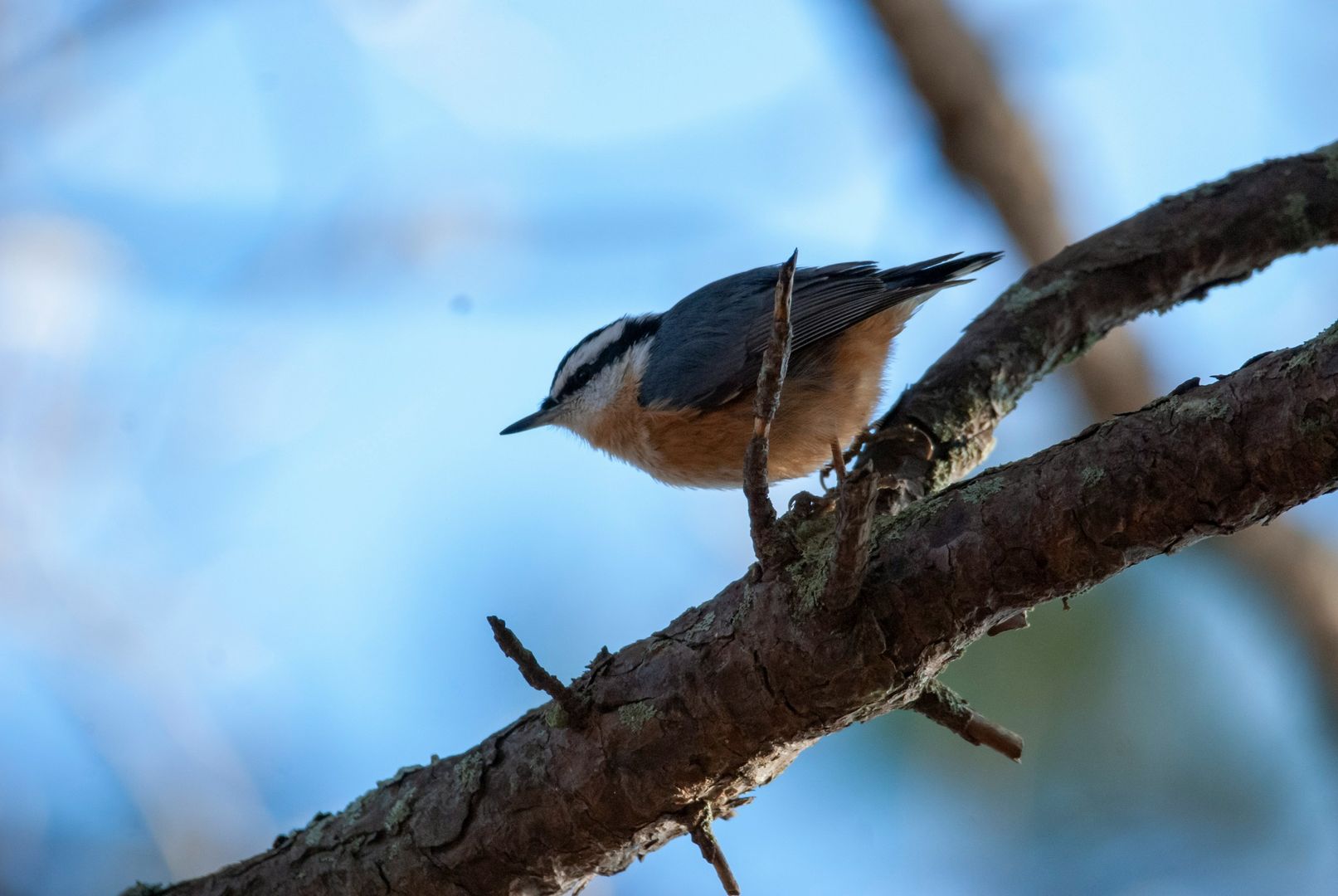
- Family – Sittidae
- Species – Sitta canadensis
- Primary Activity Time – Dawn and Dusk
- Diurnal
- Resident & Irruptive
The Red-breasted Nuthatch is a small, compact nuthatch that leans on conifer seeds in winter and switches to insects in summer. Like its White-breasted cousin it climbs headfirst down trunks, and it caches seeds in bark crevices for later. In years when northern cone crops fail, many move south, so numbers away from the north woods swing from winter to winter.
Males are blue-gray above with rich cinnamon underparts, a black cap, and a black eyeline under a crisp white eyebrow. Females look similar but paler, with a grayer cap and softer orange below.
The Red-breasted Nuthatch call is a nasal yank that's higher and more tinny than the White-breasted Nuthatch, a bit like a toy trumpet played by someone on their first lesson. It's one of the easier Michigan bird sounds to learn once you've heard it a few times.
In Michigan it's resident in the conifer forests of the Upper Peninsula and northern Lower Peninsula and spreads farther south in irruption winters. It's also a regular at Great Lakes feeders, showing up at about 43% of FeederWatch sites in the region.
Feeder favorites: suet, black oil sunflower seeds, peanuts
Michigan Winter Birds FAQ
What birds stay in Michigan during winter?
Plenty. Black-capped Chickadees, Northern Cardinals, White-breasted Nuthatches, Blue Jays, and Downy and Hairy Woodpeckers stay year-round, and they're joined by winter visitors like Dark-eyed Juncos and American Tree Sparrows. The Michigan DNR's winter birding guide also lists American Goldfinches, Pine Siskins, Pine Grosbeaks and redpolls as feeder birds to watch for.
Where can I see Snowy Owls in Michigan?
Look somewhere flat, open and windy: Great Lakes shorelines, airports, and big farm fields, especially in the Upper Peninsula and along Lakes Michigan and Huron. Scan fence posts, hay bales and the tops of small rises. Give them plenty of space, since a flushed owl burns energy it needs to get through the winter.
Do robins stay in Michigan in winter?
Some do. Many American Robins head south, but others stay, mostly in the southern Lower Peninsula, where they flock to fruiting trees and shrubs instead of hopping across lawns. That change in habits is why so many people assume they've left.
What is Michigan's state bird?
The American Robin, adopted by House resolution in 1931. It hasn't been an easy reign: bills to replace it with the Kirtland's Warbler came up in 1976, 2003 and 2022, and none have passed, so far.
What should I feed birds in winter in Michigan?
Black oil sunflower seed covers the most species, suet brings in woodpeckers and nuthatches, nyjer pulls in finches, and millet scattered on the ground keeps juncos and sparrows happy. Our guide to the best bird food goes deeper. Open water is just as valuable when everything freezes, so a heated bird bath can outdraw any feeder. And skip the bread entirely: it fills birds up without giving them the nutrition they need.
What birds have you seen in Michigan lately?
Share them on the Sparkbird App, where you can swap sightings with other Michigan birders and find people to go birding with in person.
And if that Snowy Owl still hasn't shown up after your third lap of the airport perimeter, don't take it personally. It's probably sitting on a hay bale two fields over, wondering why that car keeps circling.
No comments yet.