
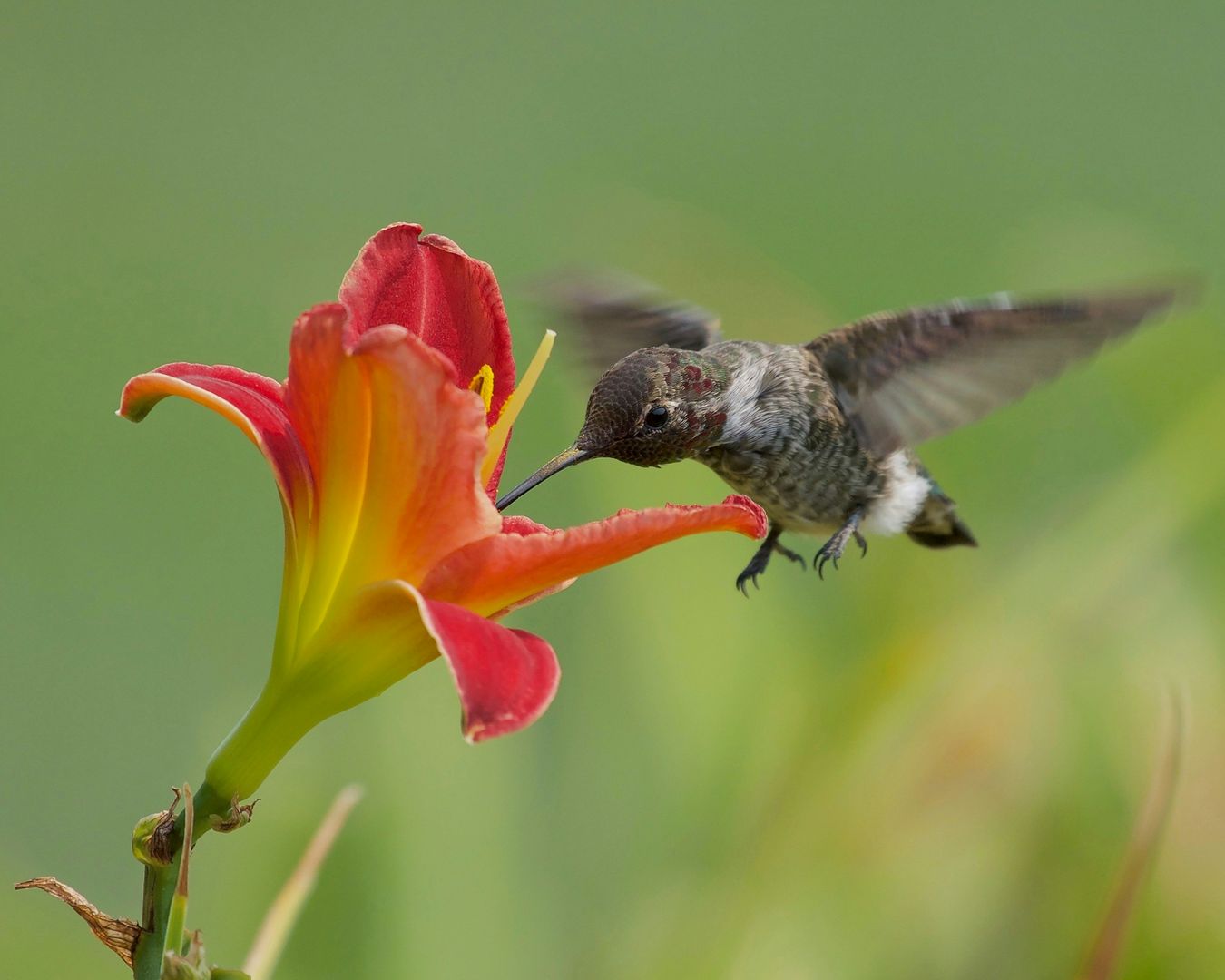
Hummingbirds are one of the most aggressively charming birds in North America.
They're tiny, territorial, and apparently unaware they weigh three grams.
They'll defend a feeder from birds ten times their size with the energy of someone who's been waiting for this moment their entire (albeit short) life.
Want to learn more?
Here are ten facts about hummingbirds that
1. The Smallest Migrating Bird
Many hummingbirds migrate for the winter, preferring temperatures between 60–90°F. The largest is the Giant Hummingbird at up to 9 inches. The smallest is the Bee Hummingbird at 2 inches and roughly 1.5 grams.
That's lighter than a penny.
Their migration is the equivalent to a human walking from New York to Los Angeles and back.
The Rufous Hummingbird travels the farthest relative to body size of any North American bird — approximately 4,000 miles each way, from Mexico to Alaska. Scientists who study this have described the energy math as "barely possible," which feels like something you want a bird in your yard to know about itself.
2. There Are 5 Different Names for a Group of Hummingbirds
A bouquet. A shimmer. A tune. A hover. A glittering.
When was the last time you saw a glittering of anything that wasn't Edward Cullen? Hummingbirds are the only group of animals that have earned five distinct collective nouns, presumably because no single word was extravagant enough.
3. There Are 330 Hummingbird Species
All of them live exclusively in the Americas. They range from Alaska to Tierra del Fuego, from sea level to over 16,000 feet elevation in the Andes. The US and Canada are home to about 15–20 species, with the highest diversity concentrated in the Southwest.
Twenty-one species are currently listed as endangered or critically endangered, with roughly 255 species declining in population.
The primary threats are habitat loss and climate change altering the timing of flower blooms that migration schedules evolved around. A hummingbird arriving in spring to find that the flowers it depends on bloomed two weeks early is, nutritionally, in trouble.
4. Their Name Comes From the Sound of Their Wings
Hummingbirds beat their wings an average of 60 times per second — fast enough to produce a constant audible hum. The Horned Sungem manages 90 beats per second; the Anna's Hummingbird dives at speeds that require 80 beats per second to maintain control.
They're not flapping their wings, which is the part that separates them from every other bird.
Hummingbirds rotate their wings in a figure-8 pattern, generating lift on both the upstroke and downstroke.
This is why they can hover, fly backwards, and stop instantly — capabilities that require the figure-8 mechanics rather than standard flapping.
5. They Can Smell Their Way Out of Danger
It was long believed that hummingbirds had no meaningful sense of smell and relied entirely on visual cues to locate nectar. A 2021 study from UC Riverside found otherwise.
Hummingbirds detect the defensive chemical compounds released by aggressive insects near nectar sources, using smell to avoid flowers occupied by bees or wasps.
They're not just looking for red. They're also evaluating whether the restaurant has difficult clientele before committing to a visit.
6. Their Hearts Beat Up to 1,260 Times Per Minute
At rest, a hummingbird's heart beats 500–600 times per minute. During flight or excitement, it exceeds 1,200. The average human heart beats 60–100 times per minute — a hummingbird's runs at roughly twelve times that rate.
To sustain this, they consume up to twice their body weight in nectar daily, visiting 1,000–2,000 flowers. They also eat small insects and spiders for protein, which is not something the marketing typically mentions but is essential for their survival.
When temperatures drop at night, most hummingbirds enter torpor, a controlled state of reduced metabolic function that drops their heart rate and body temperature to conserve energy.
A hummingbird in torpor can be unresponsive to touch; they rouse themselves at dawn when temperatures rise.
7. They Can Fly Up to 60 mph
Average cruising speed is 20–30 mph in direct flight. During courtship dives, males reach 50–60 mph. These speeds produce the distinctive explosive sound you sometimes hear in a backyard without warning.
One study measured Anna's Hummingbird males pulling 9 g of centrifugal force during dives, exceeding the g-forces fighter pilots experience during high-speed maneuvers.
This from a bird that weighs four grams.
8. Largest Brain Relative to Body Size of Any Bird
Hummingbirds have the highest brain-to-body ratio of all birds. their brain accounts for 4.2% of body weight, roughly twice the human percentage.
Much of this is dedicated to spatial memory: hummingbirds remember the exact location and nectar levels of every flower they've visited, routing efficiently between them to avoid revisiting emptied sources.
This is why the same hummingbirds return to your yard each year. They remember where you are.
(They also remember if you let the nectar get moldy. They have opinions about that.)
9. Hummingbirds Use Their Tongue, Not Their Beak
The long bill is a delivery mechanism, not a straw. Hummingbirds use their tongue which extends well beyond the beak tip.
It acts as a pump, using rapid muscular contractions to draw nectar in. The tongue can extend and retract up to 20 times per second during feeding.
10. They Can Fly Upside Down and Backwards
No other bird can truly fly backwards...but hummers can.
Hummingbirds achieve this through the same figure-8 wing rotation that allows hovering. By adjusting the angle and path of the figure-8, they generate thrust in any direction.
Flying upside down is typically brief and reactive. More so in aggressive encounters or to escape predators. The same shoulder joint that enables all of this makes hummingbirds structurally unique among birds.
Why These Facts Matter Beyond Trivia
A creature with a heart running at 1,200 beats per minute, a brain that maps every flower on your block, and a migration route that covers 4,000 miles are in your backyard.
It'll come if you fill a red feeder with sugar water.
Most people notice hummingbirds and then go back inside. There's real research suggesting that regular engagement with the natural world, even passive observation, has measurable effects on stress and attention.
Hummingbirds are one of the easier access points: they come to you, they're visible in daylight, and they're impossible to be bored by.
The Sparkbird App was built to connect you with the nature and keep you grounded in a world where it's easy to feel disconnected.
The hummingbird that keeps visiting your yard is worth knowing by name. It's probably the same one returning each year, and it knows your yard better than most guests do.
So give 'em a reason to stay longer.
FAQ
How long do hummingbirds live?
Wild Ruby-throated Hummingbirds typically live 3–5 years, and Rufous Hummingbirds at just over 8 years.
Where do hummingbirds sleep?
On branches, feet curled around a twig, often entering torpor. They roost alone and sheltered spots like dense vegetation. They don't use birdhouses.
How many flowers can a hummingbird visit per day?
Between 1,000–2,000 flowers. They prioritize flowers based on nectar quality and learned experience.
Do hummingbirds migrate at night?
Ruby-throated Hummingbirds cross the Gulf of Mexico as a non-stop overwater flight of roughly 500 miles that typically takes 18–22 hours.
They can fly it at night, though most depart at dusk and arrive the following morning. This is the most demanding stretch of a migration that was already remarkable.

No comments yet.