
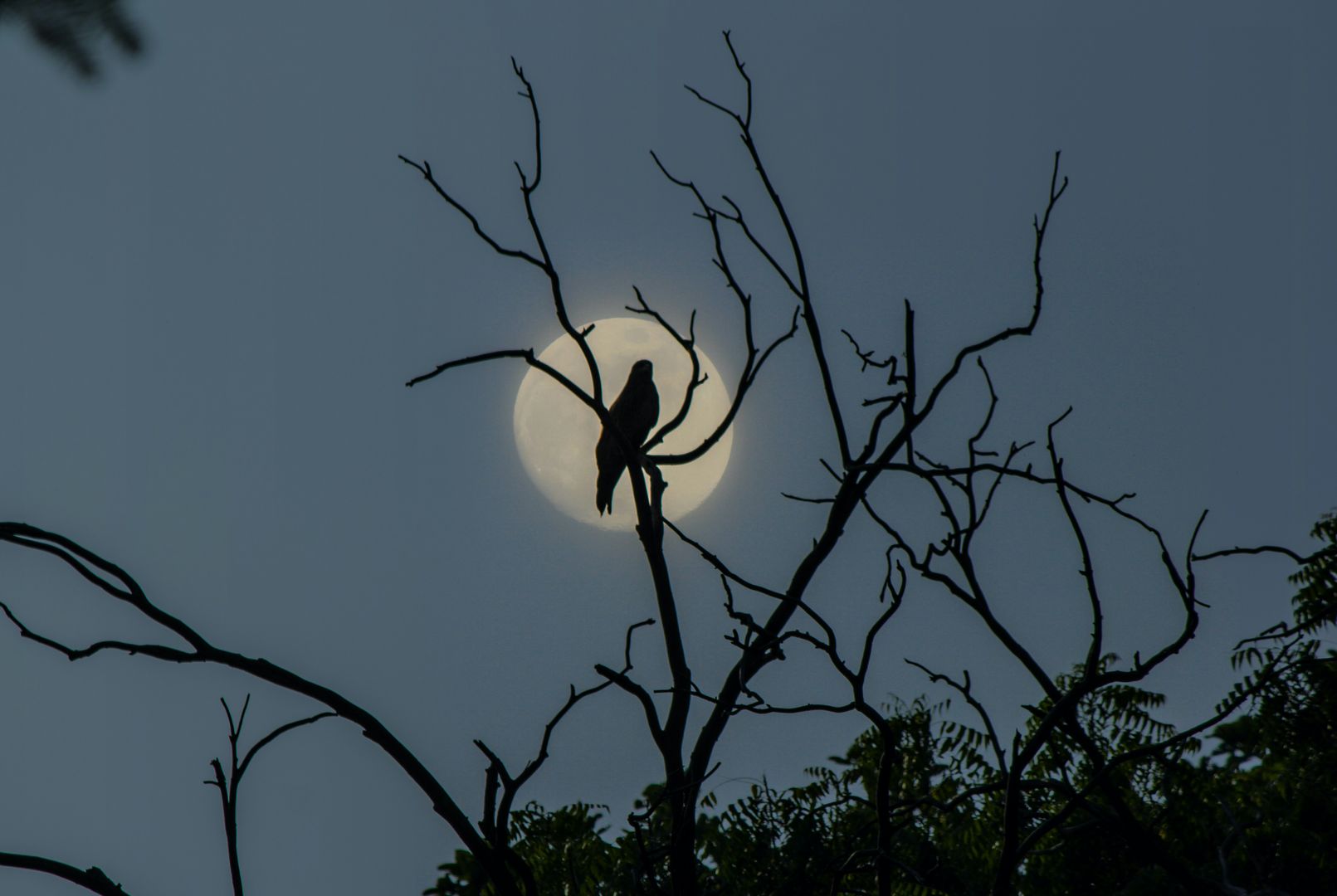
You're lying in bed at 2am. The house is quiet.
Then: something outside.
Not wind. Not a car. Something that sounds like a car alarm being operated by someone who learned cars from watching other car alarms. You now have two options — try to sleep through it, or figure out what that is.
This guide is for the second type of person.
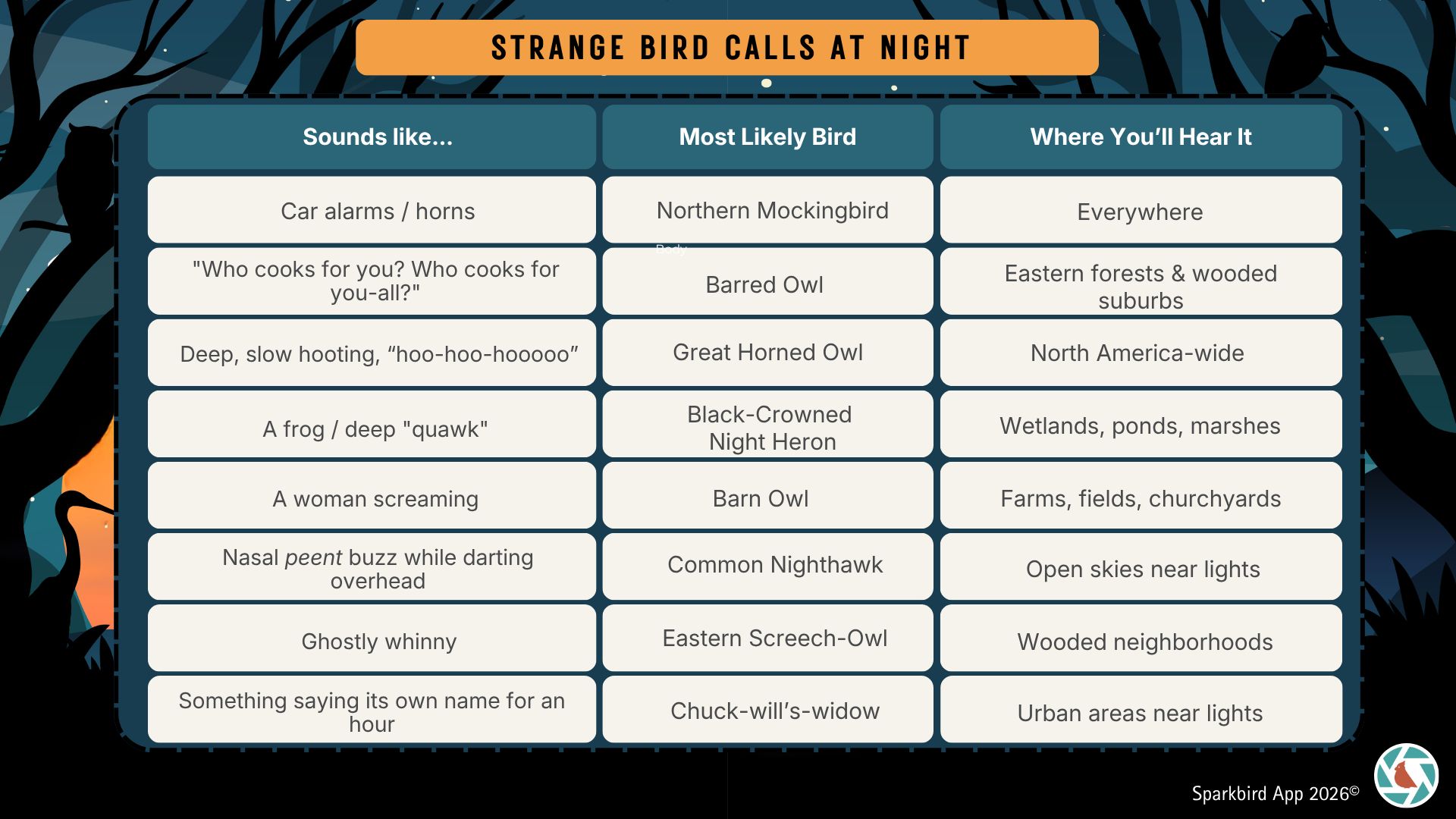
The most common birds that sing at night in North America are the Northern Mockingbird, Great Horned Owl and Eastern Whip-poor-will. Near water, add the Black-Crowned Night-Heron.
If it genuinely sounds like a woman screaming, read on.
Quick ID: What That Sound Might Be
Why Are Birds Singing at Night?
Most birds follow a rhythm set by light. Sing at dawn, stop at dusk. But a surprising number break that rule, and for a variety of reasons.
They're nocturnal. Owls, nightjars, and night-herons evolved to hunt and communicate after dark. These aren't confused day birds. They're actually operating exactly as intended.
They're trying to mate. Unmated male mockingbirds, in particular, will sing through entire nights during breeding season, especially when there's a full moon. The logic: more competition during the day, so sing when rivals are quiet.
Streetlights are confusing them. Robins, thrushes, and other diurnal birds have internal clocks triggered by light.
Studies confirm that light pollution causes these birds to start singing hours early or sing through the night, disrupting their natural cycles, and eventually their health & breeding success.
That cheerful robin song at 1am is less charming when you know it's a symptom of light pollution.

Light pollution is one of the most under-discussed threats to bird welfare
- it disorients migrants
- disrupts breeding timing
- confuses day birds into burning energy they need for survival
Reducing light pollution in your own yard is one of the simplest conservation steps available.
Motion-sensor lights, shielded fixtures, and turning off unnecessary outdoor lighting after midnight are all real contributions.
The 9 Birds (Plus One You Didn't Expect)
1. Northern Mockingbird
Sounds like: A car alarm, a robin, a cardinal, and a sparrow all taking turns.
The Northern Mockingbird is the most likely culprit for any 2am mystery sound in a suburban or urban area. Males can learn and repeat over 200 distinct sounds including other birds, frogs, car alarms, and mechanical noises. They cycle through them in sequences of three or more repetitions before switching to the next.
They sing at night almost exclusively during breeding season, especially on well lit nights. If it's spring or summer, you're near a city, and the sound keeps switching genres every ten seconds, this is your bird.
2. Barred Owl
Sounds like: Someone asking "who cooks for you? Who cooks for you alllll?" with escalating urgency.
The Barred Owl is one of the most vocal owls in North America and remarkably comfortable in forested suburbs and city parks with mature trees. Its classic hooting sequence is memorable enough that once you learn it, you'll never mistake it for anything else.
During mating season, pairs produce duets that degenerate into what sounds like a chaotic argument between two people who have both completely lost the plot. Cornell Lab describes this as "raucous caterwauling."
3. Great Horned Owl
Sounds like: The cinematic owl sound. Deep, resonant, four to five slow hoots.
The Great Horned Owl is the most widespread owl in North America and produces the classic hoo-hoo-hoo-hoooo most people think of when they imagine an owl. It begins calling at dusk as it establishes territory and starts hunting, and continues through the night.
Their range is enormous — forest edges, suburbs, open country, even urban parks. If you're hearing deep, slow hooting, this is the most statistically probable answer.
4. Barn Owl (The One That Sounds Like a Person Screaming)
Sounds like: A long, drawn-out human scream. Genuinely alarming the first time.
Barn Owls do not hoot. They produce a harsh, high-pitched screech that many people interpret as a person in distress. The call lasts one to two seconds and is often repeated.
If you've ever been outside at night and heard something that made you consider calling the police, Barn Owl is high on the suspect list. (The other main candidate is Red Fox, which also screams but usually from ground level with more variation.)
Barn Owls frequent farms, open fields, marshy areas, and old buildings. If you're in a rural or semi-rural area and it sounds like something terrible is happening in a nearby field, it is probably a Barn Owl and everything is fine.
5. Chuck-will's-widow
Sounds like: A four-syllable phrase repeated at steady intervals, endlessly: chuck-WILL's-WID-ow.
The Chuck-will's-widow belongs to the nightjar family. These master camouflage artists are crepuscular hunters that are almost impossible to spot despite being widely distributed. The call is unmistakable once you know it: the bird appears to be announcing itself by name, loudly, for up to an hour at a stretch.
It's the largest North American nightjar and is known for occasionally swallowing small songbirds whole...which feels like relevant context for a bird this committed to announcing its presence.
- Related: 9 Ways to Attract Hummingbirds
6. Common Nighthawk
Sounds like: A nasal, buzzy peent repeated while the bird wheels erratically through the sky, often visible in the air above city lights.
Common Nighthawks aren't hawks and aren't exclusively nocturnal. They're most active at dusk and dawn, hunting flying insects on the wing. Near city lights that attract insects, they'll hunt well into the night.
The diving display males perform during breeding season produces a deep booming sound as air rushes through their wingtips — one of the stranger sounds in North American birding, and distinctive once heard.
7. Common Poorwill
Sounds like: A soft, hollow poor-will repeated at intervals, the smallest and quietest of the nightjars.
The Common Poorwill holds a unique distinction among North American birds: it's the only species known to enter true prolonged torpor, a hibernation-like state where its temperature drops and metabolism slows dramatically to survive cold snaps. The Hopi people called it Holchko, "the sleeping one."
The call is easy to miss. Quieter than Chuck-will's-widow and less insistent than a mockingbird. It's a western species found from the Great Plains into the Pacific states.
8. American Robin
Sounds like: A rich, melodic cheerily-cheer-up-cheerio, at midnight.
Robins are not nocturnal. They're confusing themselves. Urban robins near streetlights and lit windows often sing through the night because their internal clocks respond to artificial light as if it were dawn. The result is a genuinely lovely song at deeply inconvenient hours.
It's a small but concrete reminder of the effect light pollution has on bird behavior. And one of the easier-to-observe examples if you live near sodium streetlights.
9. Black-Crowned Night-Heron
Sounds like: A short, abrupt quawk, somewhere between a frog and a crow. Often heard from ponds and marshes at dusk.
Black-Crowned Night-Herons are stocky, short-necked herons that roost in trees during the day and become active at dusk. Their flight call — that sudden, startling quawk — is frequently heard near urban ponds, golf course water features, and city parks with water.
If you're walking near water at dusk and something gives you a sharp, unexpected bark from the reeds, this is almost certainly it.
When It's Probably Not a Bird
Before you confidently ID something as a bird, consider the alternatives:
Red Fox: Produces a high, piercing scream that sounds remarkably like a person in distress. Often heard in late winter during mating season. Fox screams come from ground level and are often followed by barking or other fox vocalizations.
Tree Frogs and Spring Peepers: Chorus frogs can produce enormous volumes of high-pitched calls that easily pass for a wall of baby birds. If the sound is coming from near water and involves hundreds of voices at once, frogs are the likely answer.
Flying Squirrels: Thin, high-pitched cheeps and soft chattering from trunks and nest boxes. Less alarming but easy to mistake for a small bird.
The fastest way to settle the question is to record it. Even a twenty-second phone recording gives you something to compare against.
How to Figure Out What You Heard
Will Battel started Sparkbird in 2018 with the same "what is that?" that most birders start with. Night sounds especially, because you can't see anything and the acoustic deception of still night air makes everything sound closer and stranger than it is.
The Cornell Lab's Merlin app has a Sound ID feature that identifies birds from audio in real time. Open it, hold your phone toward the sound, and it will give you a list of likely matches based on what it hears and your location.
The Sparkbird app is where you log the sighting once you've made the ID, build your life list, and find other birders who've heard the same thing in your area. Hearing something strange at 2am is considerably more satisfying when you can tell someone what it was!
FAQ
What bird sounds like a car alarm at night?
Almost certainly the Northern Mockingbird.
Why is a bird singing at 3am?
It's either breeding season, or an urban bird confused by artificial light.
Are birds singing at night a good sign?
Yes & no. Owls calling at night is generally a sign of a healthy local ecosystem. Mockingbirds are so adaptable they'll sing anywhere. Diurnal birds like robins, though, no. That's a light pollution issue.
Still not sure what that sound is?
The birding community genuinely enjoys a 2 am mystery sound!
The above article may include sponsored content or product affiliate links for which Sparkbird may earn a commission.

No comments yet.