
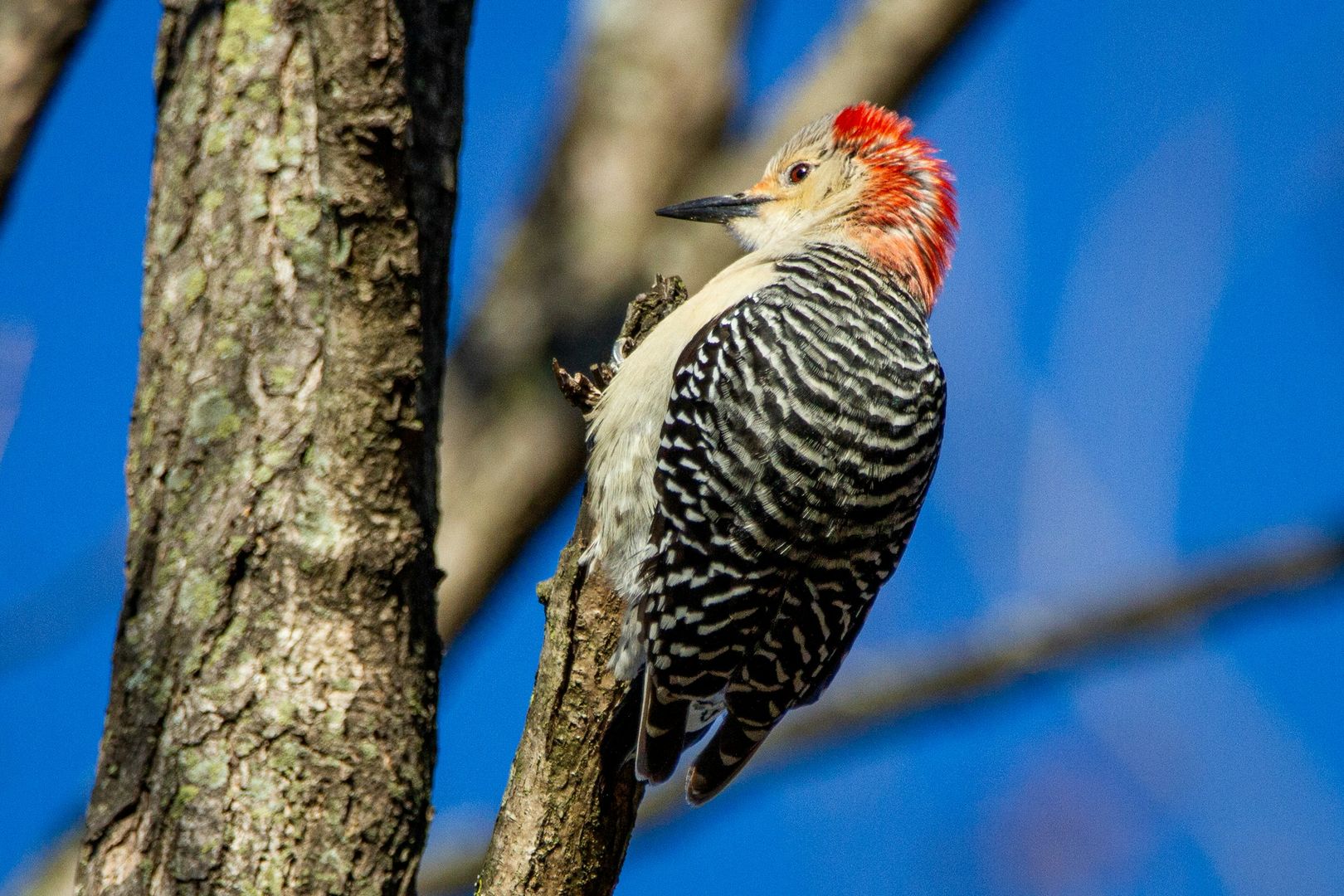
Delaware's official state bird is a chicken, which is either a deeply humble choice or a bold flex. Either way, it's not one of the winter birds in Delaware you'll be ticking off at the feeder.
Delaware winters are usually more slush than snowpack, so this isn't a story about a few tough birds toughing it out. It's about who shows up.
Types of Winter Birds in Delaware
There are 3 types of winter birds in Delaware you'll see on this list:
- Resident Delaware Birds – found year-round, and many of them visit feeders
- Winter Migrants / Visitors – birds that breed farther north and spend the winter here. The headliners gather at Bombay Hook National Wildlife Refuge near Smyrna and Prime Hook National Wildlife Refuge near Milton
- Irruptive Species – birds that show up in big numbers some winters and barely at all in others, usually when seed and cone crops fail up north
Each entry covers ID, male vs female, calls, where to find the bird in Delaware, and its feeder favorites if it visits feeders. If you're wondering where the summer crowd went, here's where birds go in the winter.
1. Northern Cardinal
- Family – Cardinalidae
- Species – Cardinalis cardinalis
- Primary Activity Time – Dawn and Dusk
- Diurnal
- Resident Delaware Bird
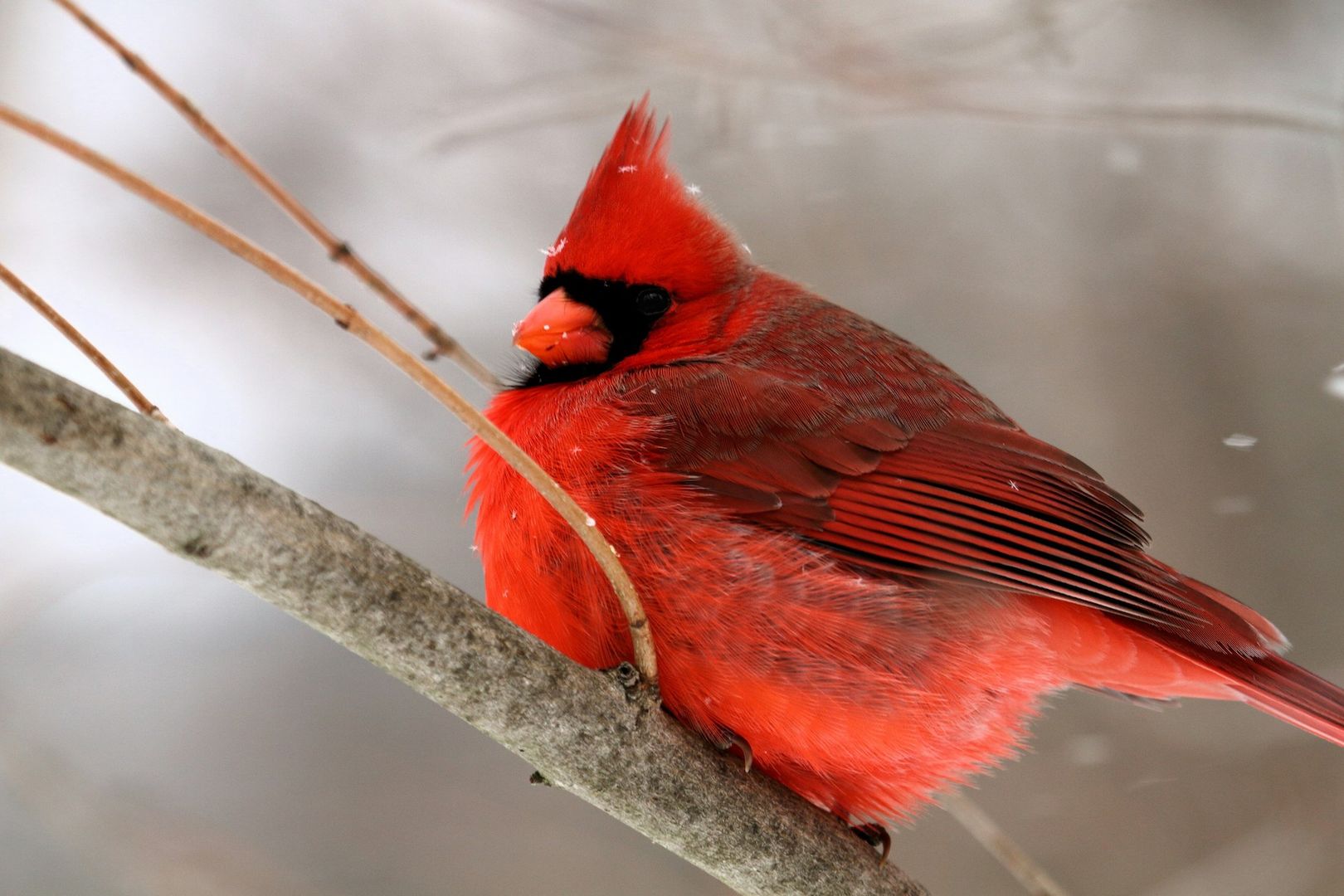
If you only see one bird at a Delaware feeder this winter, it's probably this one. The Northern Cardinal was the number one bird in Project FeederWatch's Mid-Atlantic rankings, turning up at more than 98 percent of reporting feeders. It eats seeds, fruit, and insects, and in winter it leans on sunflower, safflower, and whatever's left on the holly.
Males are bright red with a black face and a thick orange-red bill. Females are a warm tan-brown with reddish tinges on the crest, wings, and tail, plus the same orange bill. Both raise and lower the crest depending on their mood, which is more emotional transparency than I manage before coffee.
The song is a series of loud, clear whistles, often written as birdie-birdie-birdie or cheer-cheer-cheer, and the call is a sharp metallic chip. Females sing too.
Cardinals live statewide, from Wilmington backyards to hedgerows in Sussex County farm country, wherever there's thick cover nearby. For more on keeping them around, read cardinals in winter: where they go, what they eat, and how to attract them.
Feeder favorites: black oil sunflower, safflower, cracked corn on a platform
2. Carolina Chickadee
- Family – Paridae
- Species – Poecile carolinensis
- Primary Activity Time – Daytime
- Diurnal
- Resident Delaware Bird
The Carolina Chickadee is Delaware's everyday chickadee, the small, round bird that grabs one sunflower seed, flies off to a branch, and hammers it open before coming back for another. It also stashes seeds in bark crevices to eat later, which is a better winter meal-prep plan than mine.
It has a black cap and bib, white cheeks, and a soft gray back. It looks a lot like the Black-capped Chickadee to the north, but the Carolina is a little smaller with a neater edge to its bib. Males and females look alike.
The call is the namesake chick-a-dee-dee-dee, faster and higher than the Black-capped version, and the song is a four-note whistle that sounds like fee-bee-fee-bay.
Look for it statewide in woods, parks, and yards with trees, often leading a small mixed flock of titmice, nuthatches, and woodpeckers.
Feeder favorites: black oil sunflower, suet, shelled peanuts
3. Tufted Titmouse
- Family – Paridae
- Species – Baeolophus bicolor
- Primary Activity Time – Daytime
- Diurnal
- Resident Delaware Bird
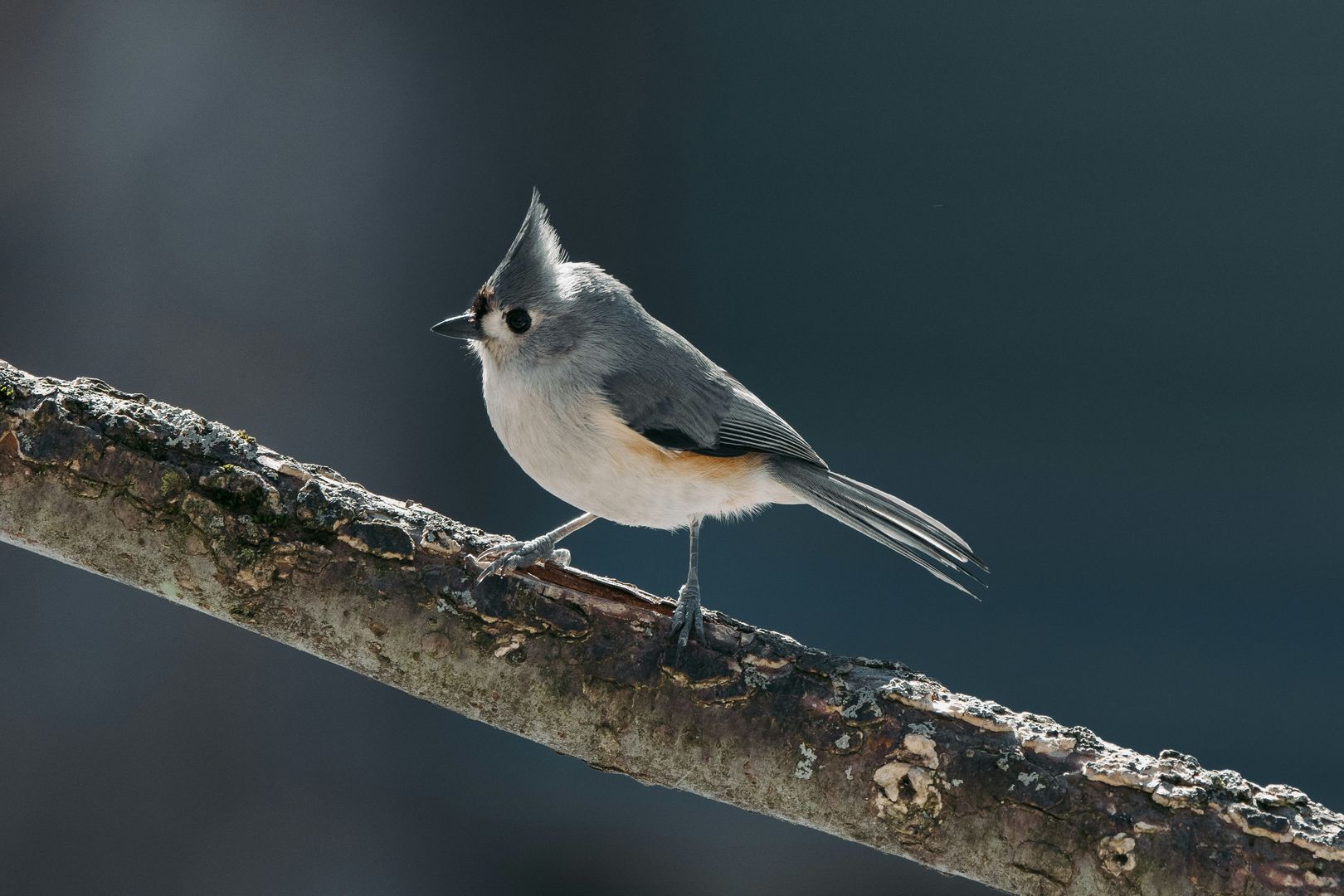
The Tufted Titmouse is the chickadee's crested sidekick, and the two are often seen together moving through bare winter trees. It eats insects, seeds, and nuts, and it's bold enough to grab a seed at the feeder while you're still standing nearby refilling it.
It's soft gray above with a pale belly, rusty flanks, big black eyes, and a pointed gray crest. Males and females look alike.
The song is a loud, clear peter-peter-peter, which you'll start hearing on mild days in late winter. Its calls are raspy and scolding, a bit like a chickadee with a sore throat.
Titmice are common statewide in deciduous woods and neighborhoods with mature trees, including the trails at White Clay Creek State Park and Brandywine Creek State Park in the north.
Feeder favorites: black oil sunflower, peanuts, suet
4. Carolina Wren
- Family – Troglodytidae
- Species – Thryothorus ludovicianus
- Primary Activity Time – Daytime
- Diurnal
- Resident Delaware Bird
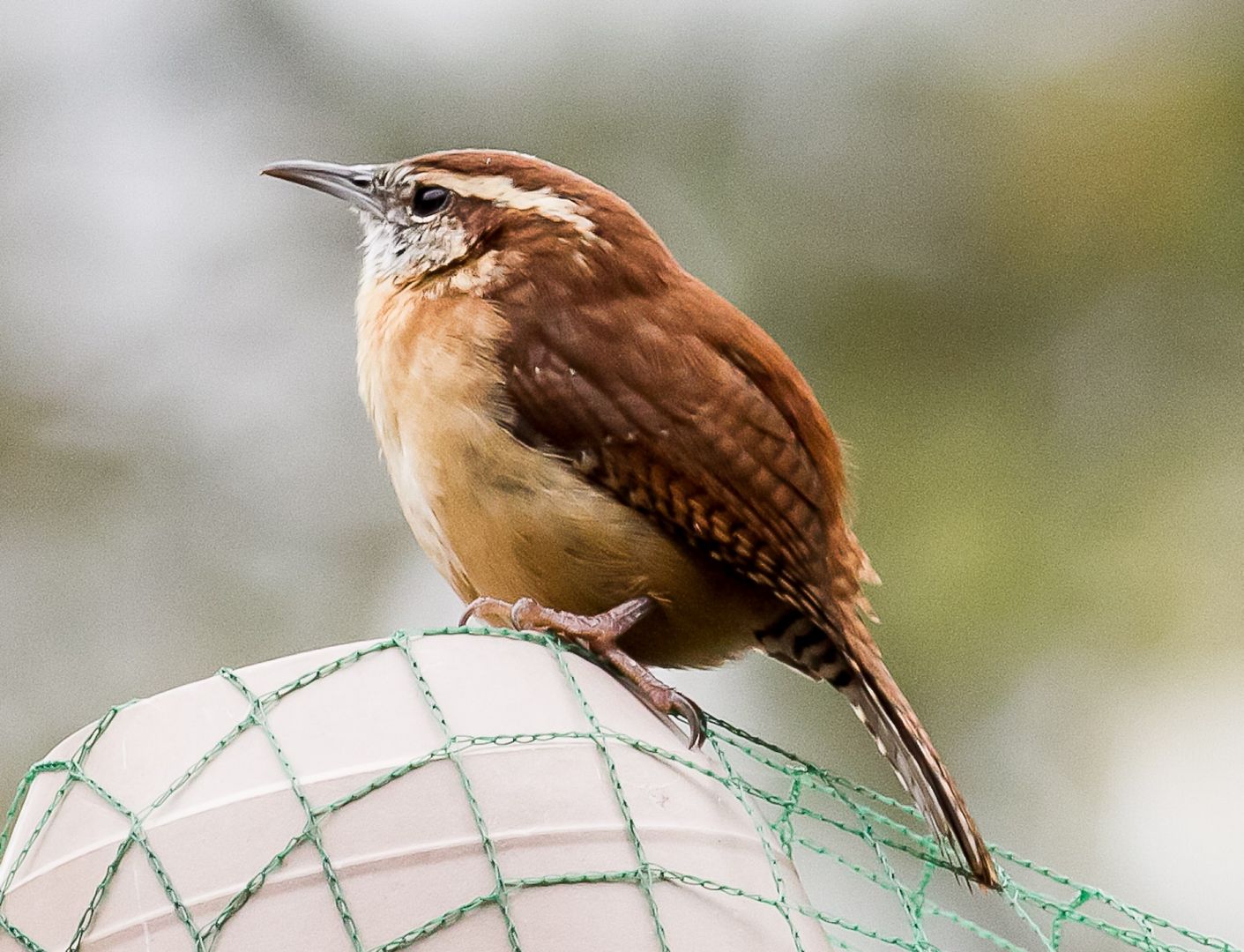
The Carolina Wren is a small, loud, rusty-brown bird that seems to think it's three times its actual size (relatable). It pokes through brush piles, woodpiles, and garage corners for insects and spiders, and in winter it will come to suet.
It's warm brown above and buffy below, with a long white eyebrow stripe and a tail it often cocks upward. Males and females look alike, and pairs stay together year-round.
Only the male sings, and his song is a ringing teakettle-teakettle-teakettle that carries a surprising distance. The female answers with a harsh chatter.
Carolina Wrens live statewide in thickets, overgrown yards, and woodland edges. A brush pile in the corner of the yard is basically an open invitation.
Feeder favorites: suet, mealworms, peanut pieces
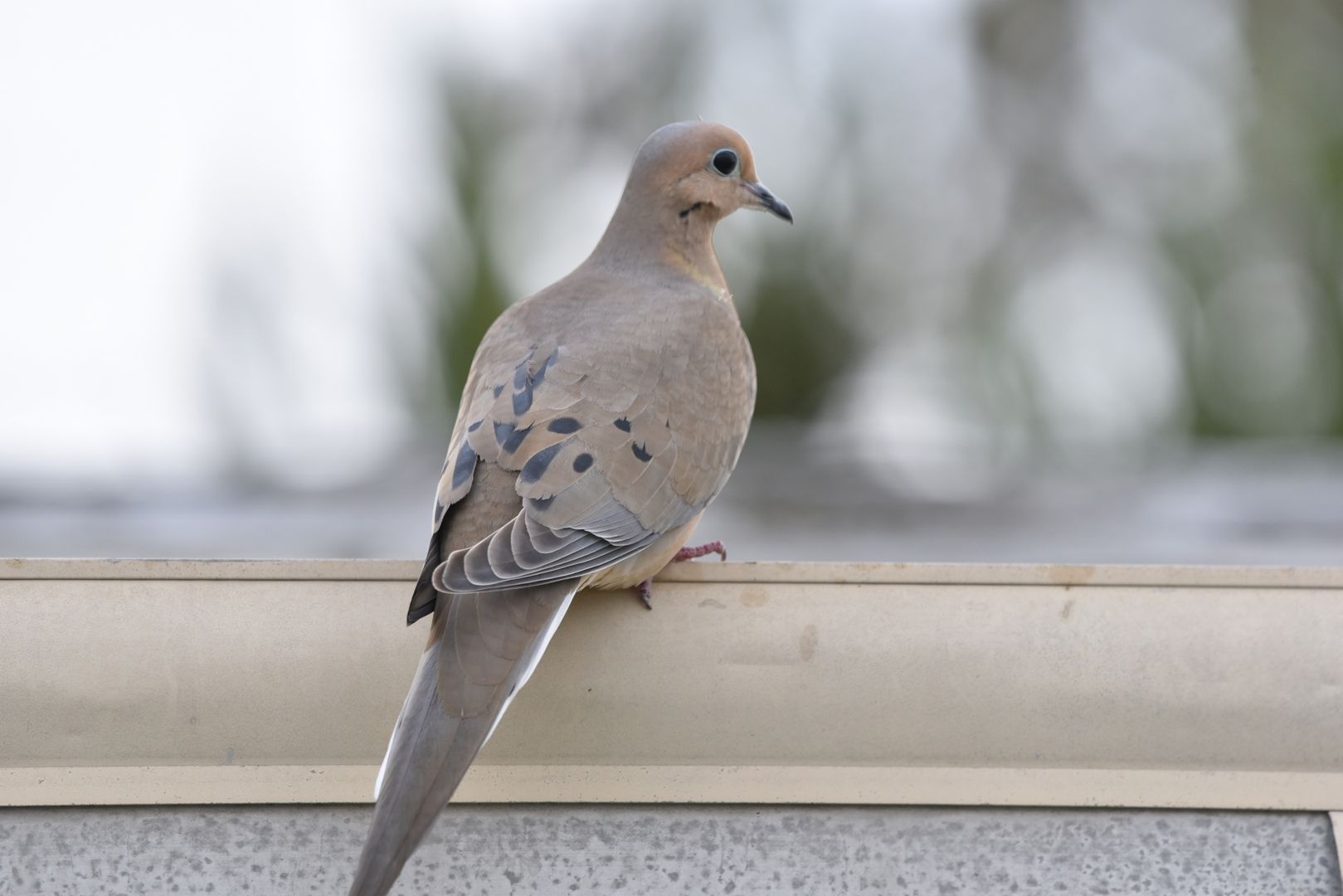
5. Mourning Dove
- Family – Columbidae
- Species – Zenaida macroura
- Primary Activity Time – Daytime
- Diurnal
- Resident Delaware Bird
The Mourning Dove is a ground-feeding seed eater that fills its crop fast, then perches somewhere sunny to digest. In winter, doves often gather in loose flocks under feeders and along the edges of farm fields.
It's slim and soft tan-gray with black spots on the wings and a long, pointed tail edged in white. Males have a faint pinkish breast and a bluish-gray crown, while females are a little browner overall.
The call is a mournful coo-OO-oo-oo-oo that people often mistake for an owl. Their wings also give a sharp whistle when they take off.
Mourning Doves are common across all three counties, especially in the farm country of Kent and Sussex.
Feeder favorites: millet, cracked corn, black oil sunflower on a platform or the ground
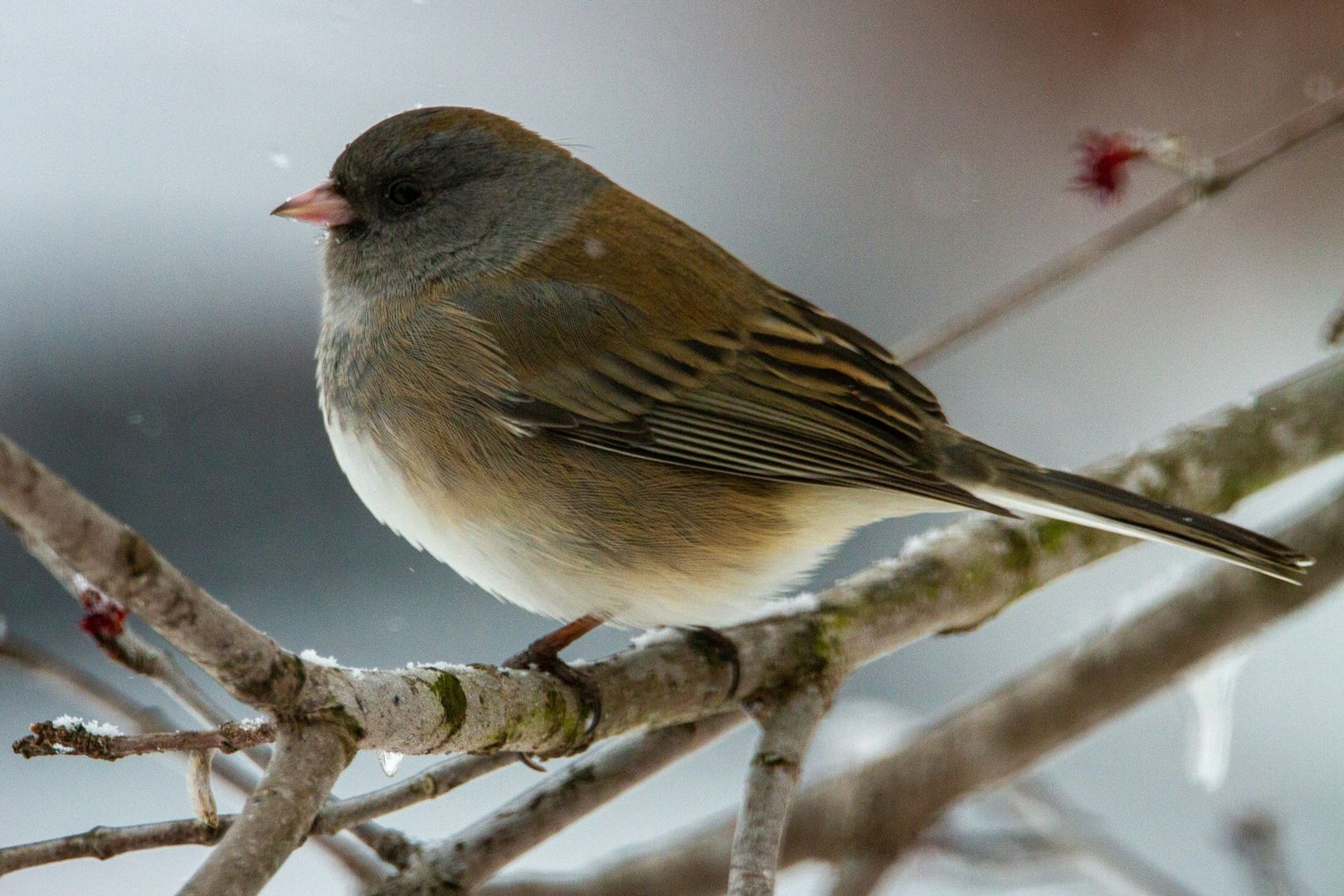
6. Dark-eyed Junco
- Family – Passerellidae
- Species – Junco hyemalis
- Primary Activity Time – Daytime
- Diurnal
- Winter Migrant / Visitor
The Dark-eyed Junco is Delaware's best-known winter arrival. Juncos breed farther north and in the mountains, then turn up in fall to spend the cold months hopping around under feeders. In FeederWatch's Mid-Atlantic list, juncos ranked third, showing up at about 96 percent of reporting sites.
Delaware's juncos are the "slate-colored" type: gray above with a white belly and a pale pink bill. Males are a darker, cleaner slate, while females are paler gray with a brownish wash. Both flash white outer tail feathers when they fly.
The call is a sharp tick or smack, and the song is a quick, musical trill.
Look for small flocks on the ground in yards, woodland edges, and brushy fields statewide from fall through early spring.
Feeder favorites: millet, cracked corn, sunflower chips scattered on the ground
7. White-throated Sparrow
- Family – Passerellidae
- Species – Zonotrichia albicollis
- Primary Activity Time – Daytime
- Diurnal
- Winter Migrant / Visitor
The White-throated Sparrow is the classic winter sparrow under Delaware's shrubs and feeders. It breeds in the northern forests, arrives in fall, and spends the winter scratching through leaf litter with a two-footed backward hop.
It has a crisp white throat, yellow spots between the eye and bill, and a striped head. The stripes come in two forms, white and black or tan and brown, and both males and females can be either one, so the head pattern doesn't tell you the bird's sex.
The song is a thin, whistled oh-sweet-Canada-Canada-Canada, and the call is a sharp pink. They sing on mild winter days, so you may hear it in January.
White-throated Sparrows are common statewide in thickets, hedgerows, and yards with brush. Leave a few leaves under the shrubs and they'll thank you for it.
Feeder favorites: millet, sunflower chips, cracked corn on the ground
8. Song Sparrow
- Family – Passerellidae
- Species – Melospiza melodia
- Primary Activity Time – Daytime
- Diurnal
- Resident Delaware Bird
The Song Sparrow is the streaky brown sparrow that's here all year, and in winter its numbers are topped up by birds from farther north. It eats seeds and insects and forages low in brush, marsh edges, and weedy fields.
It's brown and gray with heavy streaks on the breast that often meet in a dark central spot, plus a long, rounded tail it pumps in flight. Males and females look alike.
The call is a husky chimp, and the song starts with a few clear notes and then tumbles into a jumble of trills. Males start tuning up again in late winter.
Song Sparrows are found statewide, from suburban hedges to the edges of salt marsh along Delaware Bay.
Feeder favorites: millet, cracked corn, sunflower chips on the ground
9. Red-bellied Woodpecker
- Family – Picidae
- Species – Melanerpes carolinus
- Primary Activity Time – Daytime
- Diurnal
- Resident Delaware Bird
The Red-bellied Woodpecker is named for a field mark you'll almost never see, which is very on brand for bird names. It eats insects, nuts, seeds, and fruit, and in winter it's a regular at suet and peanut feeders.
The red you'll actually notice is on the head. Males have red from the bill all the way over the crown to the nape, while females have red only on the nape. Both have a black-and-white barred back and a pale belly with a faint reddish wash.
The call is a rolling kwirr or churr, one of the most common sounds in Delaware's winter woods.
Red-bellied Woodpeckers are common statewide in woods, parks, and neighborhoods with mature trees.
Feeder favorites: suet, peanuts, black oil sunflower
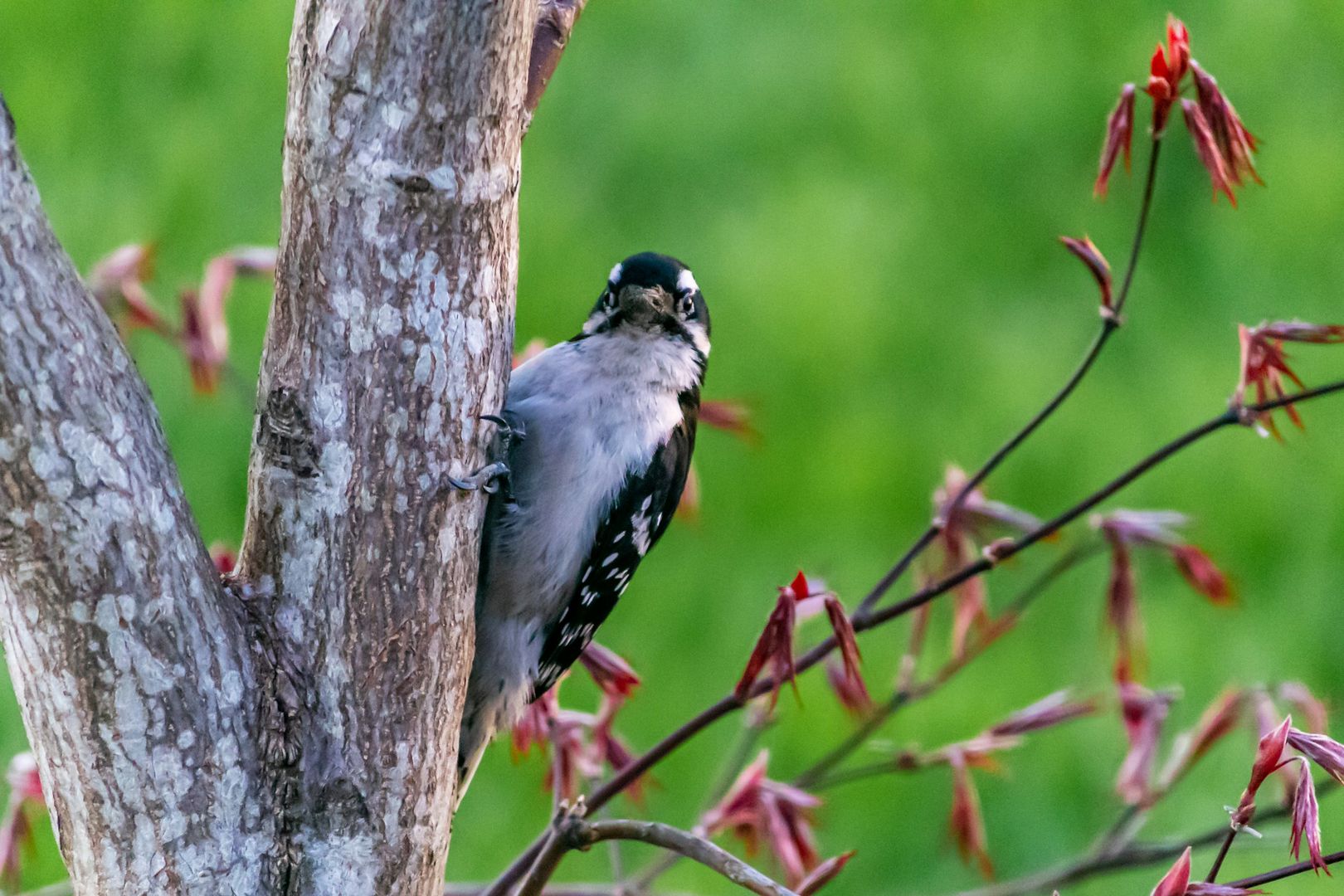
10. Downy Woodpecker
- Family – Picidae
- Species – Dryobates pubescens
- Primary Activity Time – Daytime
- Diurnal
- Resident Delaware Bird
The Downy Woodpecker is the smallest woodpecker in North America and probably the most common one at Delaware feeders. It's light enough to forage on thin twigs and even weed stems, picking out insects and larvae that bigger woodpeckers can't reach.
It's black and white with a white back, a spotted wing pattern, and a short bill. Males have a small red patch on the back of the head, and females don't.
The call is a soft pik, and it also gives a high, descending whinny.
Downies are found statewide in woods, yards, and parks, and they often travel with chickadees and titmice in winter.
Feeder favorites: suet, black oil sunflower, peanuts
11. Northern Flicker
- Family – Picidae
- Species – Colaptes auratus
- Primary Activity Time – Daytime
- Diurnal
- Resident Delaware Bird & Winter Migrant
The Northern Flicker is the woodpecker that would rather be on the ground. Ants are its main food, and in winter it switches over to more fruit and seeds. Some flickers stay in Delaware year-round, and others arrive from farther north for the winter.
It's brown with black bars on the back, a black crescent on the chest, and a spotted belly. In flight, Eastern birds flash yellow under the wings and tail and a bright white rump. Males have a black "mustache" stripe, and females don't.
The call is a loud, ringing kyeer and a long wick-wick-wick-wick series.
Look for flickers in open woods, parks, and lawns statewide, often flushing up from the grass in a flash of yellow.
Feeder favorites: suet, peanuts
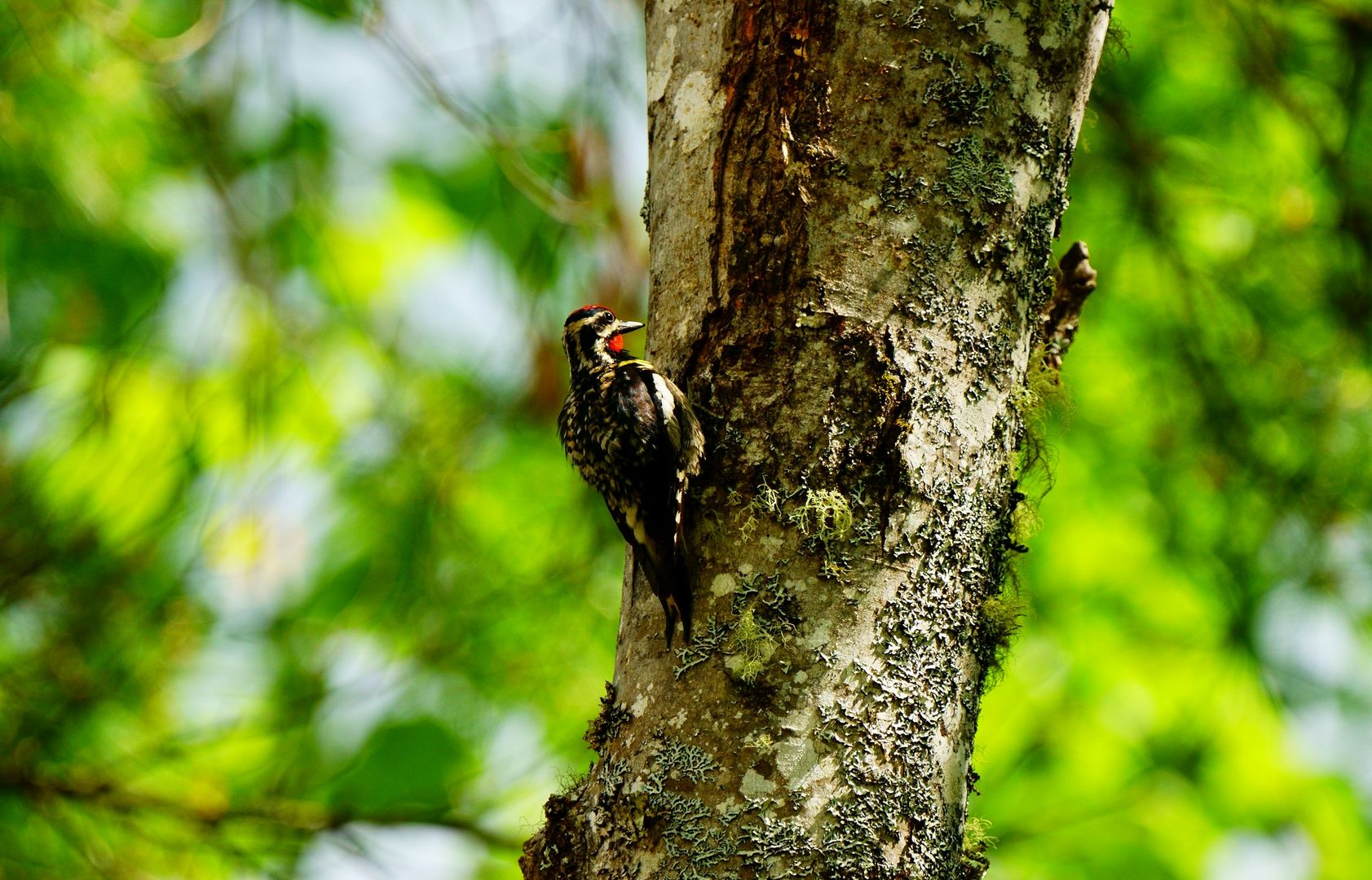
12. Yellow-bellied Sapsucker
- Family – Picidae
- Species – Sphyrapicus varius
- Primary Activity Time – Daytime
- Diurnal
- Winter Migrant / Visitor
The Yellow-bellied Sapsucker is a woodpecker that drills neat rows of small holes in tree bark, then comes back to drink the sap and eat the insects it attracts. If you've seen tidy horizontal lines of holes on a tree trunk, a sapsucker has been running a tab there.
It's black and white with a red forehead and a long white stripe on the folded wing. Males have a red throat, while females have a white throat. The "yellow belly" is a pale wash that's easy to miss.
Its call is a nasal, catlike mew, and its drumming is uneven, like someone tapping out a slowing rhythm.
Sapsuckers spend the winter in Delaware's woods, parks, and yards with mature trees, though they're quieter and less obvious than the resident woodpeckers.
Feeder favorites: suet
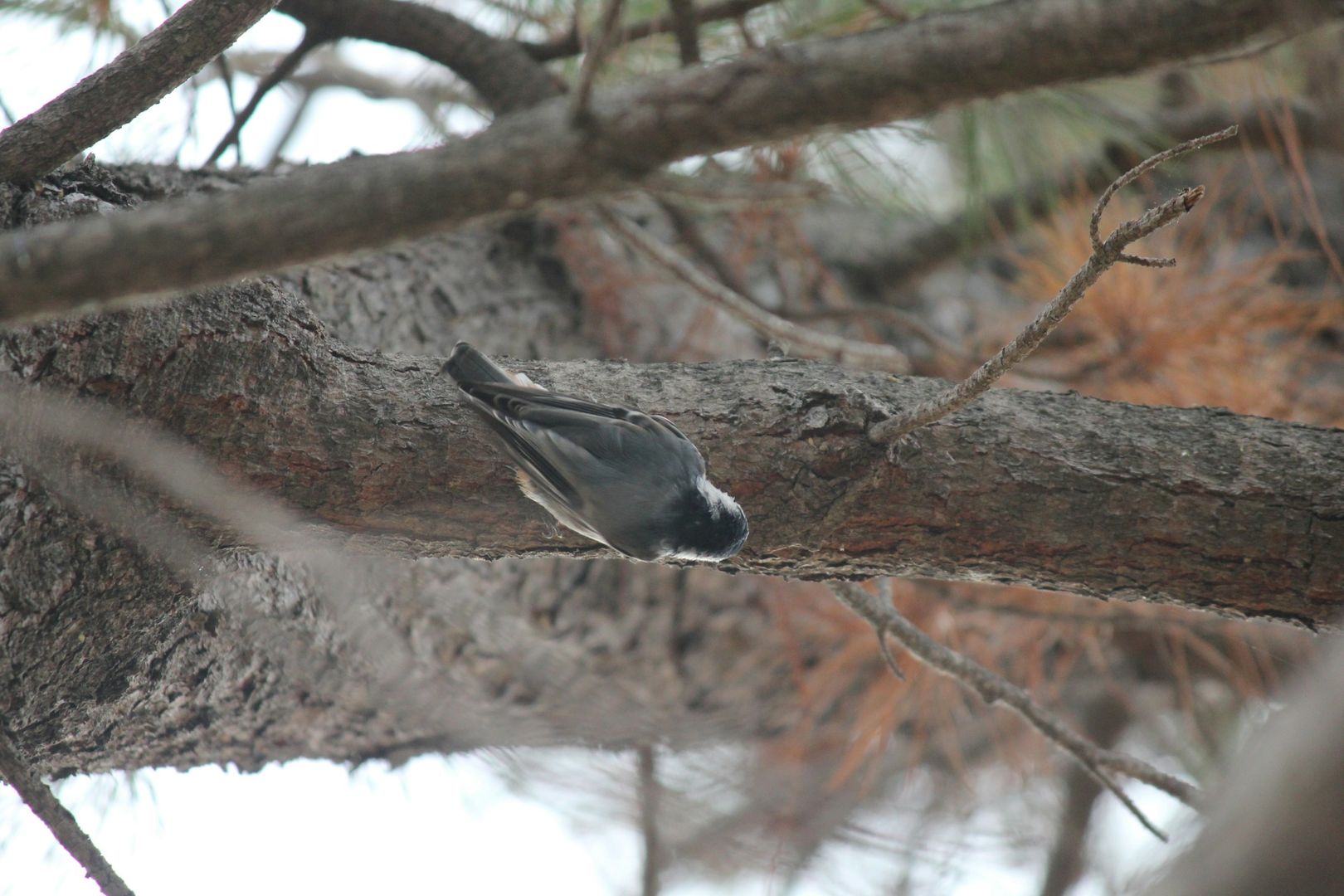
13. White-breasted Nuthatch
- Family – Sittidae
- Species – Sitta carolinensis
- Primary Activity Time – Daytime
- Diurnal
- Resident Delaware Bird
The White-breasted Nuthatch climbs down tree trunks headfirst, which gives it a view of bark crevices that other birds miss. It wedges seeds and nuts into bark and hammers them open, which is where the "nuthatch" name comes from.
It's blue-gray above with a white face and breast and a chestnut wash under the tail. Males have a glossy black cap, while females usually have a grayer one.
The call is a nasal yank or quank, often repeated as it works its way around a trunk.
White-breasted Nuthatches are common in mature deciduous woods and neighborhoods statewide, especially in the wooded north around Wilmington and Newark.
Feeder favorites: black oil sunflower, peanuts, suet
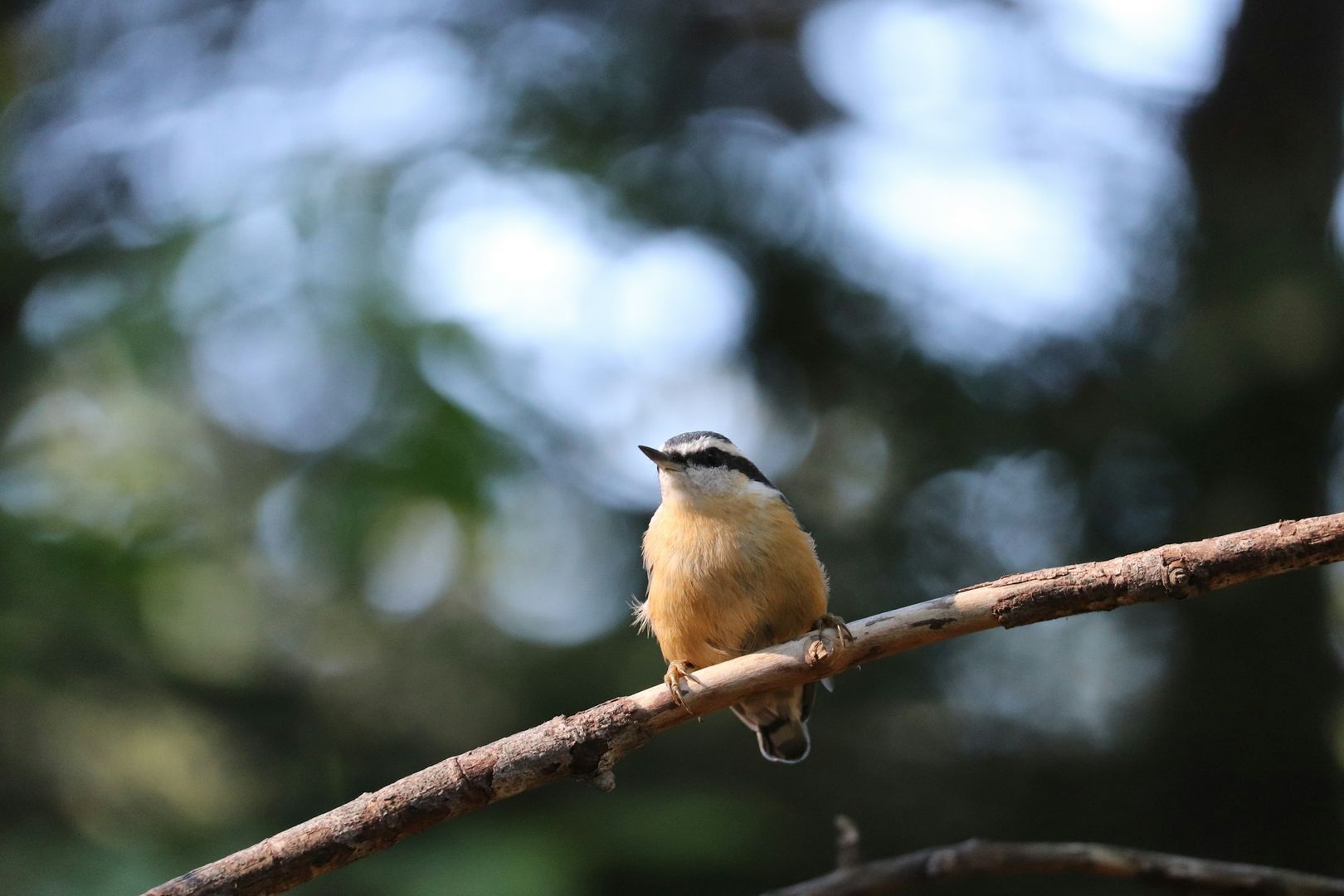
14. Red-breasted Nuthatch
- Family – Sittidae
- Species – Sitta canadensis
- Primary Activity Time – Daytime
- Diurnal
- Irruptive Species (uncommon most winters)
The Red-breasted Nuthatch is a tiny conifer specialist that comes south in big numbers only when the cone crop fails up north. Some winters Delaware feeders get a steady stream of them, and other winters you won't see one at all.
It's blue-gray above with a rusty-orange breast, a black eye line, and a white eyebrow. Males have a black cap and richer color below, while females have a duller gray cap and paler underparts.
The call is a high, nasal yank-yank, like a toy horn that's running low on batteries.
When they're around, look for them in pines and other conifers statewide, including the loblolly pine woods of southern Delaware, and at feeders near evergreens.
Feeder favorites: suet, shelled peanuts, black oil sunflower
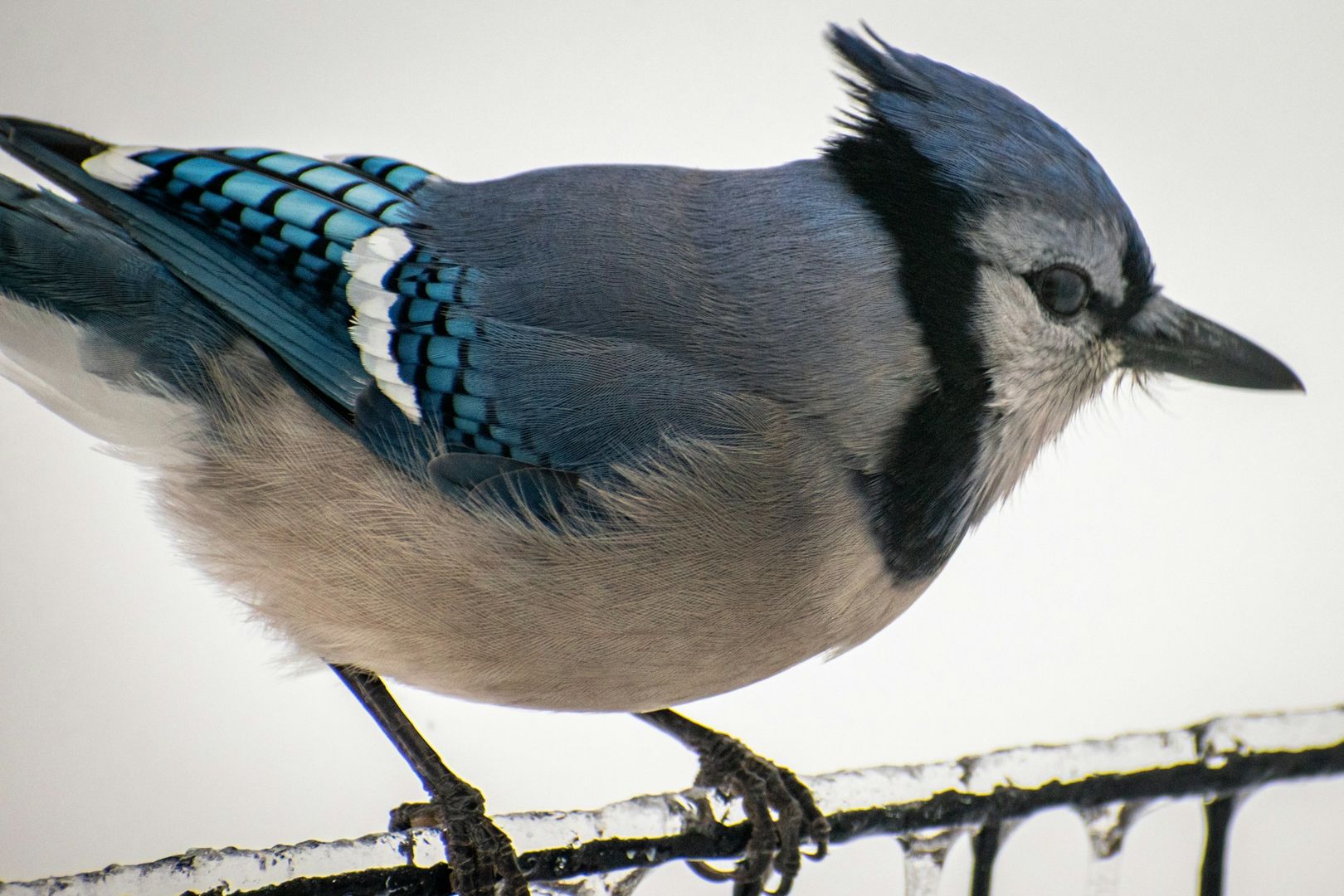
15. Blue Jay
- Family – Corvidae
- Species – Cyanocitta cristata
- Primary Activity Time – Daytime
- Diurnal
- Resident Delaware Bird
The Blue Jay is loud, smart, and not shy about announcing itself. It eats acorns, seeds, insects, and fruit, and it caches acorns in fall, which helps plant oak trees across the landscape.
It's bright blue above with a crest, white underparts, and a black necklace. Males and females look alike, though males average slightly larger.
The call is a loud jay-jay, but Blue Jays also give soft whistles, rattles, and a surprisingly good Red-shouldered Hawk impression.
Blue Jays are found statewide in woods and neighborhoods, especially near oaks.
Feeder favorites: peanuts in the shell, black oil sunflower, suet
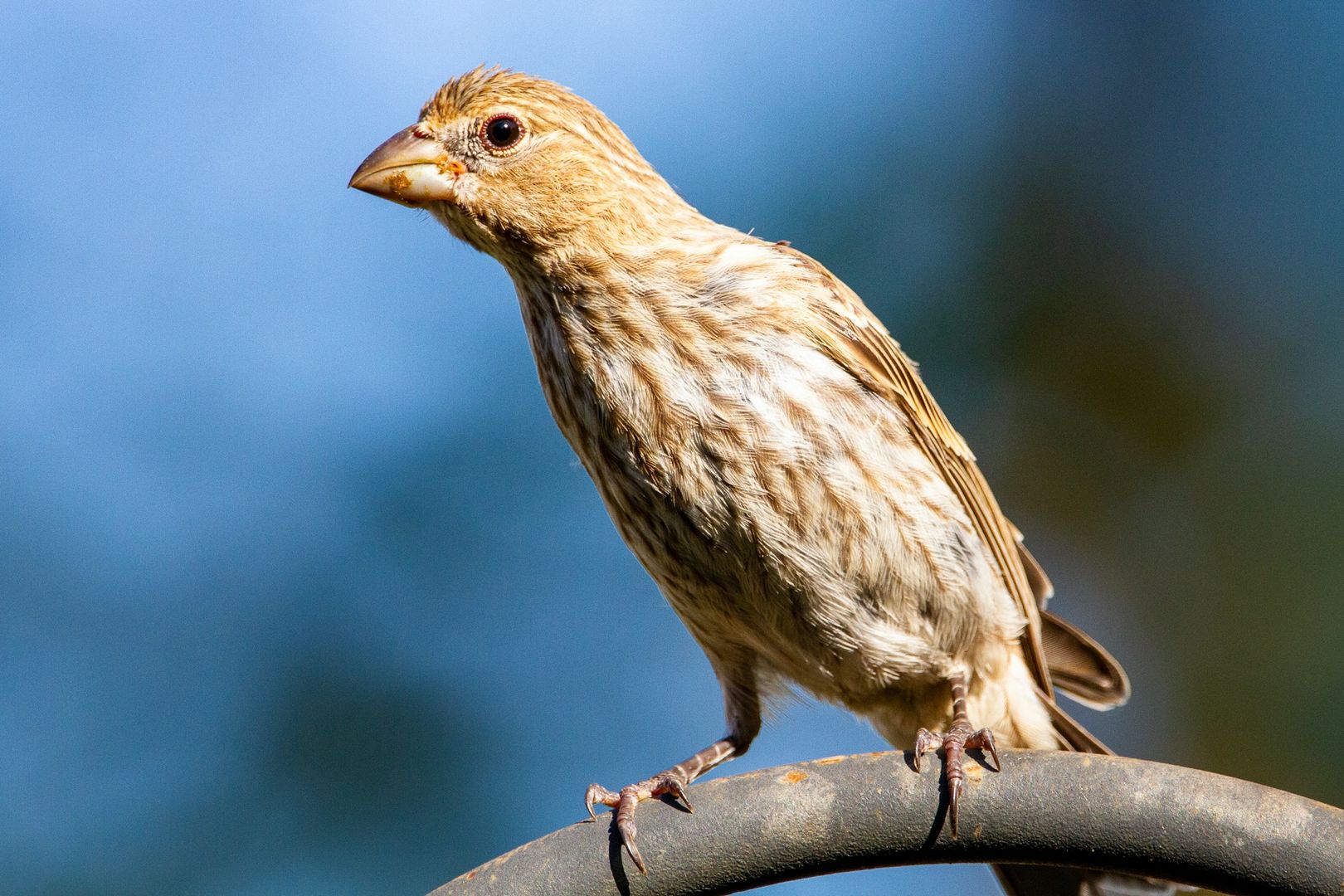
16. House Finch
- Family – Fringillidae
- Species – Haemorhous mexicanus
- Primary Activity Time – Daytime
- Diurnal
- Resident Delaware Bird
The House Finch is a social seed eater that's now common across Delaware's towns and suburbs. It travels in small, chattering flocks and is happy to camp out on a tube feeder for most of the morning.
Males have a rosy-red head, breast, and rump with brown streaks on the belly and flanks. Females are plain gray-brown with blurry streaks and no strong face pattern.
The song is a long, lively warble that often ends on a buzzy note, and the call is a short cheep.
House Finches are common around homes, farms, and towns statewide.
Feeder favorites: black oil sunflower, sunflower chips, nyjer
17. American Goldfinch
- Family – Fringillidae
- Species – Spinus tristis
- Primary Activity Time – Daytime
- Diurnal
- Resident Delaware Bird
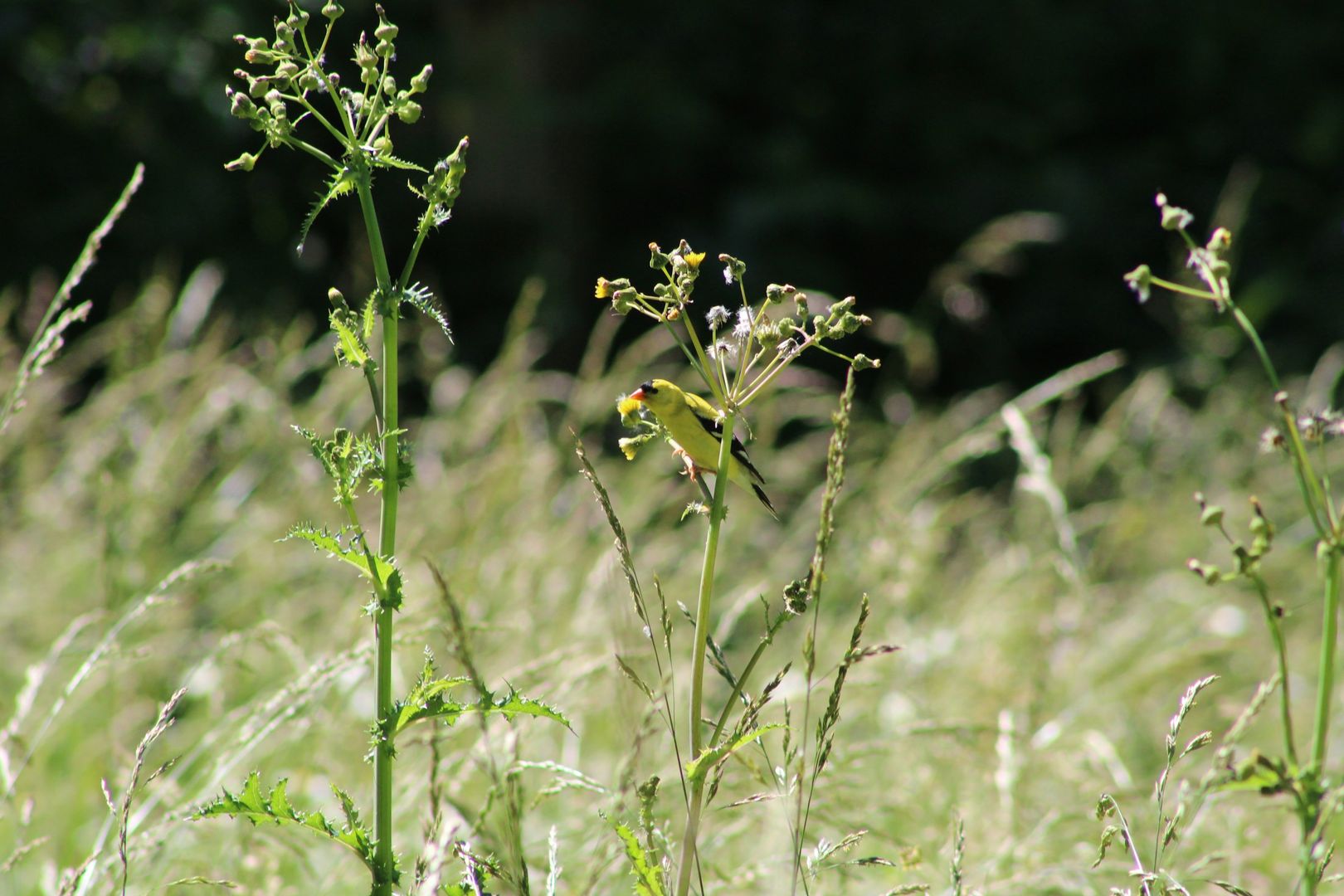
The American Goldfinch spends winter in what's essentially its sweatpants era. The bright summer yellow molts out by fall, leaving a soft olive-brown coat that blends right in with dry seedheads.
In winter, males keep some yellow on the face and throat and have jet-black wings with white bars. Females are duller and grayer with brownish wings. Both have a small, pale, cone-shaped bill.
The flight call is a bouncy po-ta-to-chip, given as the birds dip up and down in the air.
Goldfinches are found statewide in weedy fields, woodland edges, and yards with tube feeders.
Feeder favorites: nyjer, sunflower chips, black oil sunflower
18. Purple Finch
- Family – Fringillidae
- Species – Haemorhous purpureus
- Primary Activity Time – Daytime
- Diurnal
- Irruptive Species (uncommon winter visitor)
The Purple Finch is an irregular winter visitor that comes down from Canada and the northern forests in some years and skips Delaware in others. It made the bottom of FeederWatch's Mid-Atlantic top 25, so it's a real possibility at feeders, just not a guarantee.
Males look like they were dipped head-first in raspberry juice, with the color washing over the head, back, and breast and no heavy brown streaks on the belly. Females are brown and white with a bold pale eyebrow, a dark cheek, and crisp streaks, which is the easiest way to tell them from female House Finches.
The call is a sharp pik or tuck in flight, and the song is a fast, rich warble.
When they're around, look for them at feeders near woods and in mixed forests statewide.
Feeder favorites: black oil sunflower, sunflower chips
19. Pine Siskin
- Family – Fringillidae
- Species – Spinus pinus
- Primary Activity Time – Daytime
- Diurnal
- Irruptive Species (absent some winters)
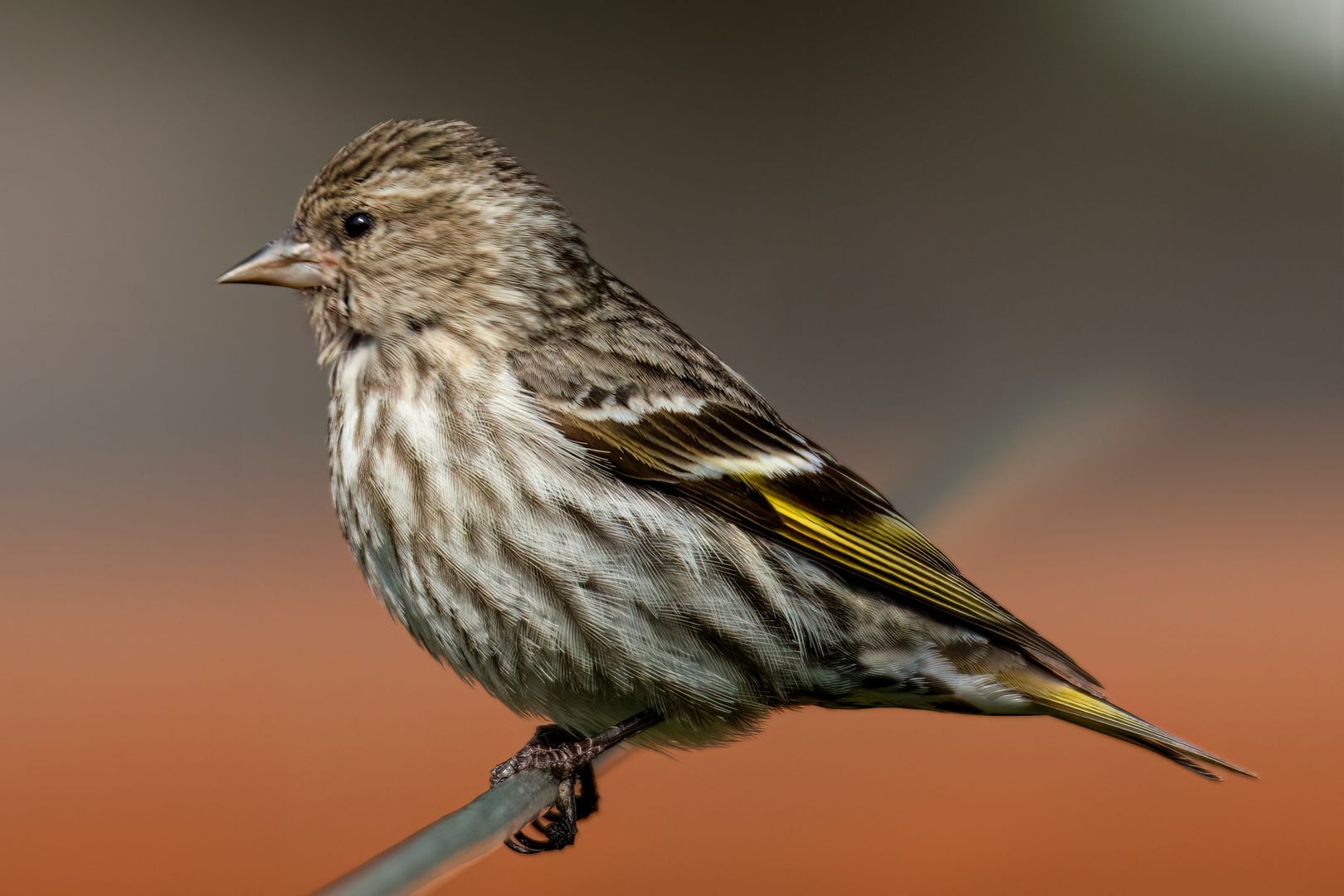
The Pine Siskin is a small, streaky finch that wanders widely in search of seed crops. In big flight years it can show up at Delaware feeders in noisy flocks, and in other years it doesn't come this far south at all.
It's brown and heavily streaked with a thin, pointed bill and flashes of yellow in the wings and tail. Males tend to show more yellow than females, but the difference is subtle.
The call is a rising, buzzy zreee, and flocks keep up a constant wheezy chatter.
When siskins are around, look for them in pines, sweetgums, and at nyjer feeders statewide.
Feeder favorites: nyjer, sunflower chips
20. Northern Mockingbird
- Family – Mimidae
- Species – Mimus polyglottos
- Primary Activity Time – Daytime
- Diurnal
- Resident Delaware Bird
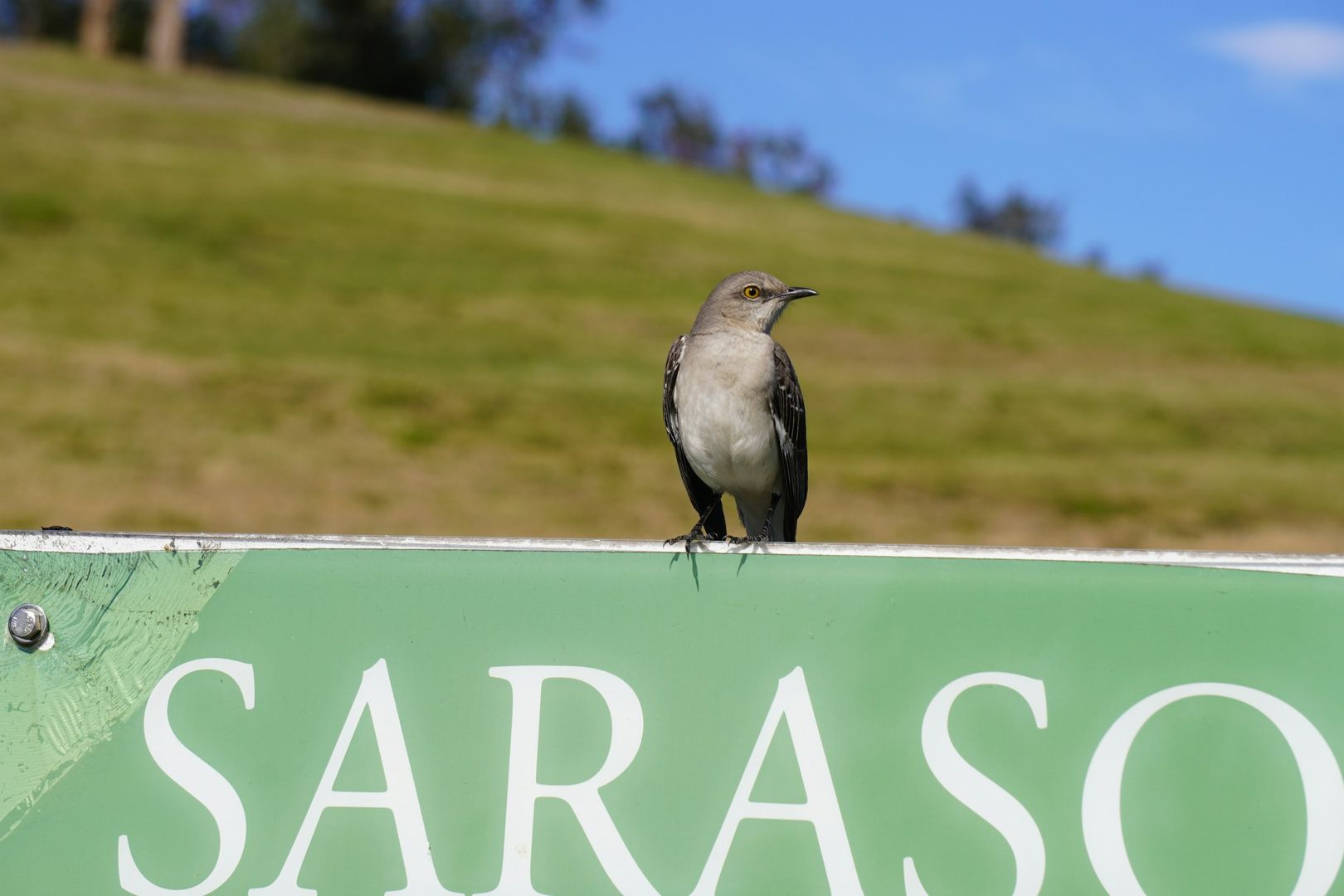
The Northern Mockingbird is the neighborhood's resident impressionist. In winter it switches from insects to fruit, and it will defend a holly bush or berry tangle from other birds like it holds the deed.
It's gray above and pale below with a long tail and bold white wing patches that flash in flight. Males and females look alike.
Mockingbirds copy other birds' songs, car alarms, and anything else they find catchy, repeating each phrase a few times before moving on. In winter they're quieter but give a harsh chack call.
Look for mockingbirds statewide in towns, parking lots, hedges, and open areas with shrubs and fruiting plants.
Feeder favorites: chopped fruit, raisins, suet
21. Eastern Bluebird
- Family – Turdidae
- Species – Sialia sialis
- Primary Activity Time – Daytime
- Diurnal
- Resident Delaware Bird
The Eastern Bluebird doesn't leave Delaware in winter. It just changes its menu, switching from insects to berries and traveling in small flocks that roam open country looking for fruit.
Males are deep blue above with a rusty throat and breast and a white belly. Females are grayish with blue in the wings and tail and a softer orange breast.
The call is a soft, musical tur-wee, and the song is a gentle, warbling whistle.
Look for bluebirds in fields, orchards, golf courses, and parks with scattered trees across the state. They'll also roost in nest boxes on cold nights.
Feeder favorites: mealworms, suet, chopped fruit
22. American Robin
- Family – Turdidae
- Species – Turdus migratorius
- Primary Activity Time – Daytime
- Diurnal
- Resident Delaware Bird & Winter Migrant
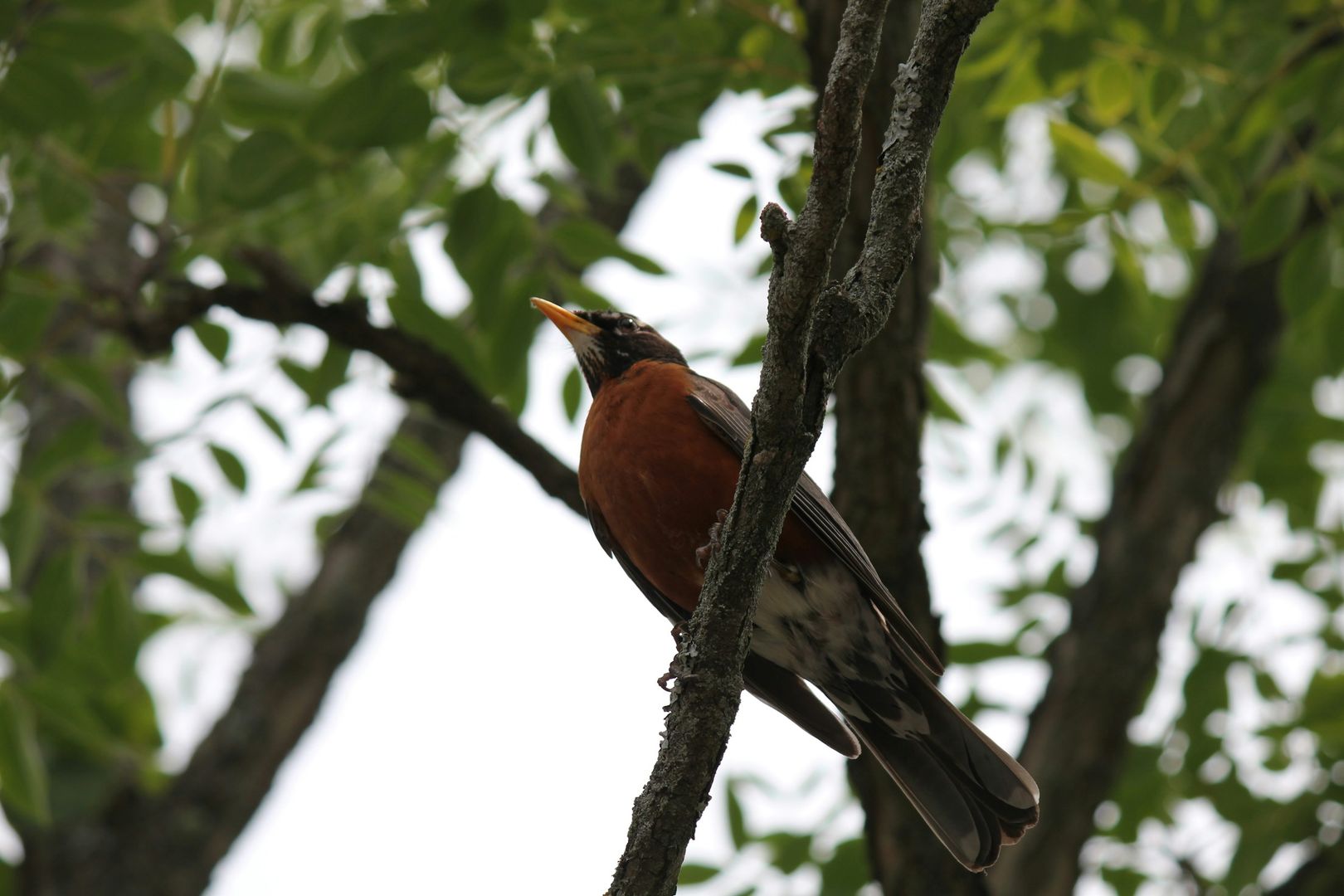
Plenty of American Robins spend the winter in Delaware. They just stop acting like lawn birds and start traveling in big, nomadic flocks that move between fruiting trees and shrubs, so it's easy to think they've left.
They have a warm orange breast, a gray-brown back, and a white eye ring. Males have a darker head and a richer orange breast, while females are paler overall.
In winter you'll mostly hear their chuckling tut-tut calls and a high, thin flight note rather than the full spring song.
Look for robin flocks in woods with holly, cedar, and other fruiting trees, and in neighborhoods with berry-heavy landscaping.
Feeder favorites: chopped fruit, softened raisins, mealworms
23. Yellow-rumped Warbler
- Family – Parulidae
- Species – Setophaga coronata
- Primary Activity Time – Daytime
- Diurnal
- Winter Migrant / Visitor
The Yellow-rumped Warbler is the one warbler you can count on in a Delaware winter, and it has a dietary trick to thank for it. It's the only warbler able to digest the waxy coating on bayberries and wax myrtle, which grow thick along the coast.
Winter birds are brownish-gray with streaks, a bright yellow rump, and small yellow patches on the sides. Males are usually a little crisper and more contrasting than females, but in winter the two can be hard to tell apart.
The call is a sharp chek, which you'll often hear before you see the bird.
Yellow-rumps are most common in the coastal thickets of Sussex County, around Cape Henlopen State Park and Delaware Seashore State Park, but they winter inland too.
Feeder favorites: suet, peanut butter mixes, mealworms
24. Ruby-crowned Kinglet
- Family – Regulidae
- Species – Corthylio calendula
- Primary Activity Time – Daytime
- Diurnal
- Winter Migrant / Visitor
The Ruby-crowned Kinglet is a tiny, olive-green bird that never seems to sit still. It flicks its wings constantly while hunting for insects and insect eggs in shrubs and low branches, which makes it look permanently over-caffeinated.
It's olive-gray with a bold white eye ring and white wing bars. Males have a red crown patch that usually stays hidden unless they're excited, and females don't have one.
The call is a husky, two-part ji-dit. Its song is surprisingly loud for such a small bird, but you'll mostly hear it in spring.
Look for kinglets statewide in thickets, woodland edges, and evergreens, often in mixed flocks with chickadees and Yellow-rumped Warblers.
Feeder favorites: suet, mealworms
25. Cooper's Hawk
- Family – Accipitridae
- Species – Astur cooperii
- Primary Activity Time – Daytime
- Diurnal
- Resident Delaware Bird & Winter Migrant
The Cooper's Hawk is the reason your feeder sometimes goes completely silent. It's a bird-hunting hawk that uses shrubs and buildings as cover to ambush songbirds and doves, and winter feeders are basically its drive-through.
Adults are blue-gray above with fine orange barring on the chest, red eyes, and a long, rounded tail with a white tip. Females are noticeably larger than males. Young birds are brown above with brown streaks below.
The call is a harsh cak-cak-cak, though it's usually silent while hunting.
Cooper's Hawks are found statewide, most often in suburbs and towns where feeders concentrate their prey.
26. Northern Harrier
- Family – Accipitridae
- Species – Circus hudsonius
- Primary Activity Time – Daytime
- Diurnal
- Winter Migrant / Visitor (common in coastal marshes)
The Northern Harrier is the low, tilting hawk you'll see coursing over Delaware's marshes in winter. It hunts by flying just above the grass and using an owl-like facial disk to listen for voles.
Males are pale gray above with black wingtips, earning the nickname "gray ghost." Females and young birds are brown. Both have a long tail and a bright white rump patch that's easy to spot as they bank.
Harriers are mostly quiet in winter.
The Bombay Hook bird checklist lists Northern Harriers as common in winter, and Audubon calls out Little Creek Wildlife Area and Port Mahon Road for winter raptors. Prime Hook's marshes are another good bet.
27. Bald Eagle
- Family – Accipitridae
- Species – Haliaeetus leucocephalus
- Primary Activity Time – Daytime
- Diurnal
- Resident Delaware Bird
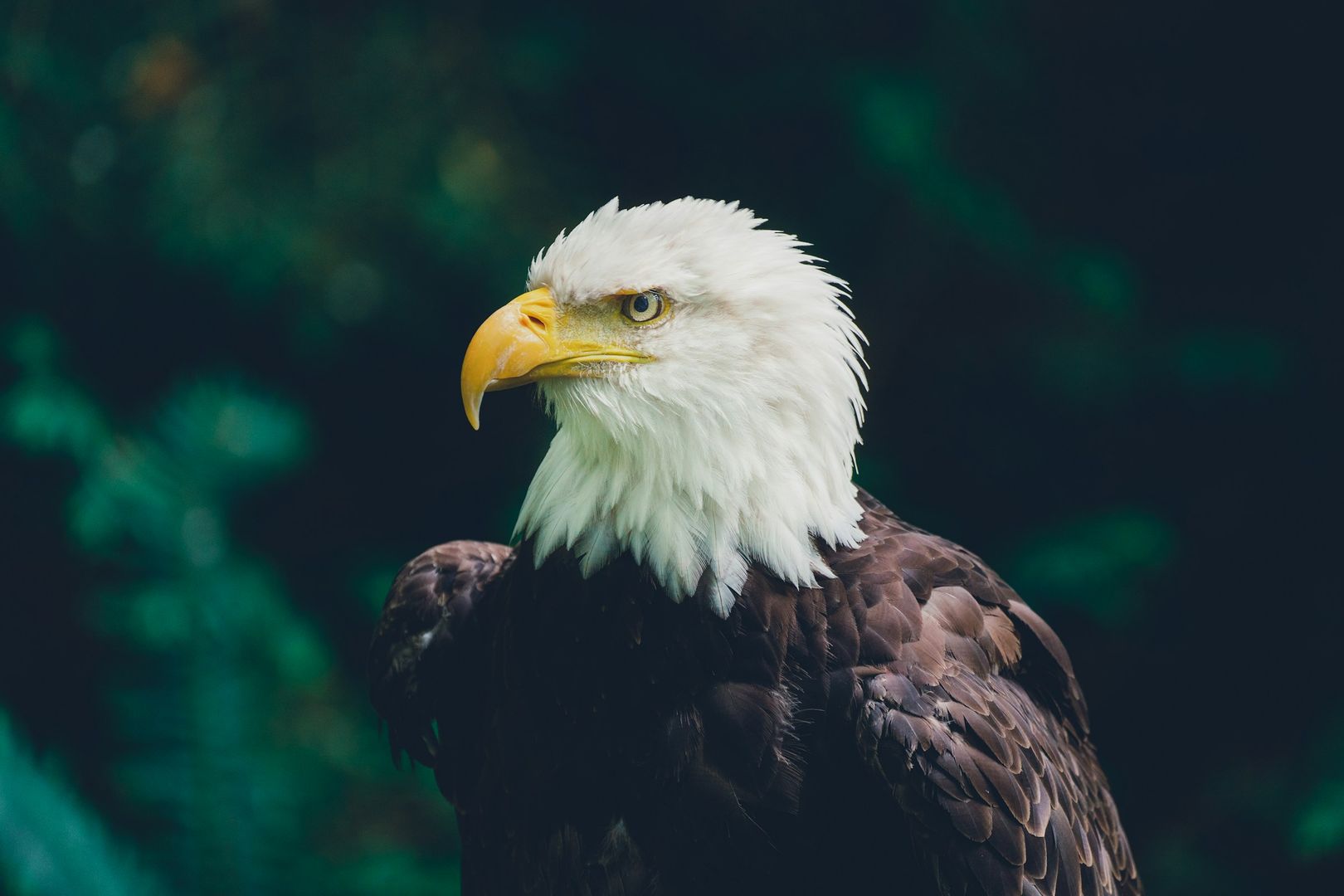
The Bald Eagle doesn't wait for spring to get started in Delaware. At Bombay Hook, nesting begins in January and eggs are laid in February, so winter is prime time to watch pairs repairing nests the size of a hot tub. In December, they're easy to spot perched on bare branches.
Adults have a dark brown body, white head and tail, and a big yellow bill. Young eagles are mottled brown and white and take several years to get their full adult look. Females are larger than males.
The call is a surprisingly thin, high chatter, nothing like the scream movies give it (that one usually belongs to a Red-tailed Hawk).
Look for eagles along the Delaware River and Bay, at Bombay Hook and Prime Hook, and around large ponds and rivers inland.
28. Short-eared Owl
- Family – Strigidae
- Species – Asio flammeus
- Primary Activity Time – Dawn and Dusk
- Crepuscular
- Winter Migrant / Visitor (uncommon)
The Short-eared Owl is an uncommon winter visitor that hunts open marshes and fields at dusk, often in the same spots harriers patrol by day. Its flight is floppy and buoyant, a bit like a giant moth with a commute.
It's tawny and streaked with a pale face, yellow eyes outlined in black, and tiny ear tufts you'll rarely see. Females tend to be darker and buffier than males, but it's hard to tell in the field.
It's mostly silent in winter, though it sometimes gives a raspy bark.
Look for Short-eared Owls at dusk over the marshes at Little Creek Wildlife Area, along Port Mahon Road, and at Bombay Hook. Please watch from your car or the road and give them room. They spook easily, and no photo is worth that.
29. Snowy Owl
- Family – Strigidae
- Species – Bubo scandiacus
- Primary Activity Time – Daytime and Dusk
- Diurnal / Crepuscular
- Irruptive Species (rare)
The Snowy Owl is an Arctic owl that shows up in Delaware only in some winters, and a single bird can cause a minor traffic jam. The Bombay Hook auto tour guide notes you may occasionally see a Snowy Owl on the refuge in winter, and they also turn up on open beaches and fields.
Adult males can be nearly pure white, while females and young birds have heavy dark barring. Females are larger than males.
Snowy Owls are mostly silent away from their breeding grounds.
When one appears, it's usually reported quickly on eBird and local listservs. Keep a respectful distance, since a flushed owl burns energy it needs to survive the winter.
30. Snow Goose
- Family – Anatidae
- Species – Anser caerulescens
- Primary Activity Time – Daytime
- Diurnal
- Winter Migrant / Visitor
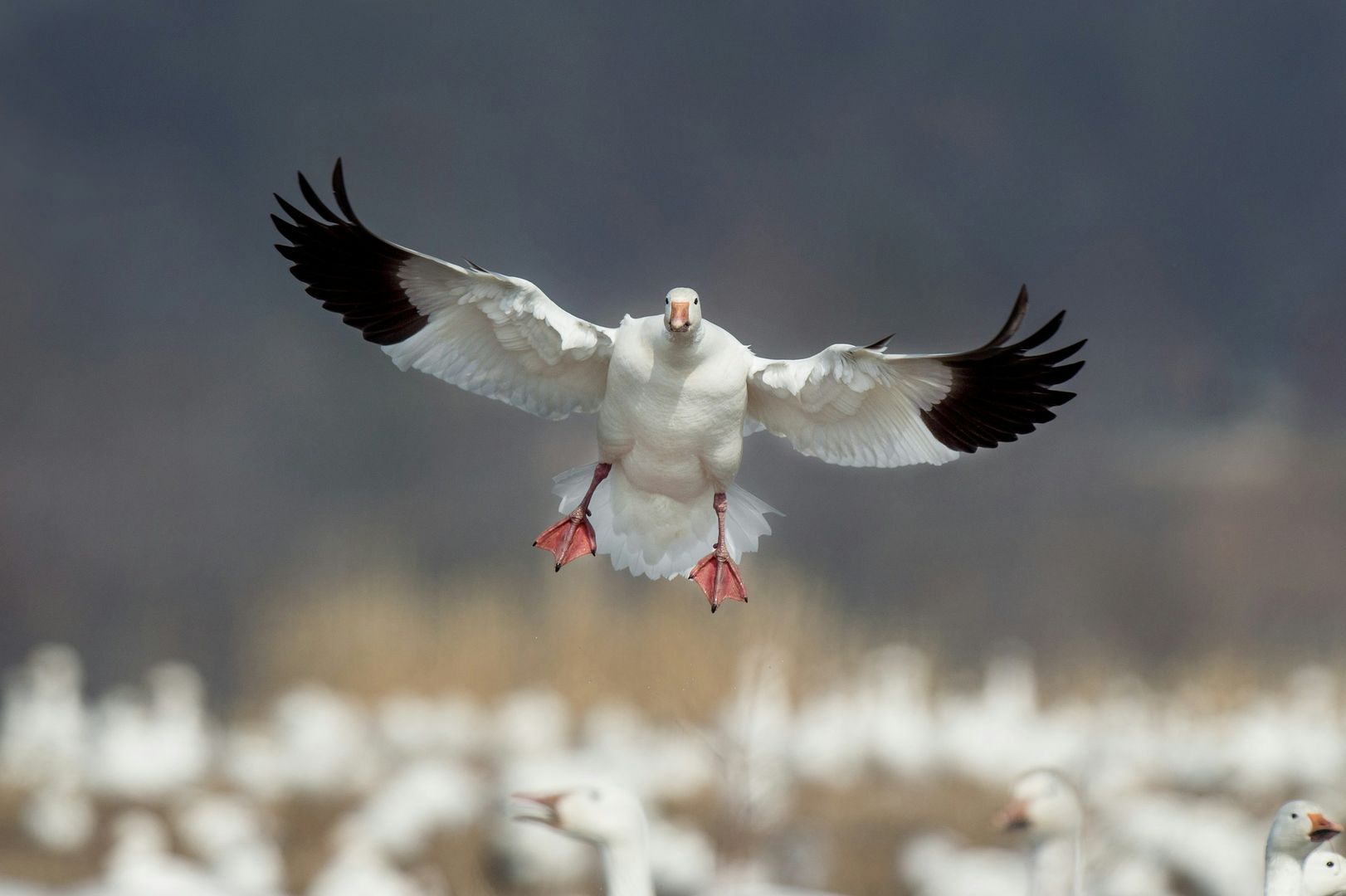
The Snow Goose is the main event of a Delaware winter. Large numbers arrive at Bombay Hook in October, and the refuge's auto tour guide says its "greatest wildlife spectacle" happens just before sunset in November and December, when the geese are at their peak. Tens of thousands of white geese lifting off a marsh at once is the kind of thing that makes non-birders pull over.
Most are white with black wingtips and a pink bill with a dark "grin patch." Some are the darker "blue" form, with a gray-brown body and a white head. Males and females look alike.
Snow Geese are loud, with a constant high, nasal honking that you'll hear well before the flock comes into view.
Look for them at Bombay Hook and Prime Hook National Wildlife Refuges and in nearby farm fields, where flocks feed on waste grain. They tend to move around, so check recent eBird reports before you go.
31. Tundra Swan
- Family – Anatidae
- Species – Cygnus columbianus
- Primary Activity Time – Daytime
- Diurnal
- Winter Migrant / Visitor
The Tundra Swan breeds in the Arctic and winters along the mid-Atlantic coast, including Delaware. It's important enough here that DNREC's winter waterfowl counts are used to measure Tundra Swan annual production.
It's all white with a black bill, often with a small yellow spot near the eye, and it holds its neck straight. That separates it from the Mute Swan, which has an orange bill and an S-curved neck. Males and females look alike, and young birds are gray-brown with a pinkish bill.
Tundra Swans were once called Whistling Swans, and their high, whistling, hooting calls carry a long way over the marsh.
Look for them on the impoundments at Bombay Hook, on large ponds, and in harvested farm fields in Kent and Sussex Counties.
32. Northern Pintail
- Family – Anatidae
- Species – Anas acuta
- Primary Activity Time – Daytime
- Diurnal
- Winter Migrant / Visitor
The Northern Pintail is the most elegant duck on the marsh, and it knows it. It's a dabbler that tips up to feed on seeds and plants in shallow water, and Bombay Hook notes that February brings large flocks of pintail ducks.
Males have a chocolate-brown head, a white stripe running up the side of the neck, a gray body, and a long, needle-pointed tail. Females are mottled brown with a gray bill and a shorter pointed tail.
Males give a soft, whistled prip-prip, while females give a low quack.
Look for pintails on the freshwater pools at Bombay Hook and Prime Hook and in flooded fields along the bay.
33. American Black Duck
- Family – Anatidae
- Species – Anas rubripes
- Primary Activity Time – Daytime
- Diurnal
- Resident Delaware Bird & Winter Migrant
The American Black Duck is a salt marsh duck, and Delaware Bay's marshes are prime winter habitat for it. It looks like a dark Mallard at first glance, which is a bit like being called "the dark one" in your friend group: not wrong, just incomplete.
Both sexes are dark chocolate brown with a paler head and a purple patch on the wing. In flight, their white underwings flash against the dark body. Males have a yellow bill, while females have a duller olive-green bill.
Females give the classic loud quack, and males give a lower, raspier call.
The Bombay Hook checklist rates Black Ducks as common in winter, and you can find them in tidal marshes all along Delaware Bay and the inland bays.
34. Purple Sandpiper

- Family – Scolopacidae
- Species – Calidris maritima
- Primary Activity Time – Daytime
- Diurnal
- Winter Migrant / Visitor (local, rocky jetties only)
The Purple Sandpiper is a stocky shorebird that spends the winter on rock jetties and breakwaters, where it picks snails and other small invertebrates off wave-splashed rocks. It's not purple, though some light catches a faint purplish sheen.
It's slate gray above with a gray chest and streaky flanks, short orange-yellow legs, and a slightly drooping bill that's orange at the base. Males and females look alike, though females average a bit larger with longer bills.
It's quiet in winter, giving an occasional soft kweet.
Look for it on the jetties at Cape Henlopen State Park, which Audubon lists as a winter spot for Purple Sandpiper, along with all three scoter species and Red-throated Loons offshore.
Birds of Delaware in Winter: FAQ
What birds stay in Delaware in the winter?
Year-round residents like the Northern Cardinal, Carolina Chickadee, Tufted Titmouse, Carolina Wren, Blue Jay, and the woodpeckers stay put. They're joined by winter arrivals, including Dark-eyed Juncos, White-throated Sparrows, Yellow-rumped Warblers, and huge numbers of geese, swans, and ducks along Delaware Bay. For a neighbor's version of the list, see our guide to winter birds in Maryland.
What are the most common Delaware birds at feeders in winter?
The usual crowd is cardinals, chickadees, juncos, titmice, Mourning Doves, Downy and Red-bellied Woodpeckers, White-breasted Nuthatches, House Finches, Blue Jays, and goldfinches. Those all made the top 11 of FeederWatch's Mid-Atlantic rankings. White-throated Sparrows and Carolina Wrens aren't far behind.
Where can I see Snow Geese in Delaware?
Bombay Hook National Wildlife Refuge near Smyrna is the classic spot, with a 12-mile wildlife drive through the marshes. Prime Hook National Wildlife Refuge near Milton is the other big one. Go in the late afternoon from November through December for the best chance at the sunset flights, and check recent reports, since flocks move between the refuges and nearby fields.
What is Delaware's state bird?
It's the Blue Hen Chicken, adopted in 1939. It's a domestic bird, not a wild species, named after a Revolutionary War company known as the "Blue Hen's Chickens." It's also the mascot of the University of Delaware's sports teams.
What are the best places to see birds of Delaware in winter?
Bombay Hook and Prime Hook for waterfowl, Little Creek Wildlife Area and Port Mahon Road for harriers and owls, and Cape Henlopen State Park for sea ducks, loons, and Purple Sandpipers. If you're up for a short drive across the bay, our guide to winter birds in New Jersey covers Cape May and the Jersey Shore.
What Delaware Birds Have You Seen Lately?
Share them on the Sparkbird App. Available in the Apple App Store.
And if anyone asks why you're standing in a marsh at sunset in December, just tell them you're here for the state bird. It's a chicken, so they'll have follow-up questions, and you'll have plenty of time to watch the geese.
Happy birding.
No comments yet.