
Colorado is the only state where a bird can winter by moving about 6,000 feet downhill instead of 1,000 miles south (honestly, a commute I'd take). That's what makes Colorado winter birds so fun: the mountain birds slide down to the foothills and feeders, northern visitors pour onto the plains, and a few hardy specialists stay up on the tundra like it's a personality trait.
The one bird you won't see is the state bird. The Lark Bunting arrives in April and heads south by September, so it skips the snowy season entirely. Below are 35 winter birds in Colorado, each with ID tips, male vs female differences, calls, where to find them in the state, and what they'll eat at your feeder.
Types of Winter Birds in Colorado
There are 3 types of winter birds in Colorado you'll see on the list:
- Resident Colorado Birds – found year-round. Many of them shift to lower elevations when the snow piles up, which is why your foothills feeder gets busier in January
- Winter Migrants / Visitors – birds that come to Colorado for the winter from Canada, Alaska, and the Arctic, like Rough-legged Hawks, American Tree Sparrows, and two of the three rosy-finches
- Irruptive Species – birds that show up in big, unpredictable numbers some winters and barely at all in others, usually when seed, cone, or berry crops fail farther north
The list starts with the birds you're most likely to see at a Colorado feeder, roughly following Project FeederWatch's Southwest region rankings, then moves up into the mountains, out onto the plains, and over to the water. If you're wondering where everyone else went, here's where birds go in the winter.
1. House Finch
- Family – Fringillidae
- Species – Haemorhous mexicanus
- Primary Activity Time – Daytime
- Diurnal
- Resident Colorado Bird
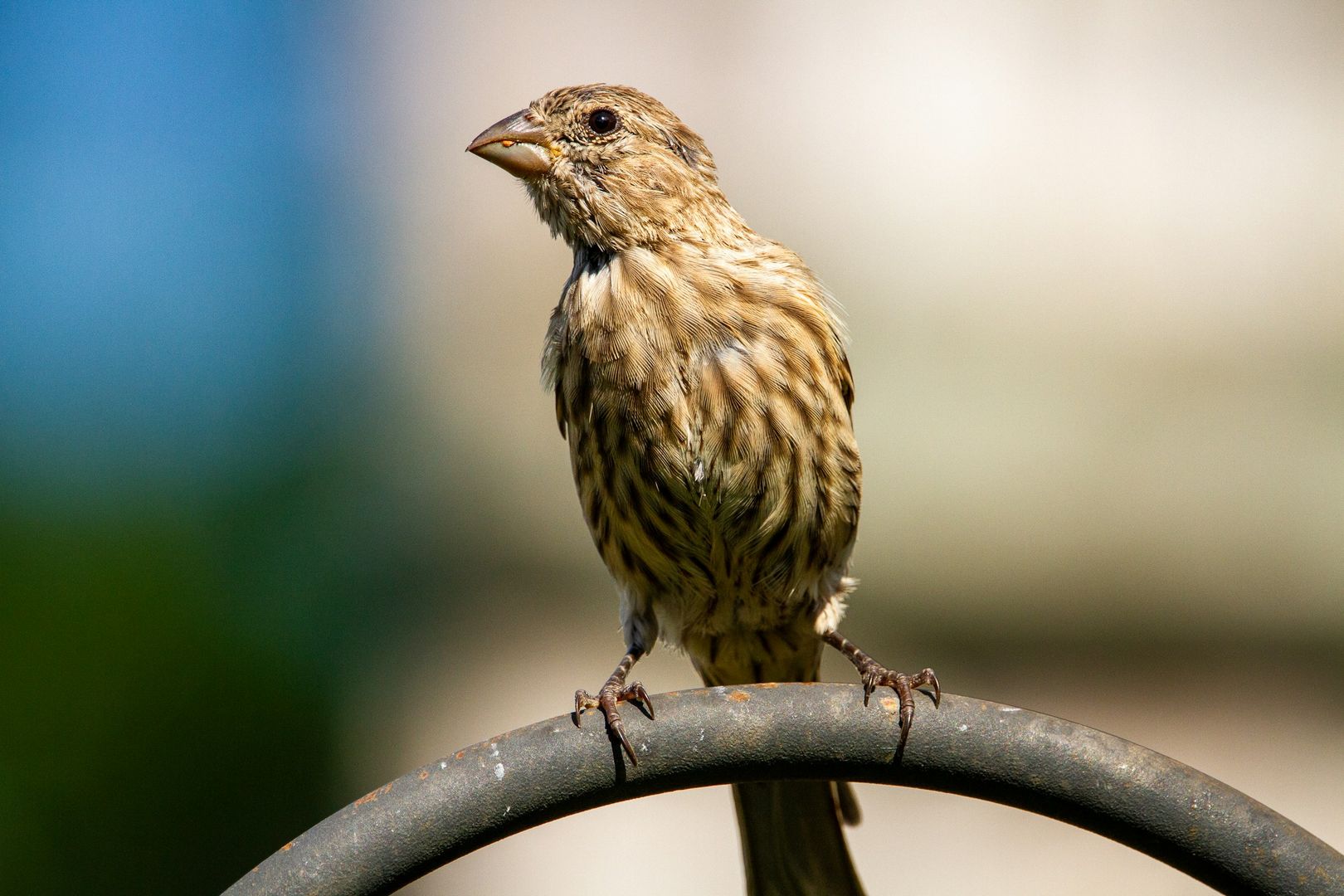
The House Finch is the most dependable feeder bird in the region. In FeederWatch's Southwest counts it showed up at 94% of sites, which is better attendance than my gym membership has ever seen. It eats seeds almost exclusively and travels in chatty winter flocks.
Males have a red to orange-red wash on the head, breast, and rump, and the exact shade depends on what they ate while growing new feathers. Females are plain gray-brown with blurry streaks and no red at all.
The House Finch song is a long, jumbled warble that often ends on a buzzy, rising note, and the call is a short cheep.
House Finches live along the Front Range, in Western Slope towns, and on farmsteads across the eastern plains. They're less common in deep mountain forest, so a big flock at a high-elevation feeder is more likely to be something else (keep reading).
Feeder favorites: black oil sunflower, sunflower chips, nyjer
2. Dark-eyed Junco
- Family – Passerellidae
- Species – Junco hyemalis
- Primary Activity Time – Daytime
- Diurnal
- Resident Colorado Bird / Winter Migrant
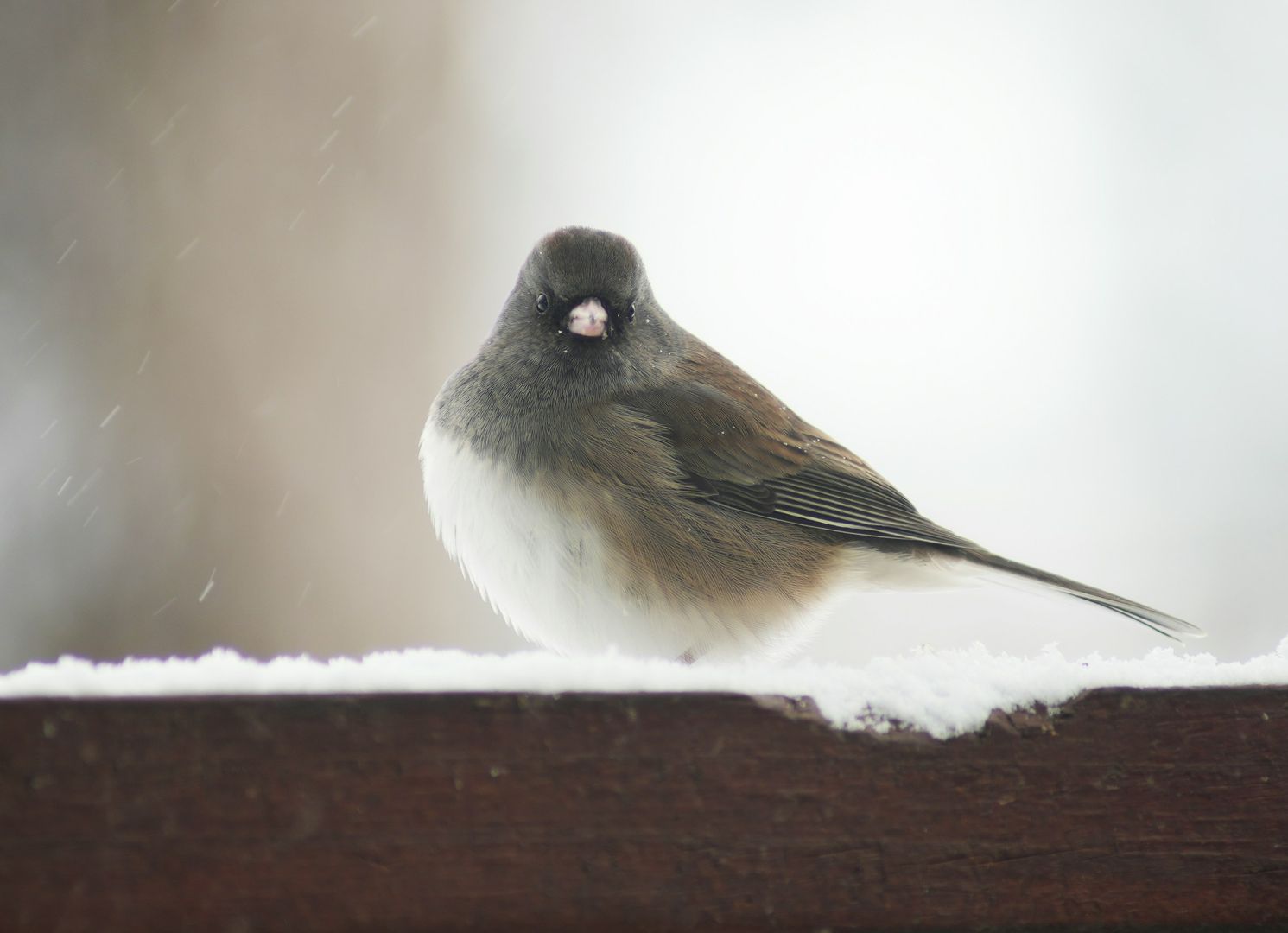
The Dark-eyed Junco is a ground-feeding sparrow, and Colorado in winter is basically a junco convention. Several distinct forms meet here, so one flock under your feeder can hold three or four different-looking birds that are all technically the same species.
Colorado Central Magazine's junco rundown lists the forms you can sort through. The Gray-headed has a gray head and a brown patch on its gray back, and it's the only one that summers in the state. The Oregon has a dark hood and pinkish-brown sides, the Pink-sided is a paler version of it, the Slate-colored is gray all over with a white belly, and the White-winged looks like a pale slate-colored with white wing bars. In most forms, males are darker and crisper while females are browner. Every junco has a pink bill and flashes white outer tail feathers when it flies.
The Dark-eyed Junco call is a sharp tick or smack, and the song is a quick, musical trill.
Juncos winter statewide, from Denver backyards to mountain-town feeders, usually in small flocks on the ground.
Feeder favorites: white millet, sunflower chips, cracked corn scattered on the ground
3. Northern Flicker
- Family – Picidae
- Species – Colaptes auratus
- Primary Activity Time – Daytime
- Diurnal
- Resident Colorado Bird
The Northern Flicker is a woodpecker that would rather be on the lawn. It eats more ants than almost any other North American bird, and in winter it switches to berries, seeds, and suet.
Colorado's flickers are the "red-shafted" form, with salmon-red under the wings and tail that flashes in flight. Both sexes are brown with black bars on the back, black spots on the belly, and a black crescent on the chest. Males have a red mustache stripe, while females don't.
The Northern Flicker call is a loud, single kyeer, plus a long, rolling wick-wick-wick-wick when it's feeling chatty.
Flickers are found statewide, from plains towns to mountain parks, and they ranked third in FeederWatch's Southwest counts.
Feeder favorites: suet, peanuts, black oil sunflower
4. Black-capped Chickadee
- Family – Paridae
- Species – Poecile atricapillus
- Primary Activity Time – Daytime
- Diurnal
- Resident Colorado Bird
The Black-capped Chickadee is a tiny, fearless omnivore that eats seeds, suet, and hibernating insects, and hides extra food in bark crevices for later.
It has a black cap and bib, white cheeks, a gray back, and buffy sides. Males and females look alike.
The Black-capped Chickadee call is the familiar chick-a-dee-dee-dee, and its song is a clear, two-note fee-bee.
In Colorado, Black-capped Chickadees are the lowland chickadee, found along the Front Range, river corridors, and towns on the plains and the Western Slope. Head up into the conifers and they're mostly replaced by the next bird on the list.
Feeder favorites: black oil sunflower, suet, peanuts
5. Mountain Chickadee
- Family – Paridae
- Species – Poecile gambeli
- Primary Activity Time – Daytime
- Diurnal
- Resident Colorado Bird
The Mountain Chickadee is the chickadee of Colorado's pine and spruce forests, and it's a champion food hoarder. The Steamboat Pilot reports that it can cache up to 80,000 seeds for winter, which makes my pantry look underprepared.
It looks like a Black-capped Chickadee that got a bold white eyebrow through its black cap. Males and females look alike.
The Mountain Chickadee call is a hoarser, slower chick-a-dee-dee, and the song is a sweet, three-note fee-bee-bee.
Mountain Chickadees live in the foothills and mountains statewide, and some drift down to Front Range neighborhoods in winter. They ranked in FeederWatch's Southwest top 10.
Feeder favorites: black oil sunflower, suet, peanuts
6. White-breasted Nuthatch
- Family – Sittidae
- Species – Sitta carolinensis
- Primary Activity Time – Daytime
- Diurnal
- Resident Colorado Bird
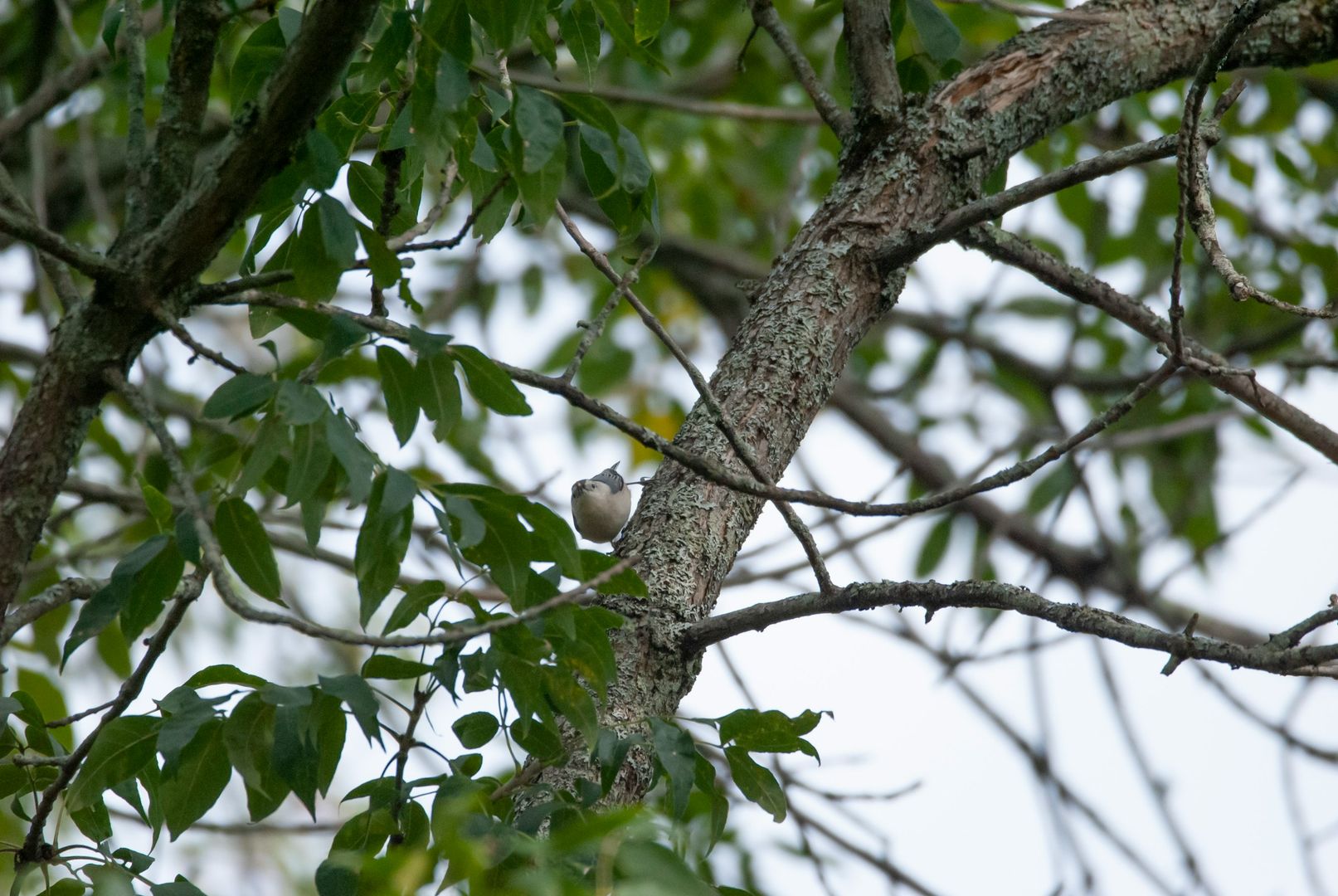
The White-breasted Nuthatch spends its winter walking headfirst down tree trunks, wedging seeds into bark and hammering them open (that's the "hatch" in nuthatch).
It's blue-gray above with a clean white face and breast and a rusty wash under the tail. Males have a glossy black cap, while females usually have a grayer one.
The White-breasted Nuthatch call is a nasal yank or quank, often repeated in a quick series.
In Colorado it lives in ponderosa pine forests, cottonwood river bottoms, and older neighborhoods with big trees.
Feeder favorites: black oil sunflower, peanuts, suet
7. Red-breasted Nuthatch
- Family – Sittidae
- Species – Sitta canadensis
- Primary Activity Time – Daytime
- Diurnal
- Resident / Irruptive
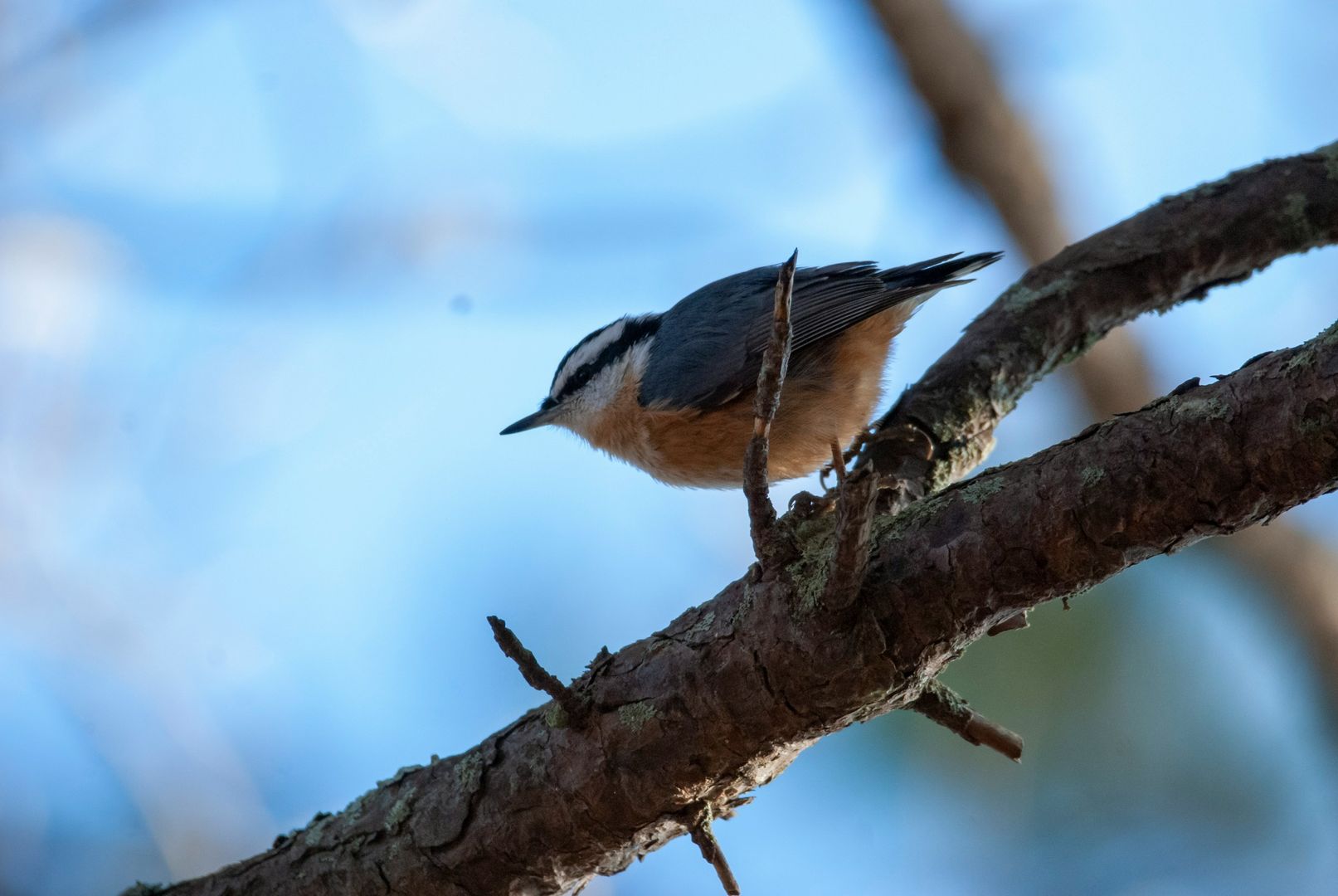
The Red-breasted Nuthatch is a small, busy nuthatch that loves conifer seeds and grabs one sunflower seed at a time from feeders.
It has a black eye stripe under a white eyebrow, a blue-gray back, and a rusty-cinnamon breast. Males have a black cap and richer color underneath, while females have a grayer cap and paler underparts.
The Red-breasted Nuthatch call is a nasal yank-yank, higher and more tinny than the White-breasted's, like a tiny tin horn.
In Colorado it breeds in spruce-fir and mixed conifer forests and is a year-round mountain resident. In some winters, more move into Front Range and plains towns when cone crops fail up north.
Feeder favorites: suet, shelled peanuts, black oil sunflower
8. Pygmy Nuthatch
- Family – Sittidae
- Species – Sitta pygmaea
- Primary Activity Time – Daytime
- Diurnal
- Resident Colorado Bird
The Pygmy Nuthatch is a ponderosa pine specialist about 4 inches long, and it might have the best winter survival plan on this list. According to Rocky Mountain National Park's Pygmy Nuthatch page, these birds never roost alone. They pile into tree cavities on cold nights, and sometimes more than 150 sleep in a single tree, which is the bird version of every cousin crashing at grandma's for the holidays.
It's slate-gray above and buffy below, with a gray-brown cap, a dark line through the eye, and a white chin. Males and females look the same.
The Pygmy Nuthatch call is a run of short, squeaky peep notes, and flocks keep up a constant chatter as they move through the pines.
In Colorado, look for them in open ponderosa pine forests in the foothills and mountains, like around Colorado Springs, Evergreen, and Estes Park.
Feeder favorites: suet, sunflower chips, shelled peanuts
9. Downy Woodpecker
- Family – Picidae
- Species – Dryobates pubescens
- Primary Activity Time – Daytime
- Diurnal
- Resident Colorado Bird
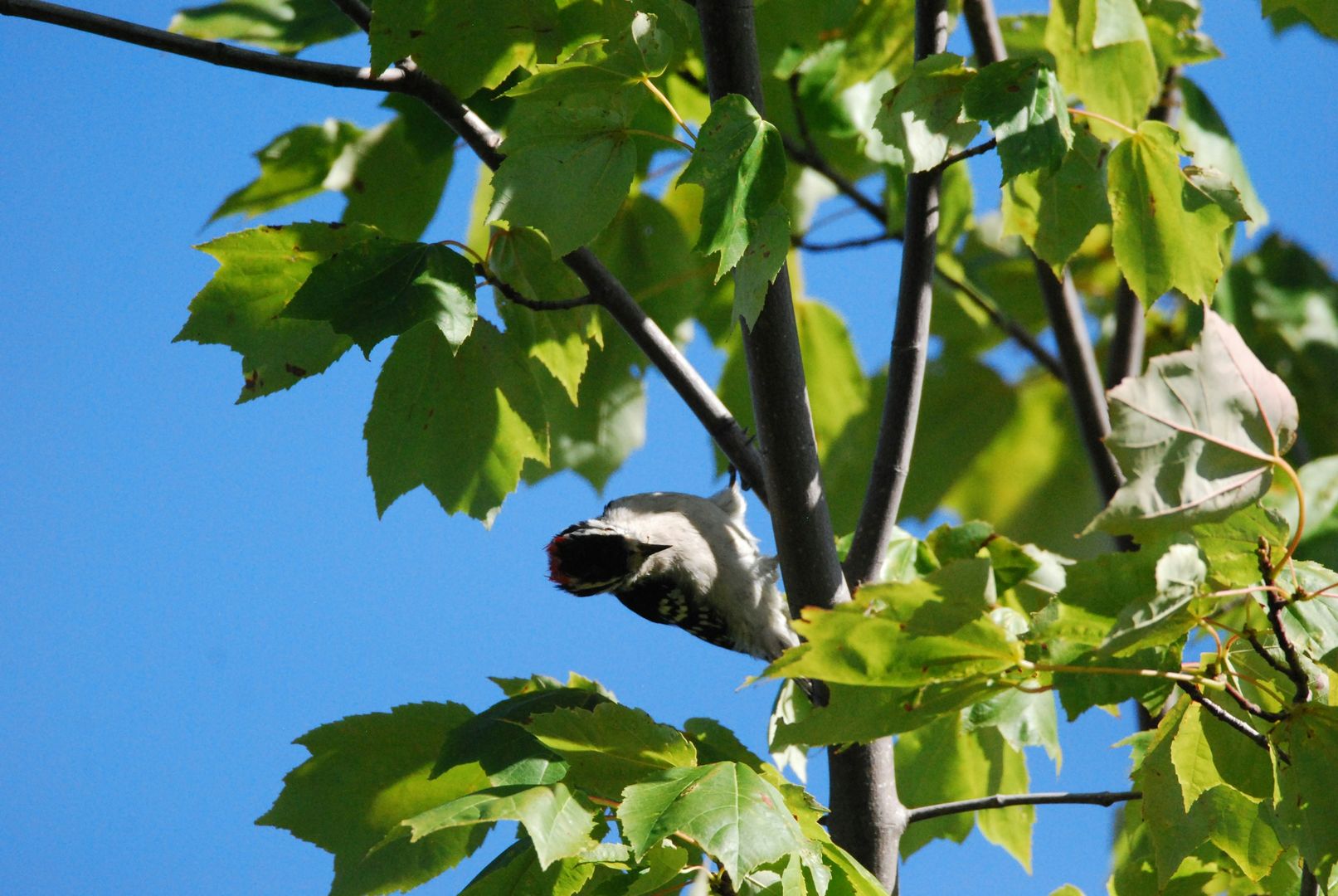
The Downy Woodpecker is the smallest woodpecker in Colorado. It picks insects and larvae out of twigs and weed stems and happily hangs on suet feeders all winter.
It's black and white with a white back, a short, stubby bill, and black spots on its white outer tail feathers. Males have a small red patch on the back of the head, while females don't.
The Downy Woodpecker call is a soft pik and a high, descending whinny.
In Colorado, Downies are most common in cottonwood river corridors, parks, and neighborhoods along the Front Range and in lower valleys.
Feeder favorites: suet, black oil sunflower, peanuts
10. Hairy Woodpecker
- Family – Picidae
- Species – Dryobates villosus
- Primary Activity Time – Daytime
- Diurnal
- Resident Colorado Bird
The Hairy Woodpecker looks like a Downy Woodpecker that upgraded to the large size. It digs insects out of bark and is a regular at suet in mountain towns.
The easiest tell is the bill, which is about as long as its head (the Downy's is much shorter). Rocky Mountain birds also tend to have fewer white spots on the wings than Hairies back east. Males have a red patch on the back of the head, while females don't.
The Hairy Woodpecker call is a loud, sharp peek and a rattling whinny.
In Colorado, Hairy Woodpeckers are more of a forest bird than the Downy, common in the foothills and mountains, especially in conifer and aspen stands.
Feeder favorites: suet, peanuts, black oil sunflower
11. Black-billed Magpie
- Family – Corvidae
- Species – Pica hudsonia
- Primary Activity Time – Daytime
- Diurnal
- Resident Colorado Bird
The Black-billed Magpie is a flashy, opinionated corvid that eats almost anything, from insects and seeds to carrion and roadkill. It's one of those birds that seems to know exactly what you're doing at all times.
It's black and white with a very long tail that shines blue-green in the sun, and big white wing patches that flash in flight. Males and females look alike.
The Black-billed Magpie call is a harsh, rapid mag-mag-mag or chek-chek-chek that often means a hawk or cat is nearby.
Magpies are common in Colorado's lower elevations, along the Front Range, in farm country on the plains, and in Western Slope valleys. They're rare in dense high-mountain forest.
Feeder favorites: peanuts, suet, cracked corn
12. Steller's Jay
- Family – Corvidae
- Species – Cyanocitta stelleri
- Primary Activity Time – Daytime
- Diurnal
- Resident Colorado Bird
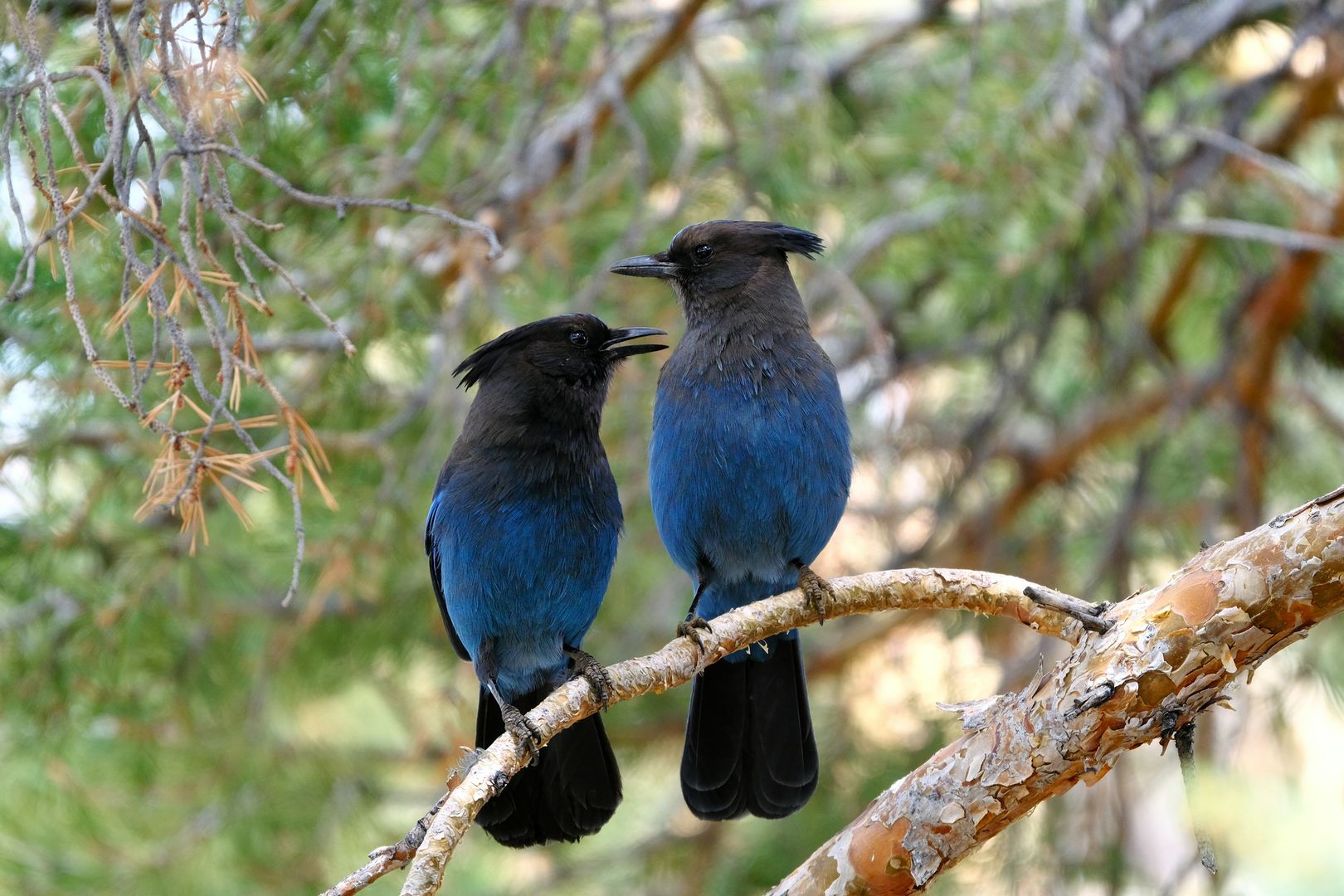
The Steller's Jay is a crested mountain jay that caches nuts and seeds in summer and digs them back up in winter. It's bold, noisy, and loves a peanut more than I love a parking spot near the trailhead.
It has a black head and tall black crest, and the rest of the body is a deep blue. Rocky Mountain birds have short white streaks over the eye. Males and females look alike.
The Steller's Jay call is a harsh shack-shack-shack, and it's also a skilled mimic of hawks, especially the Red-tailed Hawk.
In Colorado it lives in conifer and mixed forests in the foothills and mountains, and some move down to lower elevations in winter, where they show up at feeders. An Evergreen Audubon count in March 2023 tallied 11 Steller's Jays at one set of mountain feeders.
Feeder favorites: peanuts in the shell, black oil sunflower, suet
13. Woodhouse's Scrub-Jay
- Family – Corvidae
- Species – Aphelocoma woodhouseii
- Primary Activity Time – Daytime
- Diurnal
- Resident Colorado Bird
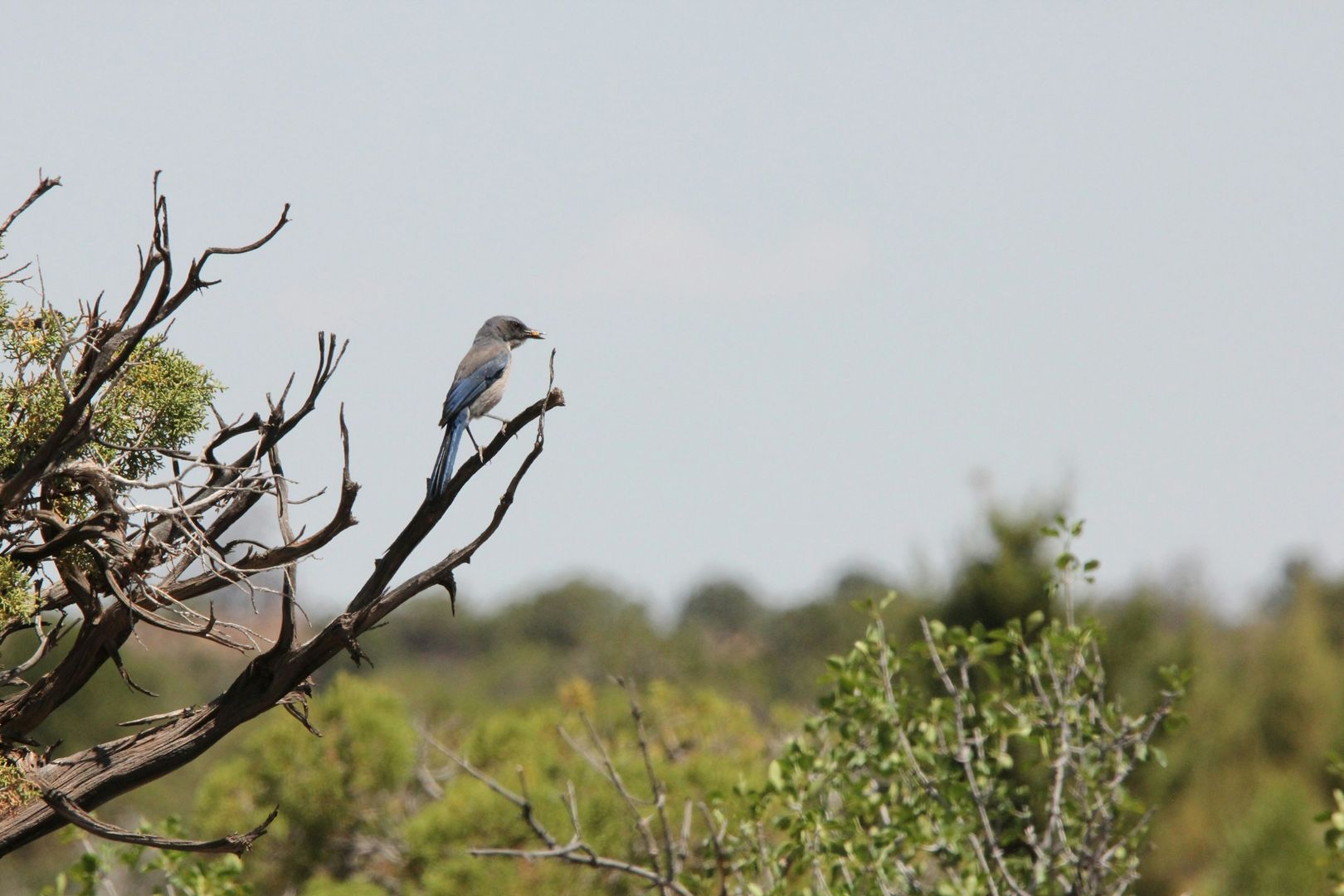
The Woodhouse's Scrub-Jay is a crestless blue jay of the foothills that eats acorns, pinyon nuts, insects, and whatever you've left on the platform feeder. It buries extra food to eat later.
It's blue on the head, wings, and tail, with a gray-brown back, a pale throat with a faint blue necklace, and grayish underparts. Males and females look alike.
The Woodhouse's Scrub-Jay call is a harsh, rising shreep given over and over, usually from the top of a shrub.
In Colorado it lives in scrub oak and pinyon-juniper country in the foothills and on the Western Slope, and it's a regular in neighborhoods along the Front Range.
Feeder favorites: peanuts, black oil sunflower
14. American Robin
- Family – Turdidae
- Species – Turdus migratorius
- Primary Activity Time – Daytime
- Diurnal
- Resident Colorado Bird / Winter Migrant
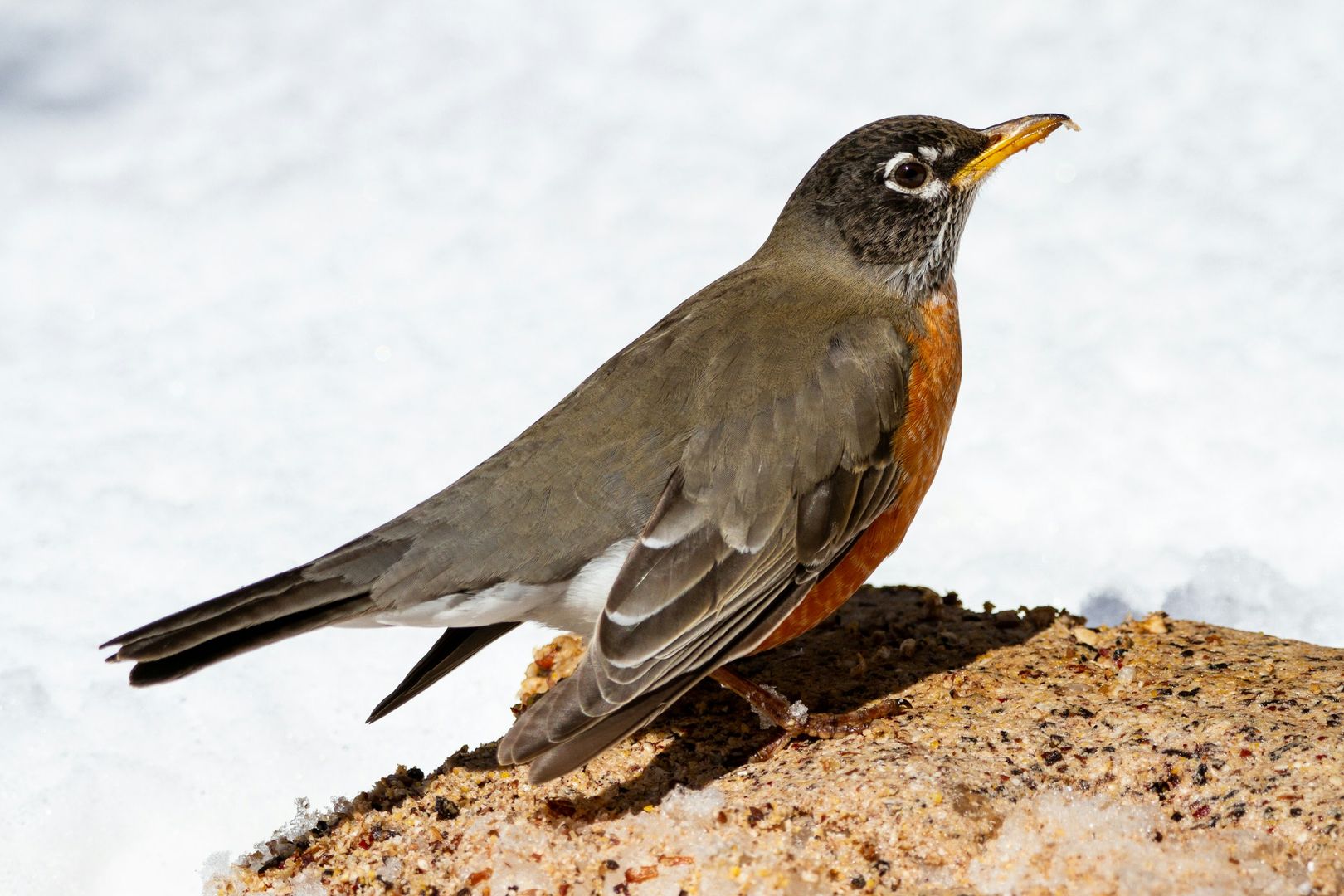
The American Robin doesn't leave Colorado for the winter. It just stops pulling worms and starts traveling in big, nomadic flocks that hunt for juniper berries, crabapples, and Russian olive fruit.
It has a warm orange breast, a gray-brown back, and a white eye ring. Males have a darker, almost black head and richer orange, while females are paler overall.
The American Robin call in winter is mostly a low tut-tut and a thin, high whistle in flight. You'll rarely hear the full cheerily cheer-up song until spring.
Robins winter along the Front Range, on the plains, and in Western Slope valleys wherever there's fruit. On one February 2026 outing on the eastern plains, Evergreen Audubon counted 215 robins in a single day.
Feeder favorites: chopped fruit, softened raisins, mealworms, and fresh water
15. American Goldfinch
- Family – Fringillidae
- Species – Spinus tristis
- Primary Activity Time – Daytime
- Diurnal
- Resident Colorado Bird / Winter Migrant
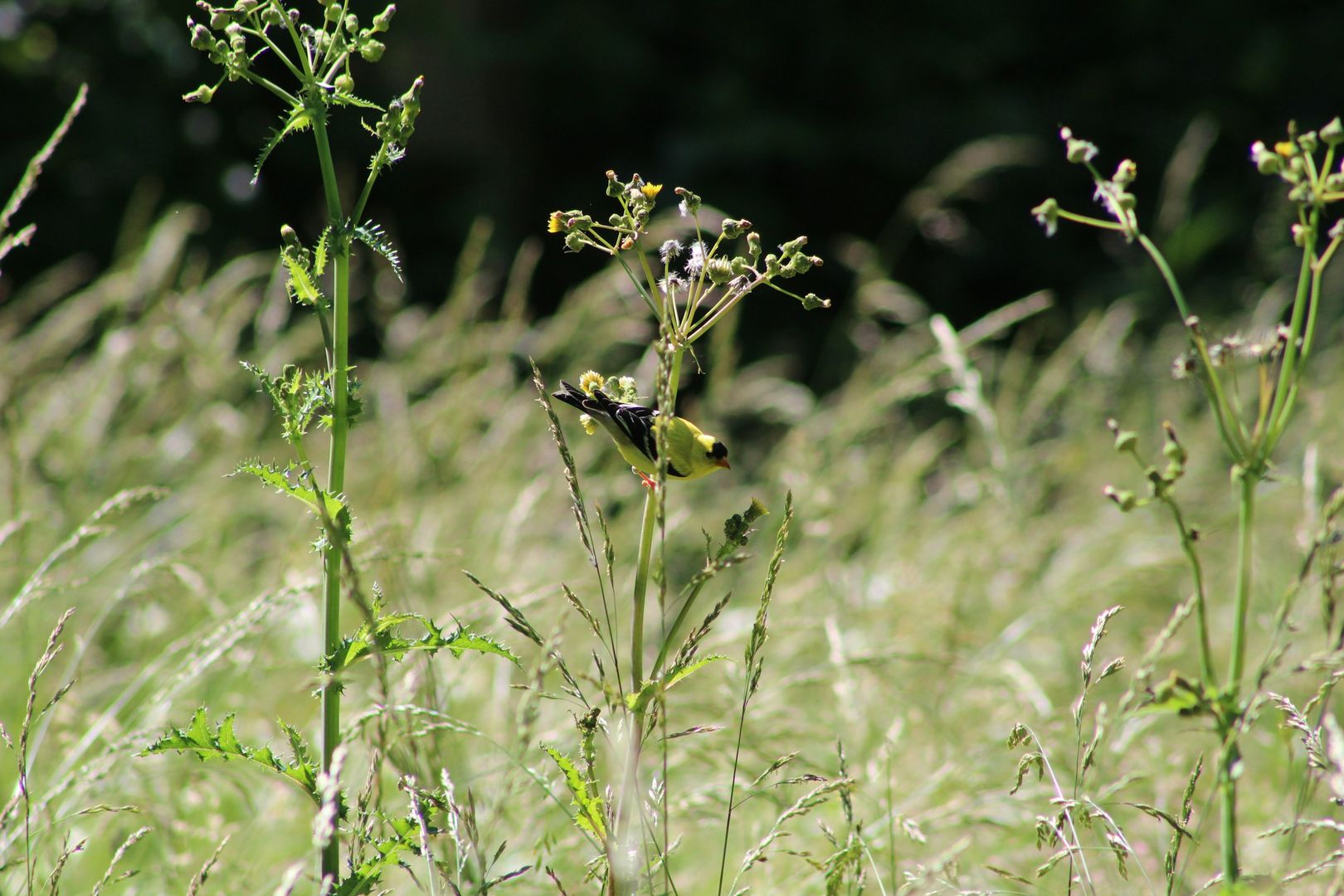
The American Goldfinch sticks around all winter, just in a much quieter outfit. Summer's bright yellow fades to a buffy olive-brown, which is either quiet luxury or a very convincing disguise.
In winter, males keep a yellowish face and throat and bold black wings with white bars, while females are duller and grayer. Both have a short, pale, cone-shaped bill.
The American Goldfinch call is a bouncy po-ta-to-chip given in its roller-coaster flight.
Goldfinches winter in weedy fields, river bottoms, and suburbs along the Front Range, the plains, and lower valleys.
Feeder favorites: nyjer, sunflower chips, black oil sunflower
16. Pine Siskin
- Family – Fringillidae
- Species – Spinus pinus
- Primary Activity Time – Daytime
- Diurnal
- Resident Colorado Bird / Irruptive
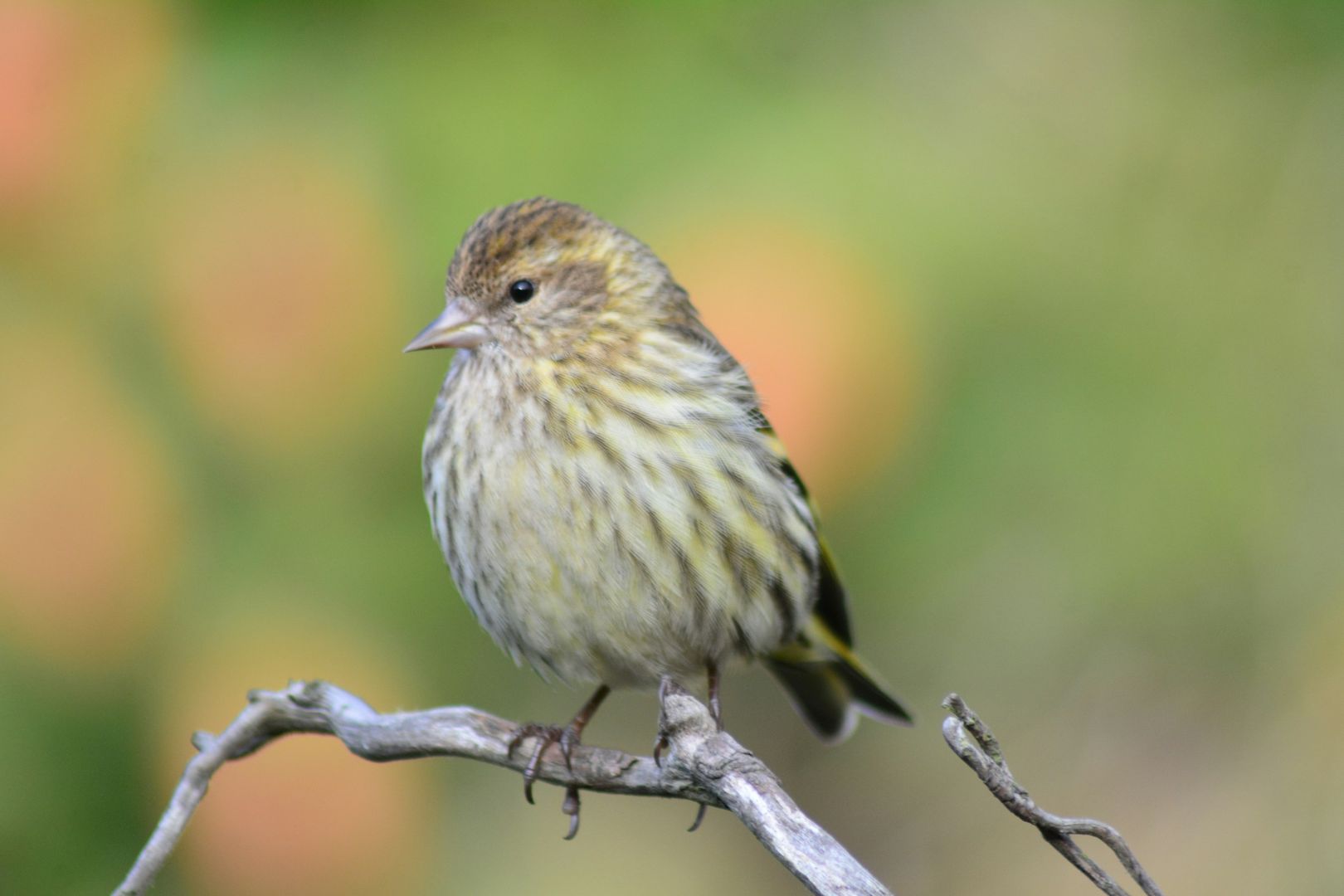
The Pine Siskin is a small, streaky finch with a sharp little bill built for conifer seeds. It's a year-round mountain bird in Colorado, but its numbers swing wildly from winter to winter as flocks wander after good cone crops.
It's brown and heavily streaked, with flashes of yellow in the wings and tail. Males usually show more yellow than females.
The Pine Siskin call is a rising, buzzy zreeee, like someone slowly zipping a jacket.
In Colorado, siskins can show up anywhere from mountain forests to Denver feeders, sometimes by the dozen.
Feeder favorites: nyjer, sunflower chips. Keep feeders clean, since crowded siskin flocks are prone to salmonella outbreaks
17. Cassin's Finch
- Family – Fringillidae
- Species – Haemorhous cassinii
- Primary Activity Time – Daytime
- Diurnal
- Resident Colorado Bird
The Cassin's Finch is the mountain finch that most people mistake for a House Finch. It eats seeds and buds and visits feeders in mountain towns all winter. It also made FeederWatch's Southwest top 25.
Males have a bright raspberry-red crown that often looks peaked, a pinkish wash over the face and breast, and a whiter belly than a House Finch. Females are brown and white with crisp, fine streaks and a faint eyebrow, which looks sharper and cleaner than a female House Finch's blurry streaks.
The Cassin's Finch song is a rich, fast warble, and the flight call is a two-part kee-up.
In Colorado it lives in conifer forests in the mountains, and some drop to lower elevations in winter.
Feeder favorites: black oil sunflower, sunflower chips
18. Evening Grosbeak
- Family – Fringillidae
- Species – Coccothraustes vespertinus
- Primary Activity Time – Daytime
- Diurnal
- Resident Colorado Bird / Irruptive
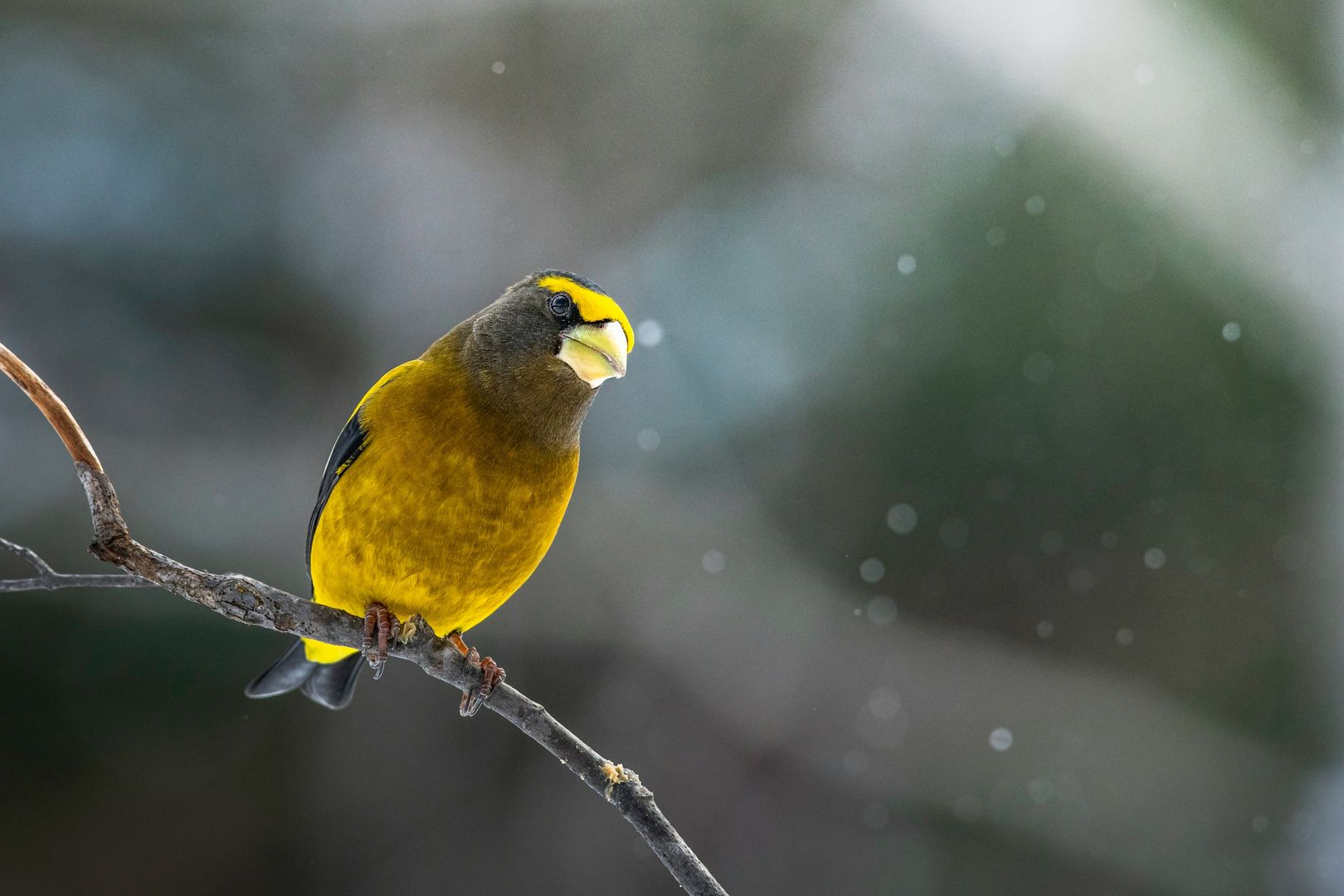
The Evening Grosbeak is a stocky finch with a massive pale bill that can crack seeds most birds can't. It's a mountain resident in Colorado, but flocks wander, so a feeder can host 30 one week and zero the next.
Males are golden-yellow with a dark head, a bright yellow eyebrow, and black wings with a big white patch. Females are gray with a yellowish wash on the neck and sides and black-and-white wings.
The Evening Grosbeak call is a loud, ringing peer or cleer, and a flock sounds a bit like a group of sparrows that took voice lessons.
In Colorado, look for them in mountain towns and conifer forests, and sometimes at lower elevations in winter.
Feeder favorites: black oil sunflower on a platform feeder
19. Spotted Towhee
- Family – Passerellidae
- Species – Pipilo maculatus
- Primary Activity Time – Daytime
- Diurnal
- Resident Colorado Bird
The Spotted Towhee is a big, colorful sparrow that feeds by hopping backward with both feet to kick away leaves, which is how I look trying to find my keys in the car.
Males have a black hood and back, rusty sides, a white belly, white spots on the wings, and red eyes. Females have the same pattern, but the black is swapped for a dark gray-brown.
The Spotted Towhee call is a cat-like, rising mew or zhreee, and the song is a buzzy trill.
In Colorado, towhees winter in the foothills, in scrub oak, and in brushy yards and parks along the Front Range. Many leave the higher elevations once snow sets in.
Feeder favorites: white millet, sunflower chips, cracked corn on the ground
20. White-crowned Sparrow
- Family – Passerellidae
- Species – Zonotrichia leucophrys
- Primary Activity Time – Daytime
- Diurnal
- Resident Colorado Bird / Winter Migrant
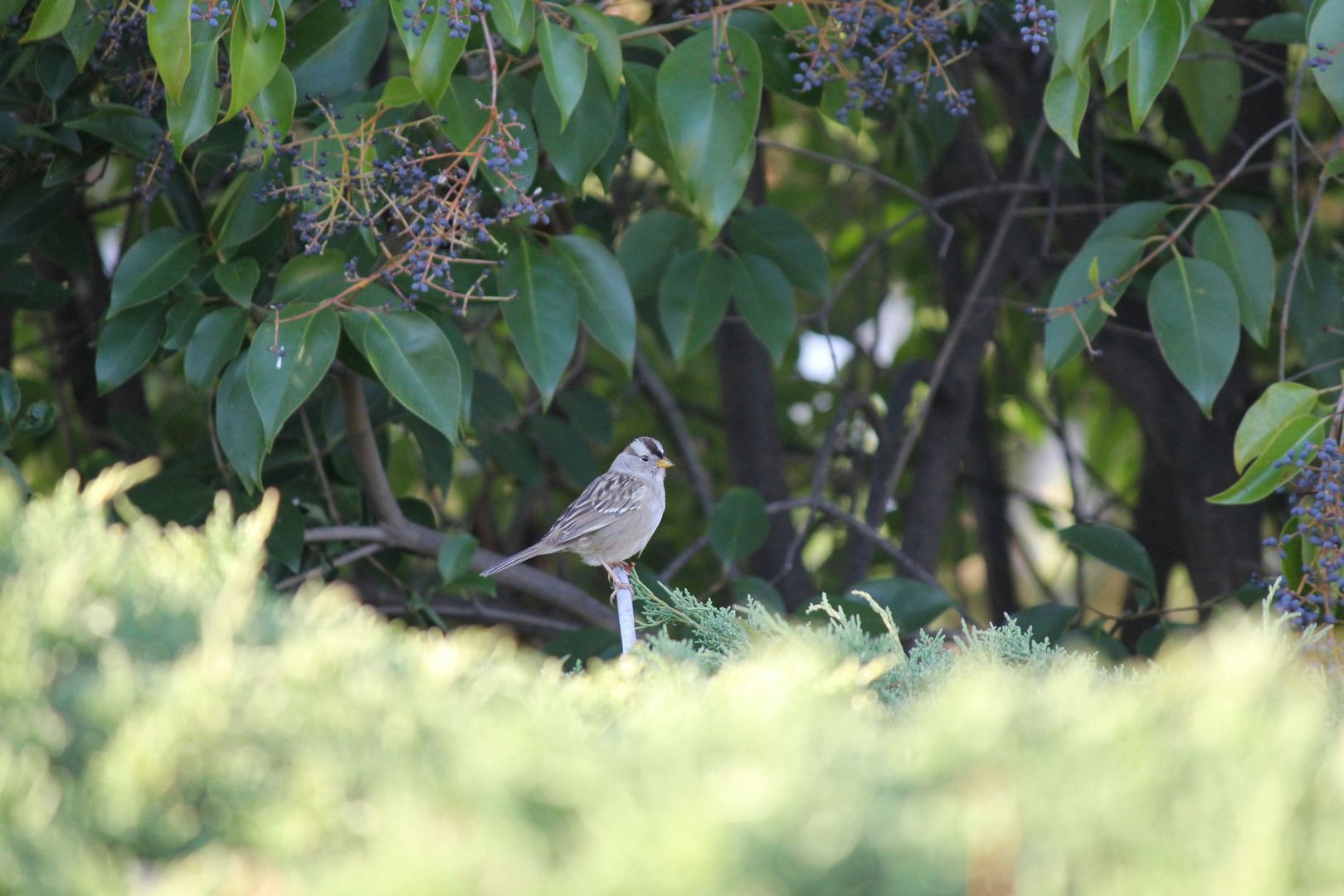
The White-crowned Sparrow is a sharp-looking sparrow with a striped head that breeds high in Colorado's mountains and winters in the lowlands. The birds you see in January are mostly visitors from farther north.
Adults have bold black-and-white stripes on the crown, a gray face and breast, and a pinkish to yellowish bill. Young birds have brown-and-tan head stripes instead. Males and females look alike.
The White-crowned Sparrow call is a sharp pink, and the song is a clear whistle followed by buzzy notes.
In Colorado they winter on the eastern plains, along the Front Range, and in lower Western Slope valleys, usually in flocks in brushy edges.
Feeder favorites: white millet, sunflower chips, cracked corn on the ground
21. American Tree Sparrow
- Family – Passerellidae
- Species – Spizelloides arborea
- Primary Activity Time – Daytime
- Diurnal
- Winter Migrant / Visitor
The American Tree Sparrow is a winter visitor from the far north that spends nearly all its time on the ground, despite the name. (Bird names are a bit like my high school nicknames: not always accurate.)
It has a rusty cap, a rusty line behind the eye, a gray face, a two-toned bill (dark above, yellow below), and a dark spot in the center of a plain gray breast. Males and females look alike.
The American Tree Sparrow call is a high tseet, and flocks give a soft, tinkling twitter.
In Colorado, they winter mostly on the eastern plains and along the Front Range, in weedy fields, cattail edges, and hedgerows.
Feeder favorites: white millet, cracked corn scattered on the ground
22. Brown-capped Rosy-Finch
- Family – Fringillidae
- Species – Leucosticte australis
- Primary Activity Time – Daytime
- Diurnal
- Resident Colorado Bird
The Brown-capped Rosy-Finch is the headliner of Colorado winter birds. The Colorado Field Ornithologists call it one of Colorado's only endemic breeding birds, because it nests on the alpine tundra here and almost nowhere else. In winter, flocks drop down from the peaks to feed, and that's when you can see them at mountain feeders.
It's a warm brown finch with pink on the belly, rump, and wings. Males have a darker brown cap and more pink, while females are duller with much less pink.
The Brown-capped Rosy-Finch call is a husky, buzzy chew, and flocks keep up a steady chatter as they swirl in and out.
They winter at high-elevation feeders in mountain towns. In March 2023, Evergreen Audubon counted about 110 Brown-capped Rosy-Finches at feeders above 9,500 feet near Evergreen. The species is under increasing stress from the loss of alpine habitat, and the CFO's winter project collects sightings, so if they visit your feeder, report them.
Feeder favorites: black oil sunflower, sunflower chips on a platform or the ground
23. Gray-crowned Rosy-Finch
- Family – Fringillidae
- Species – Leucosticte tephrocotis
- Primary Activity Time – Daytime
- Diurnal
- Winter Migrant / Visitor
The Gray-crowned Rosy-Finch breeds on mountaintops and tundra from Alaska south through the Rockies, and in winter it joins the Brown-capped flocks in Colorado. It's the most widespread of the three rosy-finches.
It's chocolate-brown with pink on the belly and wings, a black forehead, and a gray band around the back of the head. Some birds, from a race called "Hepburn's," have gray covering the whole cheek. Males are brighter and pinker, while females are duller and grayer.
The Gray-crowned Rosy-Finch call is a buzzy chew, very similar to its Brown-capped cousins, so it helps to check every bird in the flock.
In Colorado they mix into rosy-finch flocks at mountain feeders and in open, windswept valleys like North Park.
Feeder favorites: black oil sunflower, sunflower chips
24. Black Rosy-Finch
- Family – Fringillidae
- Species – Leucosticte atrata
- Primary Activity Time – Daytime
- Diurnal
- Winter Migrant / Visitor (uncommon, mountain feeders)
The Black Rosy-Finch is the rarest of the three in Colorado and the one everyone hopes to find. It breeds in the high peaks of the Great Basin and northern Rockies and drifts into Colorado in winter, usually in small numbers mixed into bigger flocks. 10,000 Birds notes it's usually the least common of the three at Colorado feeders.
Males are blackish-brown with a gray band around the back of the head and pink on the belly and wings. Females are grayer and duller, with less pink.
The Black Rosy-Finch call is a buzzy chew, like the other rosy-finches.
In Colorado, look for one or two hiding in big rosy-finch flocks at mountain feeders. That same Evergreen count found just two among more than a hundred Brown-cappeds, which is roughly my odds of finding matching socks before a 7 a.m. bird walk.
Feeder favorites: black oil sunflower, sunflower chips
25. Clark's Nutcracker
- Family – Corvidae
- Species – Nucifraga columbiana
- Primary Activity Time – Daytime
- Diurnal
- Resident Colorado Bird
The Clark's Nutcracker is a high-mountain corvid that pries seeds out of pine cones and buries them by the thousands. According to the Steamboat Pilot, it caches up to 100,000 seeds and finds most of them again months later.
It's pale gray with black wings and a black-and-white tail, and it has a long, sharp black bill. Males and females look alike.
The Clark's Nutcracker call is a harsh, grating kraaa that carries across mountain valleys.
In Colorado it lives near treeline and in high pine forests, and visits feeders and picnic areas in mountain towns.
Feeder favorites: suet, peanuts
26. Townsend's Solitaire
- Family – Turdidae
- Species – Myadestes townsendi
- Primary Activity Time – Daytime
- Diurnal
- Resident Colorado Bird
The Townsend's Solitaire is a slim gray thrush that spends the winter guarding a patch of juniper trees. According to the National Park Service's Townsend's Solitaire page, both sexes defend these berry patches, sometimes violently, and birds with bigger territories survive winter better. (I'm the same way about the last slice of pizza.)
It's plain gray with a white eye ring, white outer tail feathers, and buffy wing patches that flash in flight. Males and females look alike.
The Townsend's Solitaire call is a single, clear whistled heeh, repeated like a squeaky gate. Males also sing a long, rambling song through fall and winter.
In Colorado, look for them in juniper-covered foothills, canyons, and open pine forest, usually perched on top of a tree.
Feeder favorites: rarely visits feeders, but a heated bird bath can bring one in
27. American Dipper
- Family – Cinclidae
- Species – Cinclus mexicanus
- Primary Activity Time – Daytime
- Diurnal
- Resident Colorado Bird
The American Dipper is a songbird that walks underwater. It hunts insect larvae and tiny fish on the bottoms of fast mountain streams, even in January, and bobs up and down on rocks between dives.
It's a chunky, slate-gray bird with a short tail and a white eyelid that flashes when it blinks. Males and females look alike.
The American Dipper song is a loud, bubbly series of whistles and trills that you can hear over rushing water, and it sings all winter.
In Colorado, look for dippers on open, unfrozen streams in the mountains and foothills, often near bridges and below dams. Many move downstream in winter when higher water freezes.
28. White-tailed Ptarmigan
- Family – Phasianidae
- Species – Lagopus leucura
- Primary Activity Time – Daytime
- Diurnal
- Resident Colorado Bird
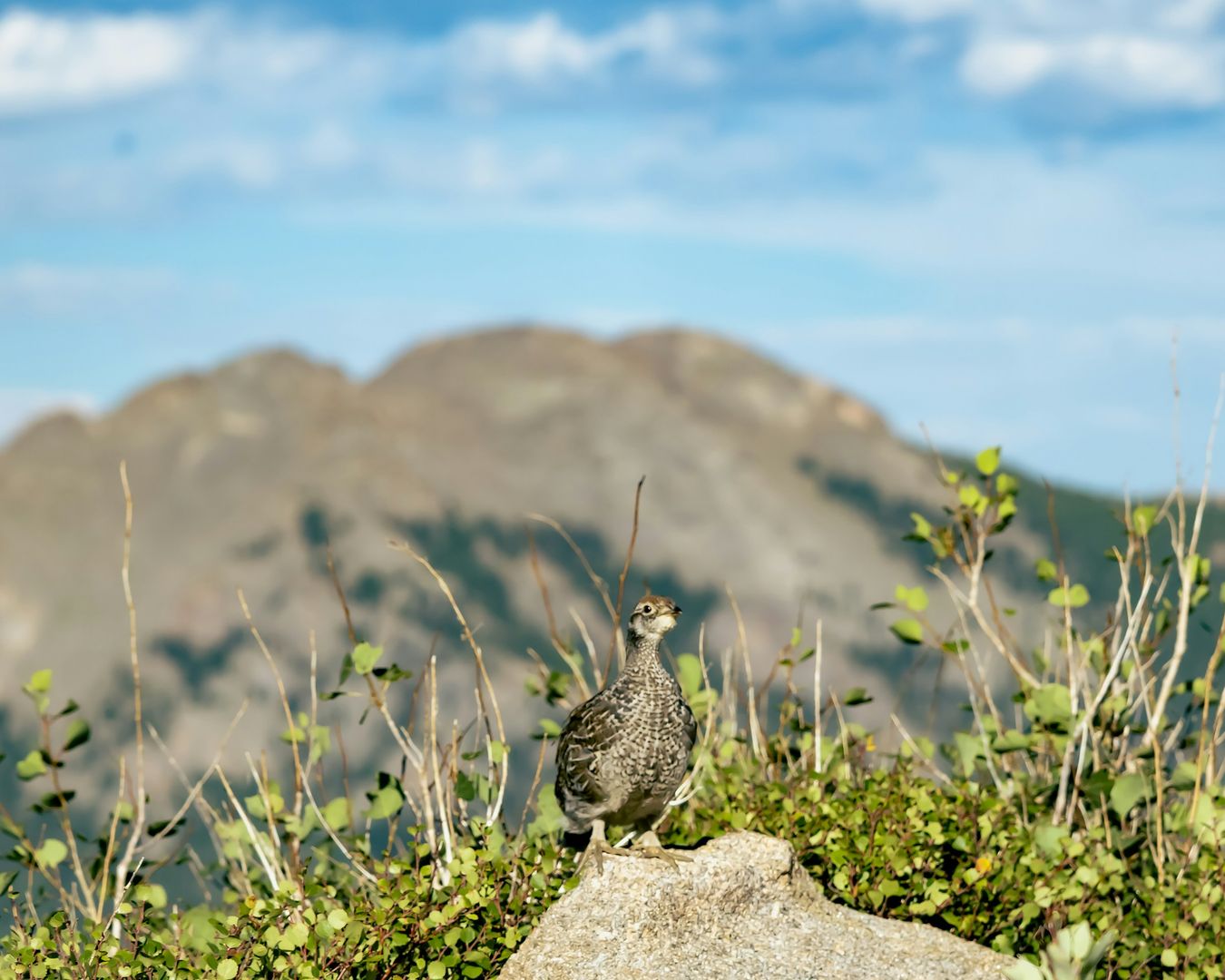
The White-tailed Ptarmigan is a grouse that lives on Colorado's alpine tundra all year. It eats dried leaves and buds in winter, digs snow roosts up to a foot deep, and grows feathered "snowshoes" on its feet, per the Steamboat Pilot.
In winter it's pure white except for its black eyes and bill, which makes it nearly invisible against the snow. Males and females look alike in winter.
The White-tailed Ptarmigan call is a soft clucking, and it's usually quiet in winter.
In Colorado it lives above treeline, roughly 10,000 feet and up, and birders often look for them at high passes in willow patches. Ptarmigan save energy by avoiding flight, so give them plenty of space and never flush them.
29. Bald Eagle
- Family – Accipitridae
- Species – Haliaeetus leucocephalus
- Primary Activity Time – Daytime
- Diurnal
- Resident Colorado Bird / Winter Migrant
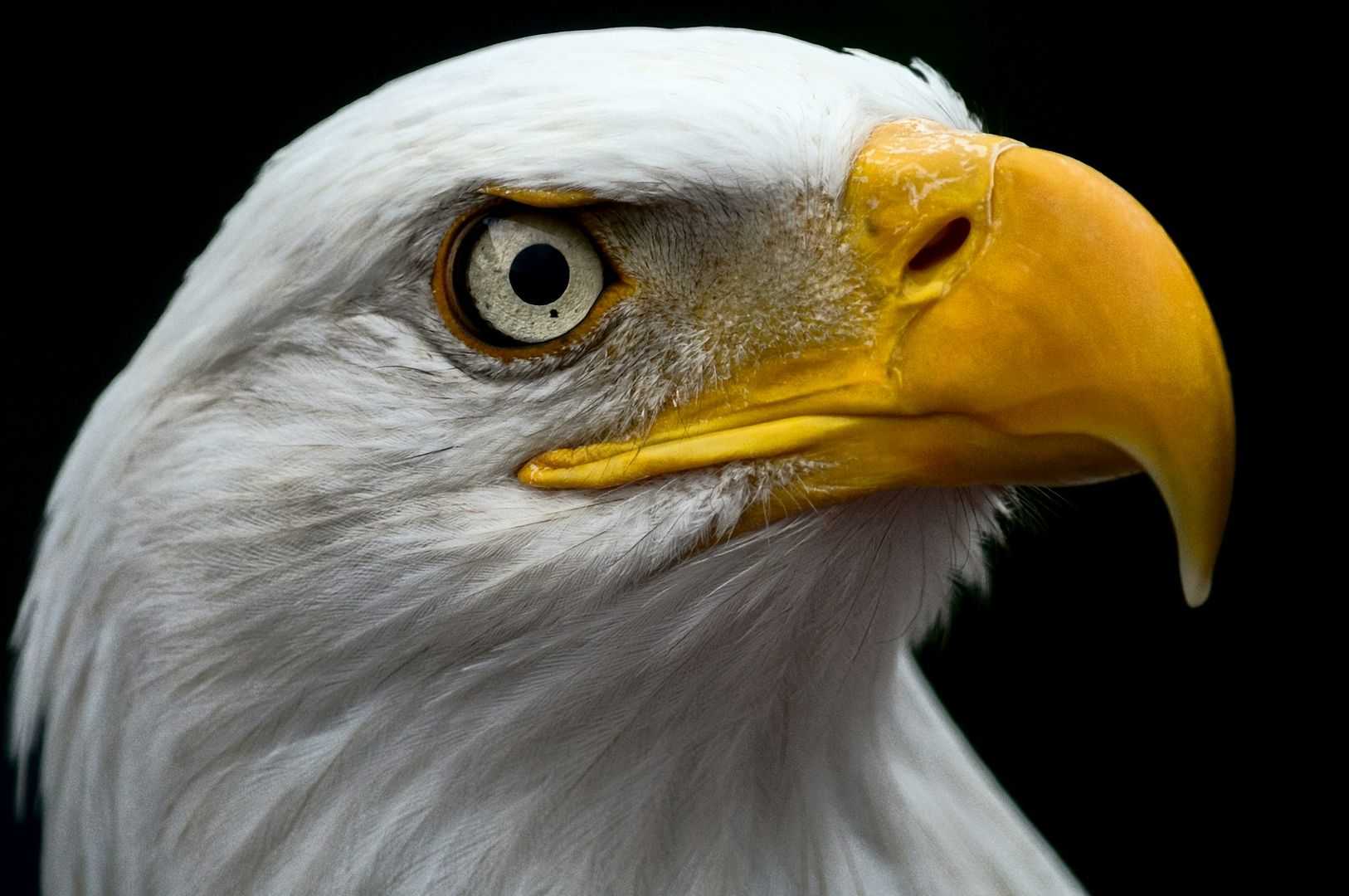
The Bald Eagle is a big fish-eating raptor that also scavenges carrion and steals food from other birds. Wintering eagles join Colorado's resident pairs, and the population has come a long way. Colorado Outdoors magazine notes the state had only two documented nests in the 1970s and more than 170 active nests by 2017.
Adults have a dark brown body, a white head and tail, and a big yellow bill. Young eagles are mottled brown and white and take about five years to get the full look. Males and females look alike, though females are bigger.
The Bald Eagle call is a high, thin series of chirps and whistles, much weaker than you'd expect from a national symbol.
In Colorado, eagles gather near open water and prairie dog towns, especially at reservoirs and rivers along the Front Range and Western Slope.
30. Rough-legged Hawk
- Family – Accipitridae
- Species – Buteo lagopus
- Primary Activity Time – Daytime
- Diurnal
- Winter Migrant / Visitor
The Rough-legged Hawk is an Arctic-breeding hawk that spends the winter hunting voles in open country. It often hovers in place facing into the wind, which is a giveaway for a hawk this size.
Most are light morph, with a pale head, a dark belly band, a white tail with a broad dark band near the tip, and dark patches at the bend of the underwing. Its legs are feathered right to the toes. Colorado Central Magazine notes females are heavier and browner on the back, and that Colorado sees far more males, since females don't migrate as far south.
The Rough-legged Hawk call is a mewing, descending scream, though it's quiet most of the winter.
In Colorado, they usually arrive in November and leave by early April. Look on fence posts and power poles in open country, like South Park along U.S. 285 and the eastern plains. Numbers vary a lot by year.
31. Ferruginous Hawk
- Family – Accipitridae
- Species – Buteo regalis
- Primary Activity Time – Daytime
- Diurnal
- Resident Colorado Bird / Winter Migrant
The Ferruginous Hawk is the largest hawk in North America, and on Colorado's eastern plains in winter it hunts prairie dogs, ground squirrels, and rabbits, often from the ground right next to a burrow.
Light-morph adults are rusty above with a pale head, a white or pale tail, white underparts, and rusty, feathered legs that form a dark "V" when it flies overhead. Males and females look alike, though females are larger.
The Ferruginous Hawk call is a harsh, descending kree-a, but it's mostly quiet in winter.
In Colorado, look over prairie dog towns on the eastern plains, especially east of Denver. A February 2026 Evergreen Audubon raptor drive from Wiggins to the Rocky Mountain Arsenal tallied five of them in a day.
32. Cooper's Hawk
- Family – Accipitridae
- Species – Astur cooperii
- Primary Activity Time – Daytime
- Diurnal
- Resident Colorado Bird
The Cooper's Hawk is a crow-sized hawk that hunts songbirds and doves, often by dashing through yards. If your feeder suddenly empties and everyone freezes, there's probably one nearby.
Adults are blue-gray above with a dark cap, fine orange barring on the chest, and a long, rounded tail with dark bands. Young birds are brown with streaks. Males and females look alike, but females are much larger.
The Cooper's Hawk call is a loud, repeated cak-cak-cak, mostly near the nest.
In Colorado it's found statewide in wooded areas and neighborhoods, and it showed up at about a third of FeederWatch sites in the Southwest region. The similar but smaller Sharp-shinned Hawk also visits feeders in winter.
33. Great Horned Owl
- Family – Strigidae
- Species – Bubo virginianus
- Primary Activity Time – Night
- Nocturnal
- Resident Colorado Bird
The Great Horned Owl is a powerful owl that eats everything from mice and rabbits to skunks and other birds. It nests earlier than almost any Colorado bird, so pairs are hooting and claiming nests in the middle of winter.
It's big and bulky with feathered ear tufts, yellow eyes, a white throat patch, and mottled gray-brown plumage with barred underparts. Males and females look alike, though females are larger.
The Great Horned Owl call is a deep, soft hoo-h'HOO-hoo-hoo, and the male's voice is lower than the female's even though he's smaller.
In Colorado it lives statewide, from cottonwood river bottoms and city parks to canyons and mountain forests. Winter evenings are the best time to hear them.
34. Bohemian Waxwing
- Family – Bombycillidae
- Species – Bombycilla garrulus
- Primary Activity Time – Daytime
- Diurnal
- Irruptive
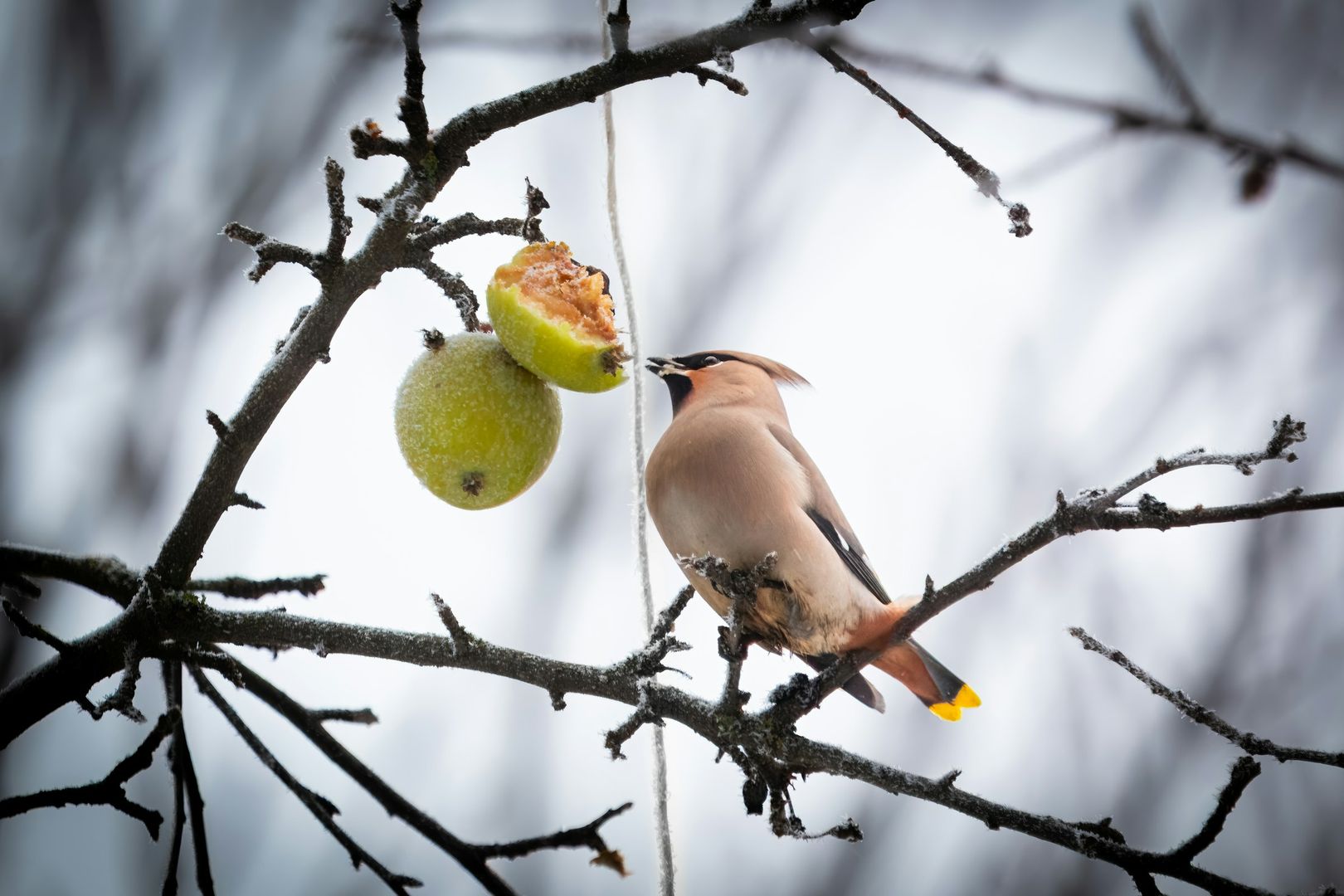
The Bohemian Waxwing is a sleek, crested berry eater that wanders south out of Canada and Alaska in some winters. When they come, they come in tight flocks that strip a fruit tree and move on.
It's soft gray with a black mask, a pointed crest, a yellow-tipped tail, and rusty feathers under the tail (the easy way to tell it from a Cedar Waxwing, which has a pale belly and white undertail). Males and females look very similar.
The Bohemian Waxwing call is a high, buzzy trill that sounds lower and rougher than a Cedar Waxwing's.
In Colorado, Bohemian Waxwings are irregular, showing up in mountain towns and along the Front Range in some years and not at all in others. Check fruiting crabapples, junipers, and mountain ash.
35. Barrow's Goldeneye
- Family – Anatidae
- Species – Bucephala islandica
- Primary Activity Time – Daytime
- Diurnal
- Winter Migrant (uncommon, open rivers on the Western Slope)
The Barrow's Goldeneye is a diving duck that eats aquatic insects, snails, and small fish. Most spend the winter on the Pacific coast, but some winter inland on rivers and lakes that stay open, and Colorado has a few of those.
Males are black and white with a purplish head, a white crescent in front of the eye, and a row of white "windows" along the shoulder. Females are gray with a brown head and an orange-yellow bill. The similar Common Goldeneye, which is far more common in Colorado in winter, has a round white spot on the face instead of a crescent.
The Barrow's Goldeneye call is mostly silent outside of courtship, though their wings make a whistling sound in flight.
In Colorado, Barrow's Goldeneyes are uncommon in winter, with reports from open river stretches on the Western Slope like the Roaring Fork near Carbondale. Check any flock of Common Goldeneyes carefully, including at Front Range lakes.
Where to See Birds of Colorado in Winter
Colorado birding in winter is mostly about elevation. A few spots and strategies cover nearly everything on this list:
- Front Range reservoirs for eagles. Barr Lake State Park near Brighton hosts big winter gatherings of Bald Eagles, plus goldeneyes, grebes, and gulls, and its Bald Eagle Festival is held in early February. Lake Pueblo State Park holds its own Eagle Days the same month
- Mountain feeders for rosy-finches. Feeders in high-elevation towns and neighborhoods are the easiest way to see all three rosy-finches, along with Steller's Jays, Mountain Chickadees, Clark's Nutcrackers, and Evening Grosbeaks. The Rosy-Finch Winter Project wants your sightings
- Eastern plains for raptors. Drive slowly past prairie dog towns and open farmland for Ferruginous and Rough-legged Hawks, Golden and Bald Eagles, Prairie Falcons, and huge flocks of Horned Larks
- Open streams for dippers. Any unfrozen mountain stream is worth a look
One more Colorado rule: if you live in bear country, only feed birds when the bears are asleep. CPW recommends you don't feed birds during months when bears are active, which is the good news here, since winter is exactly when a feeder makes the most sense. My mom once mistook a raccoon stealing her porch wine for a burglar. In Colorado, the porch bandit is a few hundred pounds heavier, so bring feeders in when spring arrives.
Colorado Winter Birds FAQ
What birds stay in Colorado in the winter?
Most of Colorado's resident birds stay, including chickadees, nuthatches, woodpeckers, jays, magpies, House Finches, and Northern Flickers. Many simply move downhill. They're joined by winter visitors like Gray-crowned and Black Rosy-Finches, Rough-legged Hawks, American Tree Sparrows, and northern juncos, plus irruptive Pine Siskins and Bohemian Waxwings in some years. For the neighbors to the north, see our guide to winter birds in Wyoming.
What are the most common birds in Colorado in winter?
At feeders, the regulars are House Finch, Dark-eyed Junco, Northern Flicker, Black-capped and Mountain Chickadees, nuthatches, Downy and Hairy Woodpeckers, American Goldfinch, and Black-billed Magpie. In FeederWatch's Southwest region, House Finch showed up at 94% of sites and Dark-eyed Junco at 82%. Outside the yard, American Robins, Canada Geese, and Bald Eagles are all easy to find.
Where can I see rosy-finches in Colorado?
The best bet is a feeder in a high-elevation mountain town or neighborhood from late fall into early spring. Their movements depend on snow, so feeder numbers tend to climb when storms bury their food up high. Rosy-finches also winter in New Mexico, where Sandia Crest near Albuquerque is famous for all three. See our guide to winter birds in New Mexico.
Is the Colorado state bird around in winter?
No. The Lark Bunting, Colorado's state bird since 1931, arrives on the eastern plains in April and heads south by September, so you won't see it in winter.
What are the best birds of Colorado to see only in winter?
Rough-legged Hawks, Gray-crowned and Black Rosy-Finches, American Tree Sparrows, and, in irruption years, Bohemian Waxwings are birds you'll mostly see in Colorado in winter. Brown-capped Rosy-Finches and White-tailed Ptarmigan are here year-round, but winter is when the rosy-finches come to feeders. Keep water open for all of them, too. Here's how to keep a bird bath from freezing in winter.
What Colorado Winter Birds Have You Seen?
Whether you're scanning a reservoir for eagles or refreshing your feeder camera for rosy-finches, share your sightings and find birders near you on the Sparkbird App.
And if you drive up to a mountain feeder and the rosy-finches don't show, wait for the next snowstorm. They'll be there, and so will a very smug Steller's Jay.
No comments yet.