
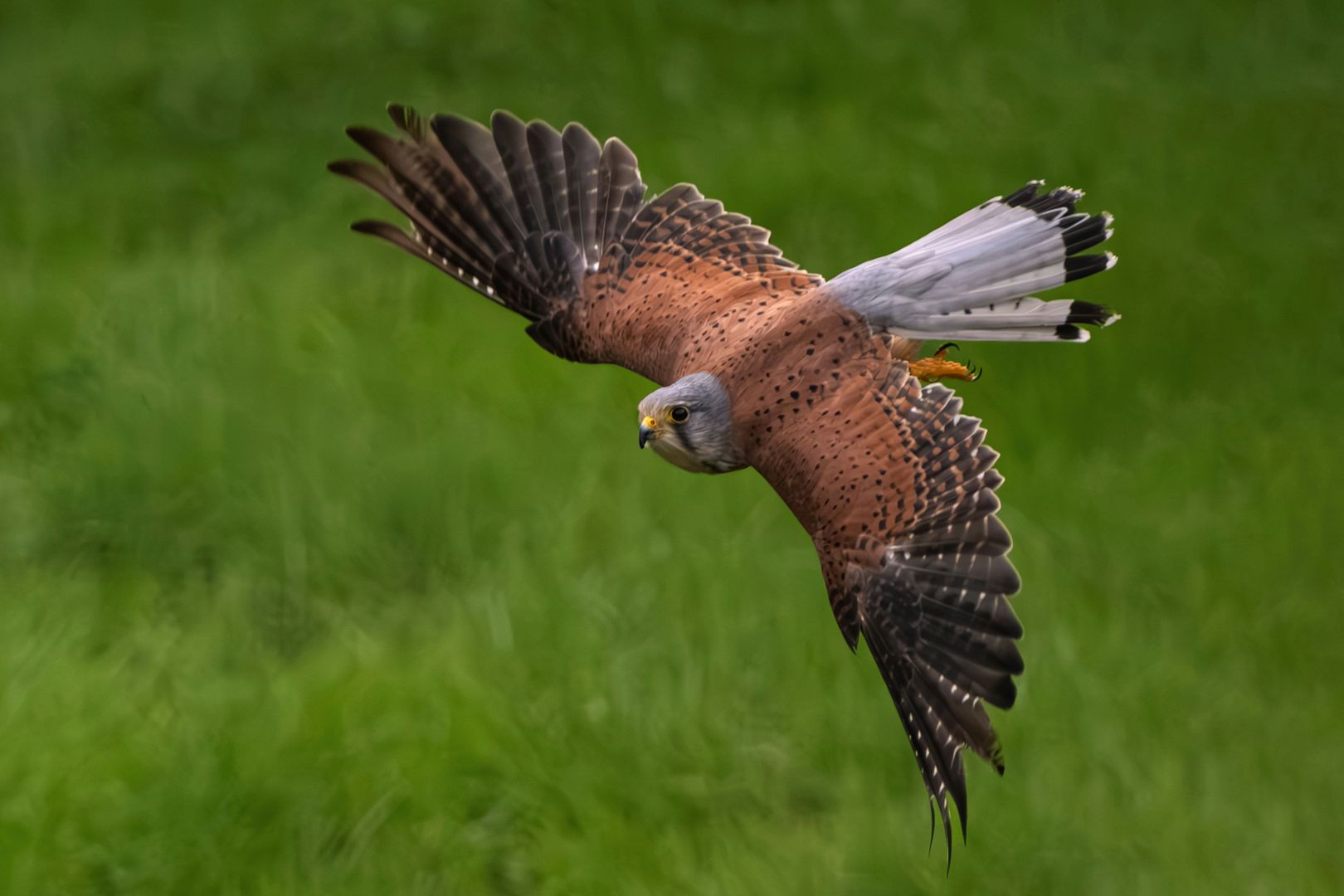
Some of us need a phone to find a coffee shop we've been to nine times. A young blackpoll warbler finds South America on its first try, at night, over open ocean.
So how do migrating birds know where to go?
There are several ways, and some of them are pretty wild.
How Do Birds Know When to Migrate?
Before the where comes the when. The biggest cue is day length. Birds can sense very small changes in daylight, and as days shorten in late summer, their bodies start prepping, and they eat more to put on fat for the trip. The Cornell Lab's migration basics also point to temperature and food supply as triggers.
Caged migratory birds even show something scientists call zugunruhe, German for "migratory restlessness." When migration season comes, they get fidgety at night and hop toward one side of the cage in spring and the opposite side in fall.
Weather decides the exact night. Big fall flights often follow cold fronts, when north winds give birds a tailwind south, according to eBird's fall birding basics.
5 Ways Birds Know How to Navigate During Migration?
Birds don't rely on one system. They cross-check several. Here are the big ones.
1) The Sun Compass
In the 1950s, researchers working with European starlings found the birds oriented by the sun's position. When the apparent sun was shifted with mirrors, the birds shifted their direction to match.
The trick is that the sun moves across the sky all day, so the bird's sun compass is tied to its internal clock, or circadian rhythm. It knows where the sun should be at 9 a.m. versus 3 p.m. and adjusts. Birds can also read patterns of polarized light in the sky, which helps around sunset and on overcast days.
2) The Star Compass
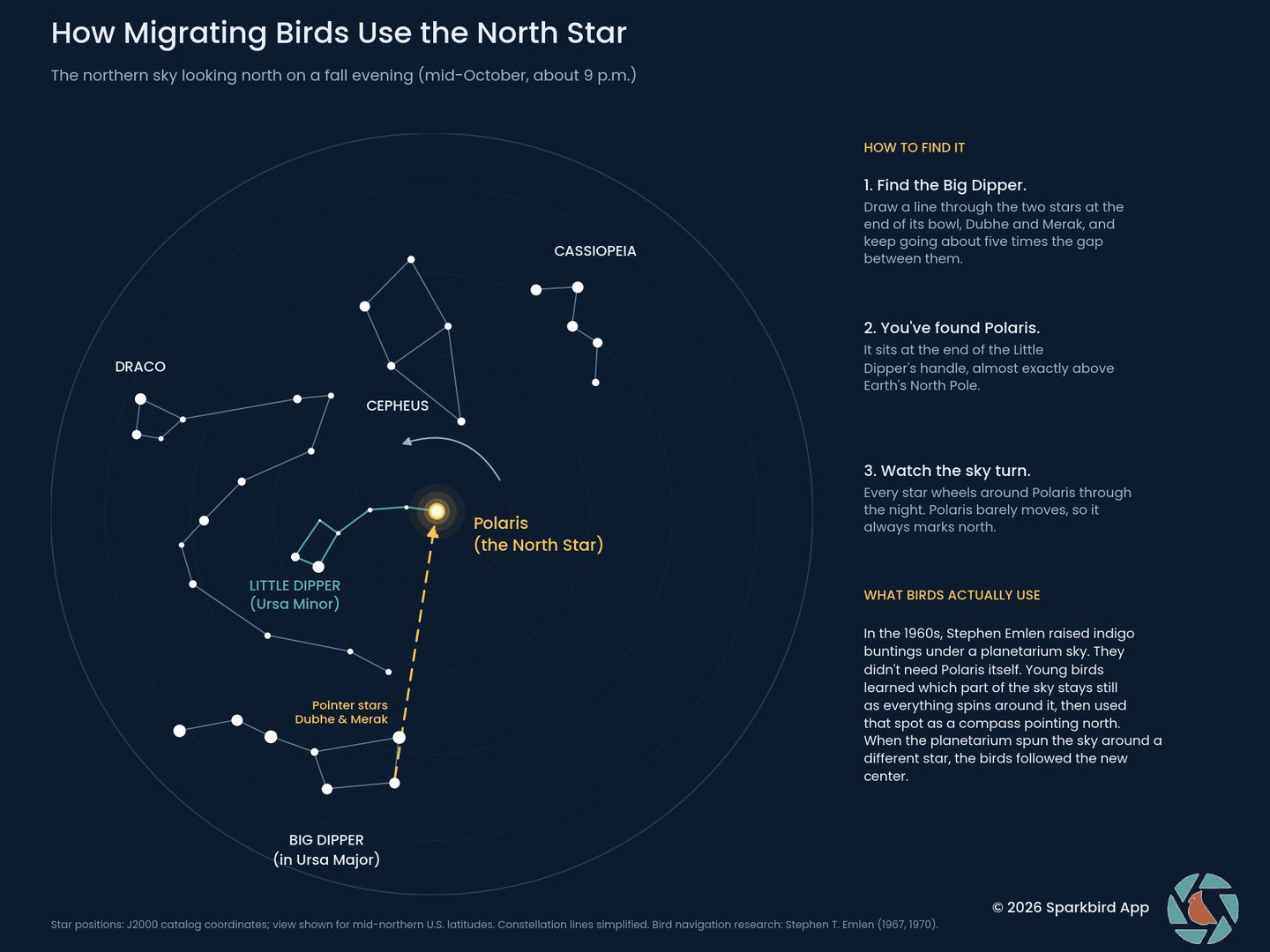
Most songbirds migrate at night, so they need a night shift navigator. In 1967, Cornell scientist Stephen Emlen put indigo buntings in a planetarium and found they oriented using the projected stars. They use the position of the North Star in the night sky.
When the planetarium sky was rotated around a different star, the birds acted as if Betelgeuse were the North Star, according to Stanford's essay on bird navigation. Young buntings learn to find the point of least movement in the sky, so they're not born knowing constellations.
They're born knowing how to find north.
3) A Magnetic Sense
Birds can sense Earth's magnetic field, and scientists think they can sense it a few different ways.
Magnetic Body Parts
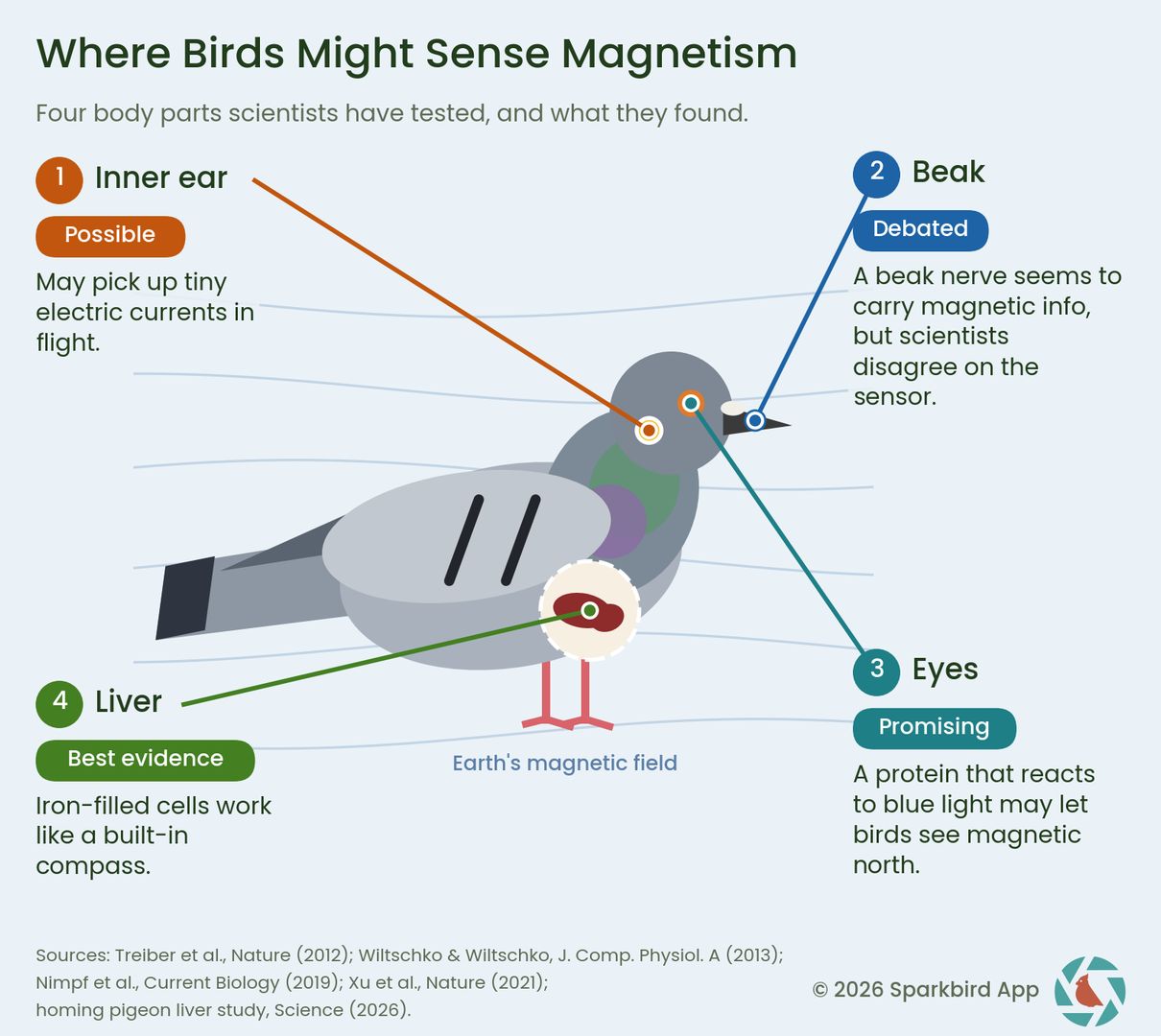
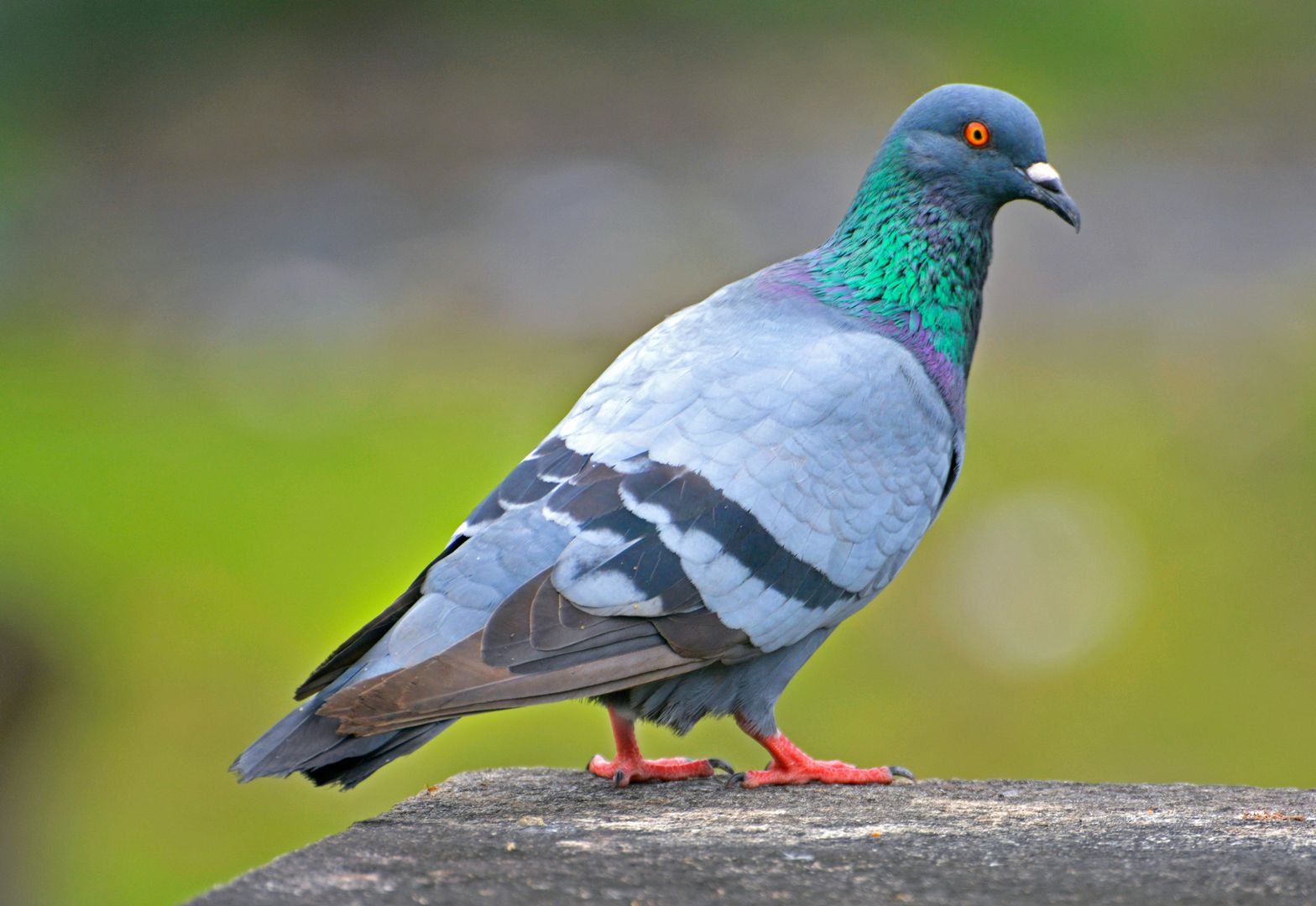
Some birds like pigeons use magnetic receptors in their beaks for navigation. This magnetite (magnetite rock) acts as a homing device. The researchers call the discovery "one factor in the multi-factorial navigational ‘map."
A recent experiment discovered there's a small amount of magnetic iron in their livers.
This acts like a compass needle the birds can feel and pulls them towards true north. Christian Kurts and Clivia Lisowski found that pigeons had a good deal of ferritin in their liver macrophages which was "scarce in the spleen and absent in the beak or brain," unable to confirm the hypothesis that birds have magnetite in their beaks.
There's also an experiment that showed "that varying magnetic fields induces electric currents in their inner ears, stimulating nerves that lead to the brain."
Birds Can See Magnetic Fields
...maybe. It's not totally confirmed yet.
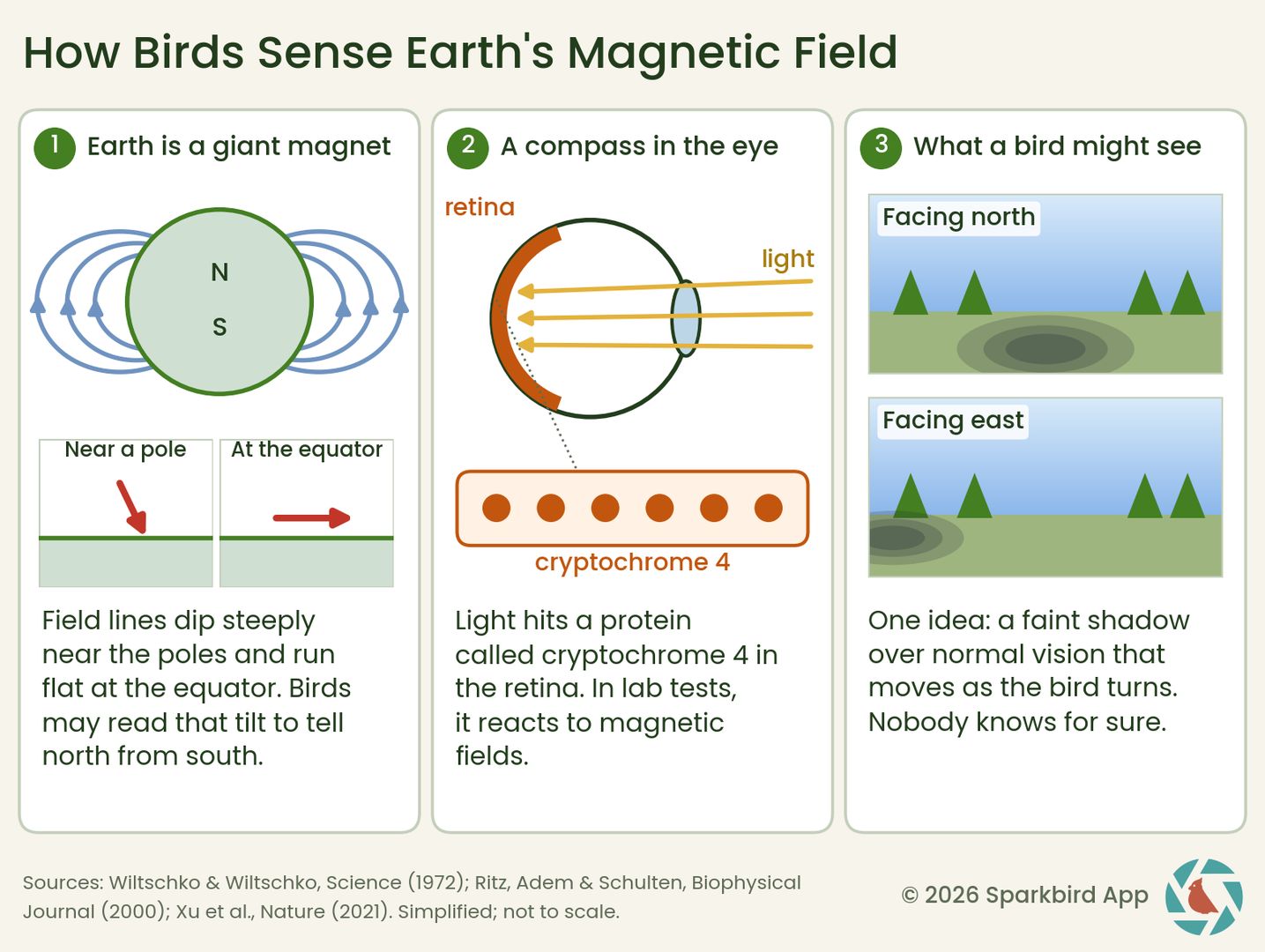
A 2021 study in Nature, covered by the University of Oxford, found that a protein called cryptochrome 4 from European robins is magnetically sensitive when it absorbs blue light, through a quantum effect involving pairs of electrons.
The researchers are careful to say it isn't proven in living birds yet, but it's the leading candidate for how a robin might actually "see" magnetic north.
4) Landmarks
Daytime migrants like hawks and waterfowl follow the map below them. Mountain ridges, river valleys, and coastlines act like highways, and birds also funnel through "pinch points," such as the narrow Strait of Gibraltar, to keep dangerous water crossings short.
5) Smell
For seabirds over open ocean, there aren't many landmarks. A 2017 study tracked 32 Scopoli's shearwaters off Menorca using GPS loggers. Birds that had their sense of smell temporarily blocked could still feed and fly, but when out of sight of land they took "curiously straight but poorly oriented flights," according to the University of Oxford's summary.
For these seabirds, the ocean seems to have a smell map.
Inherited and Learned Migration
Many young songbirds migrate alone, without adults, to wintering grounds they've never seen. That means the basics are inherited— roughly which direction to fly and for how long.
Experience gives them a map. In one experiment described by Lake Forest College, researchers caught white-crowned sparrows migrating through Washington and flew them to New Jersey. The adults corrected course toward their wintering grounds. The juveniles kept flying south, following their inherited direction, as if nothing had changed. Juvenile birds basically have a compass and spidey sense, and develop a map as they age.
Not every species works this way. Cranes, geese, and many other waterfowl travel in family groups, and young birds learn the route by following their parents. For more on the "why" behind all this effort, see why birds migrate.
What Direction Do Birds Migrate?
In North America, most migrants head roughly south in fall and north in spring. Some species fly loop migrations, taking a different route each way to follow better winds or food.
Others head out over open ocean, like the blackpoll warbler's nonstop Atlantic crossing. For the most extreme routes, check out the longest bird migrations in the world. And for when these flights happen near you, our guide to the science of fall migration covers the timing.
Hummingbirds have their own playbook, too. Here's when hummingbirds migrate and where they go.
Artificial Light is Kryptonite to a Birds Navigation
Millions of years of evolution built a navigation system that works beautifully, right up until it meets a lit-up city at 2 a.m.
Artificial light at night pulls migrating birds off course, especially on foggy or low-cloud nights, and they can end up circling buildings until they're exhausted or hit glass. We can't do much about the magnetic field, but we can control a light switch.
Audubon's Lights Out program asks people to turn off nonessential lights during migration. If you love watching birds, this is one of the easiest ways to make sure there are still birds to watch.
Frequently Asked Questions
How do birds know where to migrate for the first time?
Many young birds inherit a direction and approximate distance and fly it on their own. They refine their route with experience, which is why adults can correct course after being displaced and juveniles usually can't.
Can birds sense Earth's magnetic field?
Yes. The leading theory involves a light-sensitive protein called cryptochrome in birds' eyes, along with iron-based material in the bill. Scientists are still confirming exactly how it works in living birds.
Do birds migrate at night?
Most do. More than 80 percent of U.S. migratory species fly at night, according to BirdCast. If you've heard odd sounds after dark, our guide to strange bird calls at night can help you figure out what's out there.
What have you seen this migration season?
Tell us in the comments or through the Sparkbird App, available in the Apple App Store.
- Related: How to Use the Sparkbird App


No comments yet.