
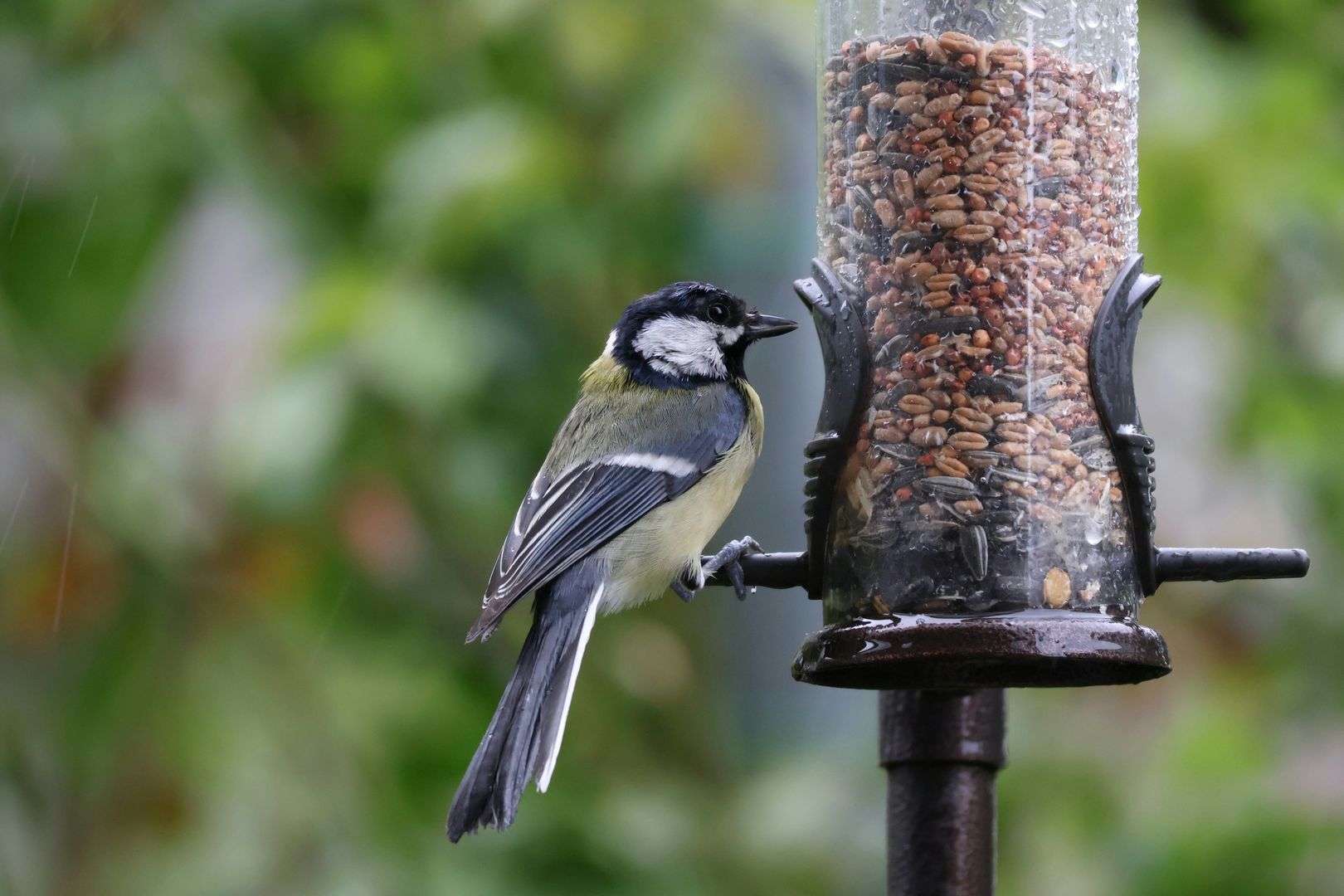
Perfectly nice windows across the country become the bird version of walking into a sliding glass door at a party.
The good news is that the best fixes are cheap, boring, and probably already in your junk drawer.
Why Do Birds Hit Windows?
Birds hitting windows isn't a sign of a dim bird. It's a sign of a very convincing window. Glass does two sneaky things at once.
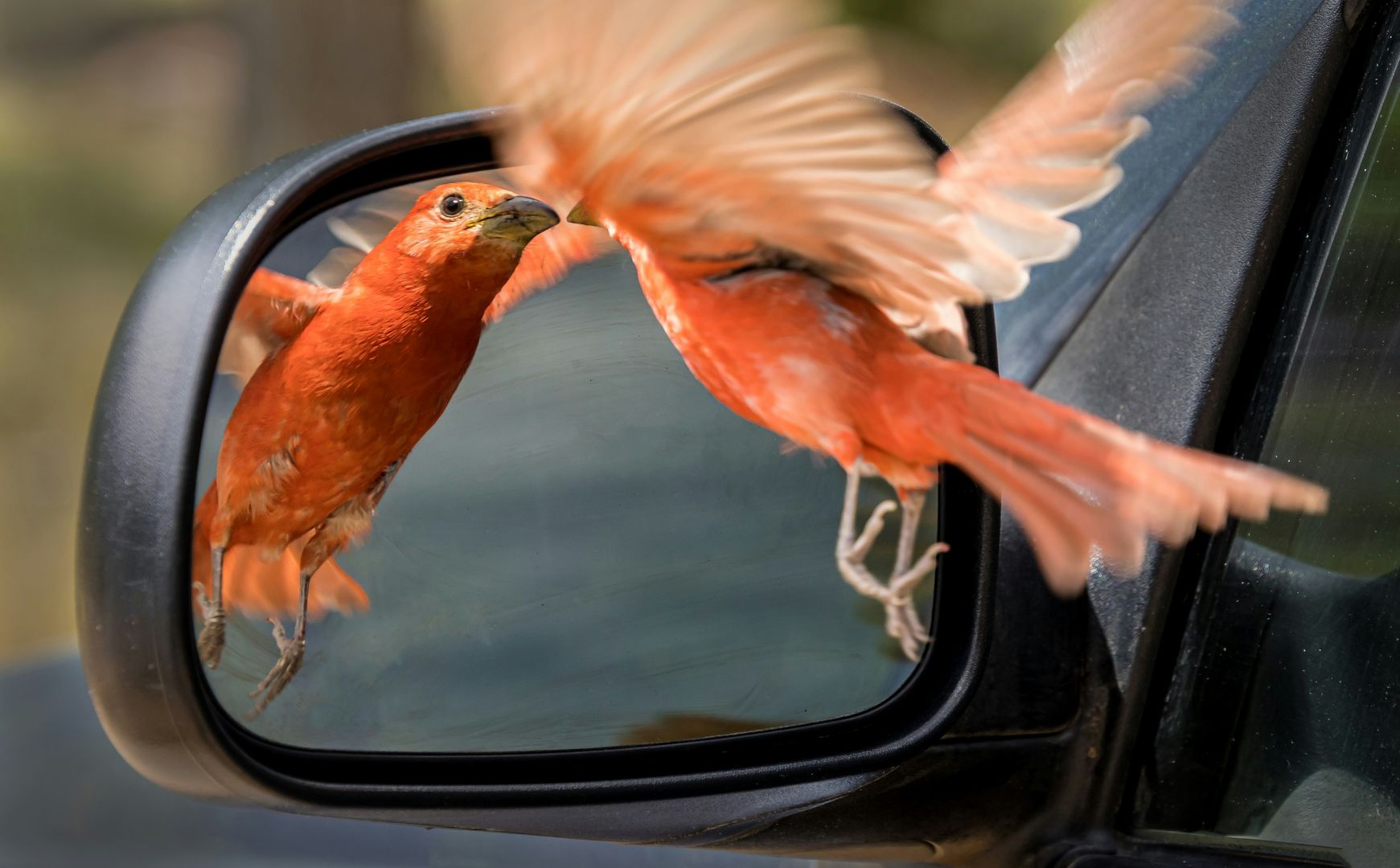
First, windows are reflective. To a bird zipping by, that big pane of glass looks like more sky and more trees, so it flies straight into what it thinks is the backyard. Second, they're transparent. If you can see through your living room to a window on the other side, so can a bird, and it reads that as a tunnel it can fly through. Corner windows and glass railings are the worst offenders.
The scale of window strikes is hard to wrap your head around. According to the Cornell Lab's guide to why birds hit windows, up to about 1 billion birds die from window collisions in the U.S. each year. Almost half of all collisions happen at houses, not skyscrapers, per the American Bird Conservancy's solutions for homes.
Why Autumn Is Ripe for Window Collisions
Cornell Lab radar research estimates about 4 billion birds fly south over the U.S. in fall, many of them young birds on their first trip, and most of them travel at night. Everything you need to know about fall bird migration covers the timing in more detail.
Night migration brings a third problem on top of reflection and transparency: light. Artificial light pulls migrating birds off course, especially on low-cloud or foggy nights, and once they're circling a lit building at dawn, they're in exactly the wrong place to make good decisions about glass.
For more on the night shift, here's where birds go at night.
The 2x2 Rule
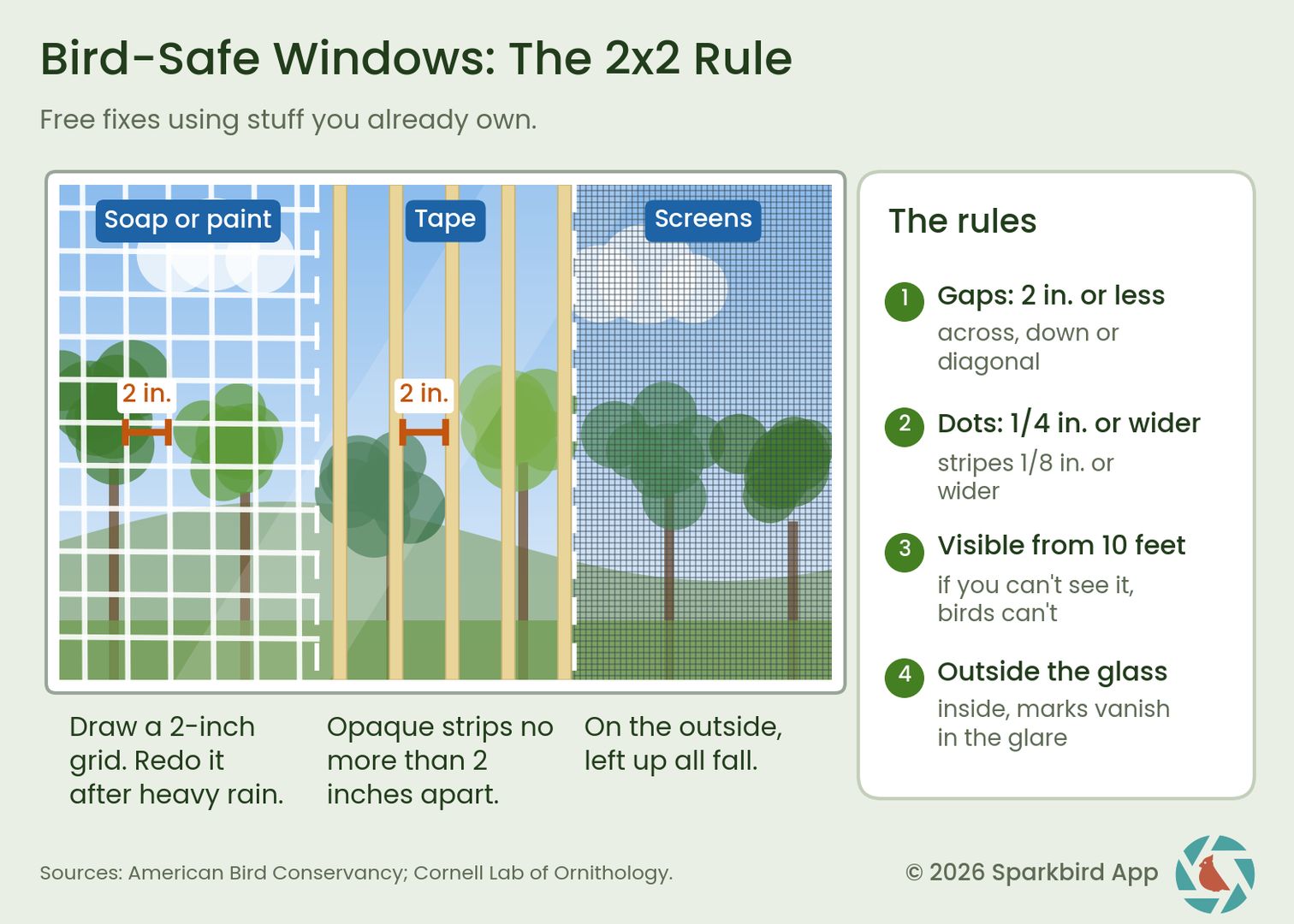
The American Bird Conservancy recommends the two-inch-by-two-inch rule: markings with gaps of no more than 2 inches, whether horizontal, vertical, or diagonal. Dots should be at least a quarter inch across and stripes at least an eighth of an inch wide, and you should be able to see the pattern clearly from 10 feet away.
You might see an older "2x4 rule" floating around— markings 2 inches apart in rows and 4 inches apart in columns) Utah State University Extension's window tips still describes tape that way. It's not wrong so much as outdated. The tighter 2x2 spacing protects the smallest birds, like kinglets and hummingbirds, and those are exactly who's flying through in fall.
The other non-negotiable is that markings go on the outside of the glass. Applied inside, they disappear behind the reflection, which defeats the whole point. Indoor decals are decorative. That's about it.
How to Keep Birds From Hitting Windows: Use What You Have First
Here's where I'm going to talk you out of a shopping trip. Before you buy anything, try the stuff you already own. ABC lists non-toxic tempera paint, acrylic paint, and plain tape as legitimate options, and the Cornell Lab points out that a bar of soap works too. Leftover poster paint is now conservation equipment. Congratulations.
Soap or Tempera Paint
Draw a grid on the outside of the glass with a bar of soap or tempera paint, keeping the lines 2 inches apart. It's cheap, it washes off, and it looks a bit like your window is mid-renovation, which, honestly, it is. Expect to redo it after heavy rain.
Tape
Masking tape, painter's tape, or any opaque tape you have works if you follow the spacing. Run vertical strips no more than 2 inches apart across the outside of the glass, or make a grid. It isn't glamorous, but neither is a thrush-shaped smudge on the glass.
Screens
If your windows already have insect screens, put them on the outside and leave them up through fall. The Cornell Lab calls mosquito screens "very effective, as long as they are on the outside." Inside screens don't count, for the same reason indoor decals don't.
When It's Worth Buying Something
Some windows really do need a commercial fix: huge picture windows, glass doors, or spots where birds keep hitting despite your soap art. Your main options are exterior decal tape (like dot patterns in a 2x2 grid), one-way perforated film that looks opaque from outside, and hanging cord curtains that sway in front of the glass. Anti-collision bird decals are a popular option.
One thing not to buy: a single hawk silhouette. The Cornell Lab is blunt that birds don't respond to falcon and owl silhouettes the way people once believed. One sticker in the middle of a big window just means the bird flies around the sticker.

WindowAlert Hummingbird Anti-Collision Window Decals, UV Reflective Glass | Protect wild birds from glass collisions with UV-reflective hummingbird window decals, semi-transparent static-cling design.
WINDOWALERT
Tips to Prevent Collisions
A few smaller changes help a lot.
- Move houseplants away from windows (they look like landing spots)
- Close blinds partway on windows that see straight through the house
- Put bird feeders 3 feet or closer to windows
You'll still see advice to keep feeders within 3 feet of a window or more than 30 feet away. Audubon says feeders closer than 3 feet keep startled birds from building up dangerous speed, but the Cornell Lab now says older distance rules aren't reliable on their own, so treat the window, not just the feeder. Our guide to everything you need to know about bird feeders covers placement for the rest of the year.
Lights Out for birds is the easiest fix
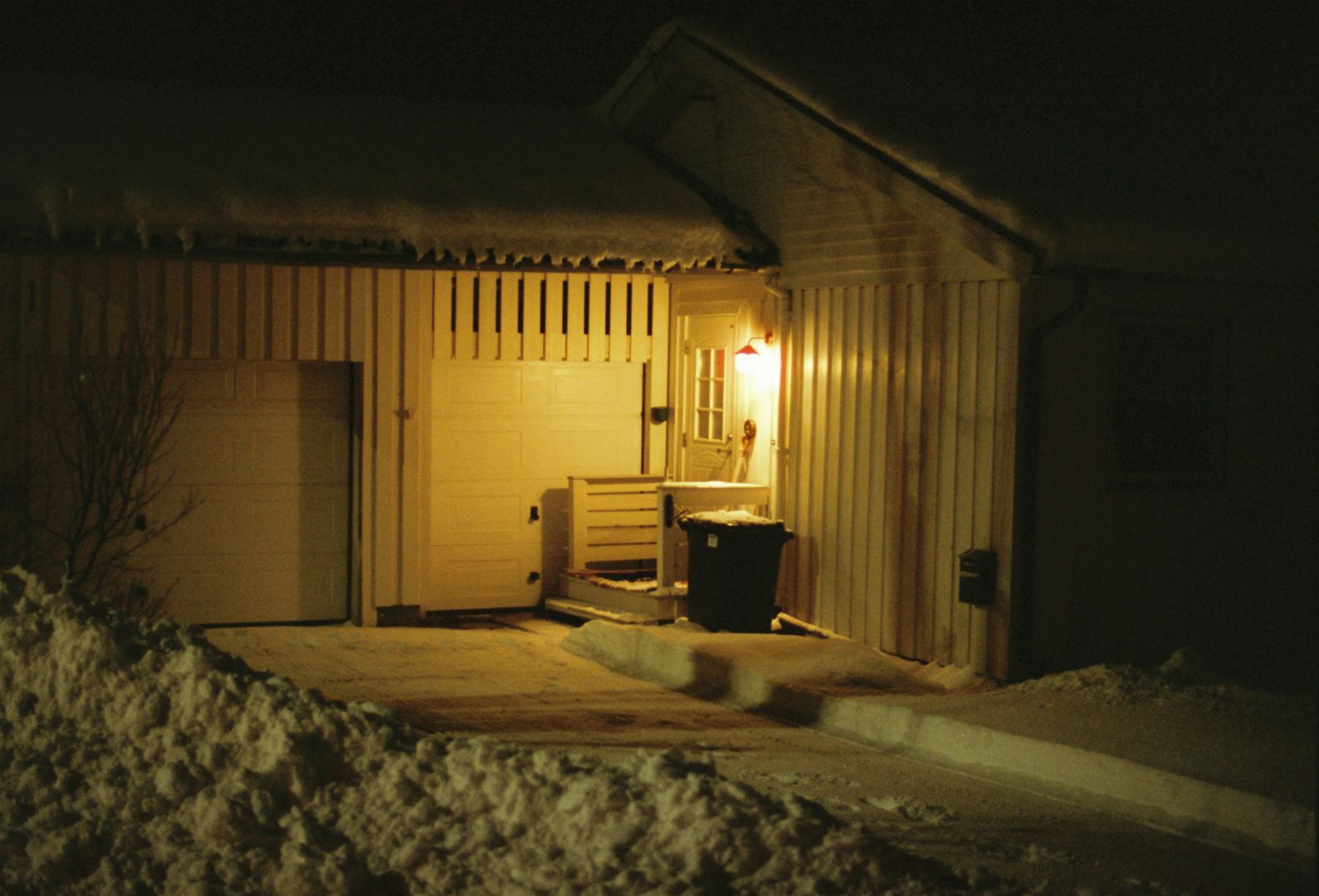
Turn off nonessential outdoor lights, draw your blinds at night, and switch any security lights to motion sensors pointed down. Audubon runs a national Lights Out program that cities and building owners join every spring and fall, and Utah State's extension notes that turning off lights during migration can cut collisions by up to 80 percent in some areas.
Live in an apartment? Close the curtains or shut off the porch light when everyone's home.
What to Do If a Bird Hits Your Window
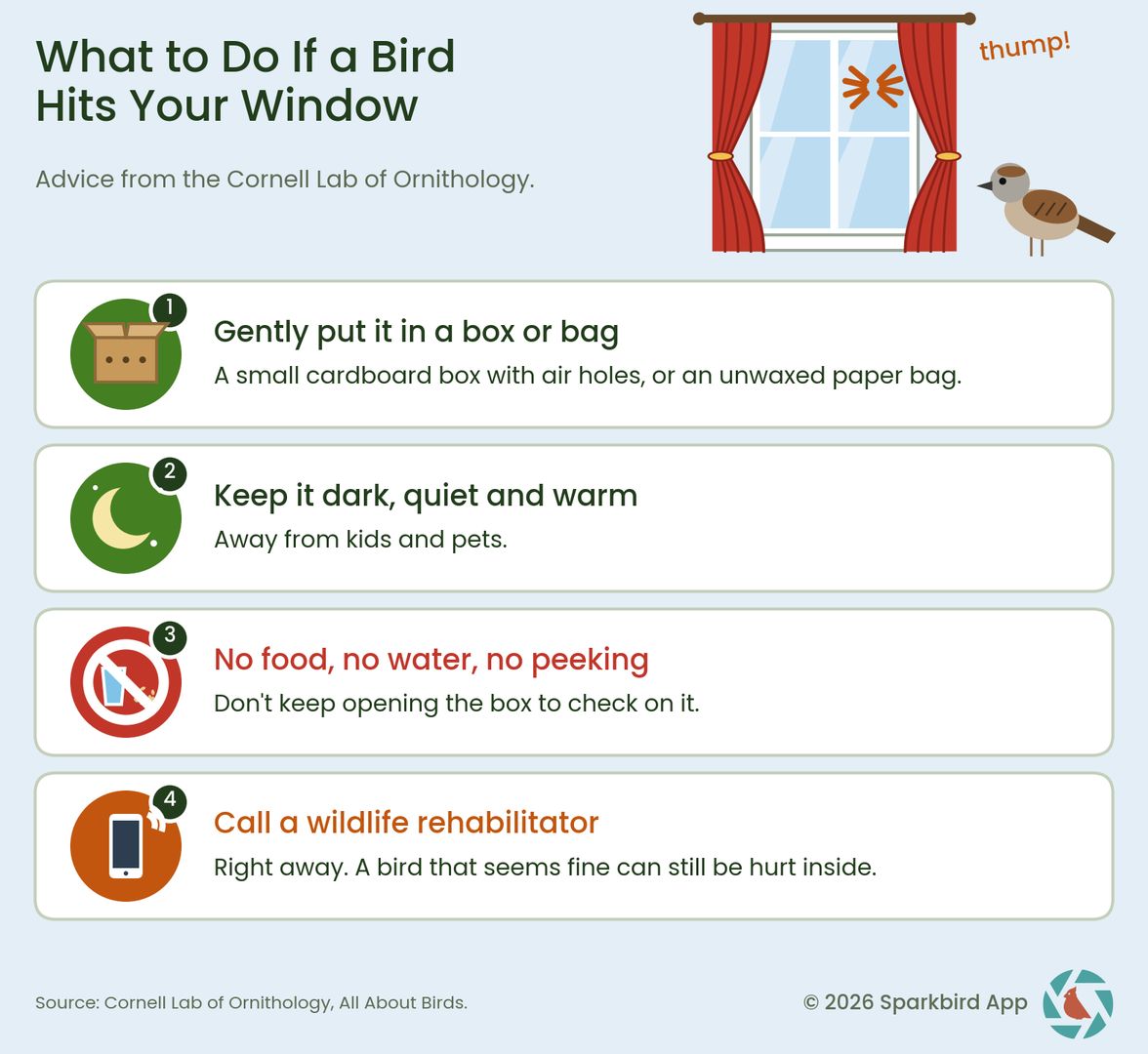
You'll hear the thump before you see anything. Here's what to do, according to the Cornell Lab.
Gently pick up the bird and put it in an unwaxed paper bag or a small cardboard box with air holes. Keep it somewhere dark, quiet, and warm, away from kids and pets. Don't give it food or water, and don't keep checking on it every two minutes (I know, I know). Then call a local wildlife rehabilitator right away. A stunned bird that seems fine can still have internal injuries.
I'll be honest that my family didn't exactly follow the textbook the first time. When I was a kid in New England, my dad patched the busted side panels of his window AC units with duct tape, and a sparrow that had been nesting on the warm sill got itself stuck to the tape. Dad put on gloves and peeled it free.
The poor thing had hurt its wings, so we set it up in our chokecherry tree with water and birdseed served in my kiddy cups. The kiddy cups were a nice touch, but the box, the dark room, and a phone call to a rehabber would've been the better call.
Frequently Asked Questions
Why do birds keep hitting the same window?
If it's spring or early summer and the same bird keeps going after the same pane, it's probably fighting its own reflection, which it thinks is a rival. If it's different birds in fall, that window is just very reflective or see-through. Both problems get fixed the same way: break up the outside of the glass.
Do hawk decals keep birds from hitting windows?
Not on their own. The Cornell Lab says birds don't react to falcon and owl silhouettes the way people expected. Any shape can work if you use enough of them to follow the 2x2 spacing.
Should I put decals on the inside or outside of the window?
Outside. A 2023 William & Mary study on window films found they only reduced collisions when applied to the external surface. Inside, the reflection hides the pattern from birds.
What have you seen this migration season?
Tell us in the comments or through the Sparkbird App, available in the Apple App Store.
- Related: How to Use the Sparkbird App

No comments yet.